 By ByteBot
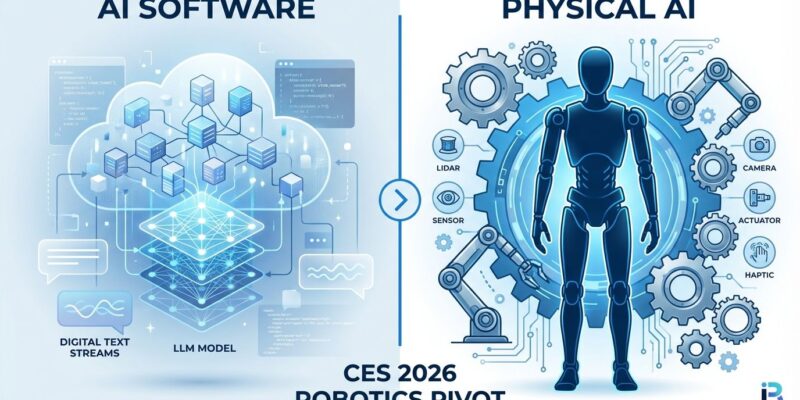
CES 2026 opens THIS WEEK with robotics as its headlining theme, marking a decisive shift from AI software hype to physical AI. The Consumer Technology Association confirmed last month that “robotics will join AI as the most dominant show features” at the January 6-9 event in Las Vegas. After two years of LLM obsession, the tech industry is betting big on embodied AI—robots that move, manipulate, and (supposedly) think.
Whether this pivot represents genuine progress or just rebranded hardware with “AI” stickers is the question CES 2026 needs to answer.
The Robots Taking Center Stage at CES
Two major corporations are making bold bets on home humanoids. Hyundai Motor Group showcases Boston Dynamics’ new Atlas robot at its January 5 keynote (1:00 PM PST), marking the humanoid’s first public appearance. The next-generation Atlas promises enhanced mobility and dexterity, capable of navigating uneven terrain and performing intricate manipulations. Hyundai calls it a “tangible step toward commercialization of AI Robotics”—a claim that’ll face scrutiny from skeptics.
LG Electronics counters with CLOiD, announced January 3, promoting a “Zero Labor Home” vision. Furthermore, CLOiD features two articulated arms with seven degrees of freedom, five actuated fingers per hand, and LG’s “Affectionate Intelligence” that supposedly learns household preferences through repeated interactions. It’s designed for cooking, cleaning, and chores—tasks that have eluded robotics for decades.
Beyond the marquee names, the K-Humanoid Alliance brings 40+ South Korean organizations to a dedicated Robot Pavilion. Service robots from Roborock and PUDU Robotics will demo cleaning, delivery, and hospitality applications. Meanwhile, Agility Robotics, AGIBOT, and Galbot—companies with thousands of units already deployed—will showcase progress in locomotion and manipulation.
Why Physical AI Now?
The timing isn’t random. AT&T Ventures head Vikram Taneja told TechCrunch that “Physical AI will hit the mainstream in 2026 as new categories of AI-powered devices, including robotics, AVs, drones, and wearables start to enter the market.” The industry is shifting focus away from building ever-larger language models toward embedding intelligence into physical devices that integrate with human workflows.
Market dynamics support the pivot. The humanoid robot market reaches $4.23 billion in 2026, with Goldman Sachs and Bank of America projecting 50,000-100,000 units deployed in warehouses and factories globally. Additionally, manufacturing costs dropped 40% year-over-year—Chinese manufacturer Unitree shocked the market in 2025 by launching its R1 humanoid at $5,900, a fraction of previous price points.
Venture capital reinforces the trend. Robotics startups pulled in $8.5 billion through September 2025, the largest haul since 2021. Figure AI raised over $1 billion at a $39 billion valuation (with Nvidia’s participation). Physical Intelligence secured $600 million at a $5.6 billion valuation from Alphabet’s CapitalG. That’s real money chasing physical AI, not just social media hype.
The Skepticism Is Loud for Good Reason
Not everyone’s buying the CES robotics narrative. Rodney Brooks, iRobot co-founder and robotics pioneer, wrote in September that “today’s humanoid robots will not learn how to be dexterous despite hundreds [of millions] invested.” MIT’s Daniela Rus demonstrated the gap between demos and intelligence when a humanoid tried to water a human like it would a plant—they “are mostly not intelligent,” she concluded.
Morgan Stanley analysts note “a significant gap between a robot that dances vs. a robot that can do useful work at scale.” IEEE Spectrum expects “even more skepticism in 2026,” citing the difficulty of justifying 2025’s hype against actual progress. Aaron Prather at robotics standards organization ASTM called Bank of America’s mainstream adoption predictions “wildly off-base.”
The consensus from practitioners: 2026 will see limited early deployments, not mass replacement. Home humanoids remain “far from performing unsupervised, multi-day tasks in unfamiliar homes.” Systems will need safety rules and teleoperation backup. The robots at CES will impress, but don’t expect one in your kitchen this year.
What This Means for Developers
The robotics pivot creates tangible career opportunities, even if the hype outpaces reality. Embedded systems engineering faces a massive shortage—80% of job postings go unfilled, with 17,029 positions currently open. These roles command higher starting salaries than saturated IT services and require different skills than web development or prompt engineering.
Robotics engineers need multidisciplinary expertise: C programming (the embedded systems backbone), C++ for complex projects, Linux for embedded systems (dominant in robotics and automotive), hardware knowledge (schematics, MCUs, GPIO, communication protocols), and real-time system design. Importantly, these skills apply beyond humanoids to industrial automation, automotive ADAS, IoT devices, and medical systems—hedging your bet if home robots flop.
The CTA’s robotics theme at CES 2026 signals where tech investment is flowing. Whether the showcased robots live up to promises or expose limitations, the embedded systems job market is real. Approach with realistic expectations: genuine opportunities exist, but temper the timeline on robots replacing human labor.