 By ByteBot
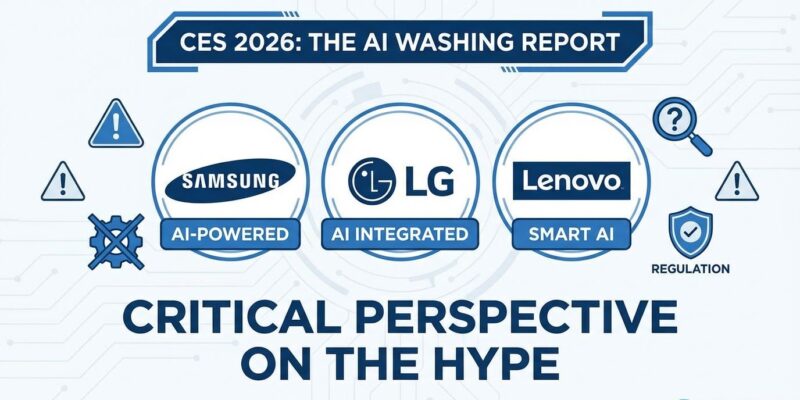
CES 2026 (January 4-9) has become a showcase for industry-wide “AI-first” positioning. Samsung announced “AI-driven customer experiences” across its entire Device eXperience Division on January 4. LG unveiled “Affectionate Intelligence” combining AI-powered solutions with advanced core technologies on January 5. Lenovo showcased its “AI-driven innovation strategy” at the Sphere on January 6. Every major tech company is announcing AI strategies across phones, TVs, laptops, and appliances. The question developers need to ask: Is this genuine innovation enabled by on-device Neural Processing Units, or is this the largest AI washing event in consumer electronics history?
The AI Washing Problem Hits Critical Mass
AI washing is “the deliberate or negligent exaggeration of a system’s artificial intelligence capabilities, typically by presenting rules-based or pre-programmed functionalities as autonomous, adaptive, or ethetically governed systems.” At CES 2026, virtually every product claims “AI-powered” features. However, many vendors are rebranding existing capabilities—image processing becomes “AI photography,” autocorrect becomes “AI keyboard,” thermostatic control becomes “AI cooling.”
Industry expert analysis from Amplitude’s product director cuts through the hype: “AI-washing worked in early 2023 when companies could simply wrap the GPT API, but this kind of ‘ingredient marketing’ has quickly lost its appeal as users have now actually used those features—and found most of them to be gimmicks.” The pattern at CES 2026 is unmistakable: Samsung, LG, and Lenovo all use identical “AI-first” language without technical differentiation. Consequently, developers evaluating vendor platforms can’t distinguish genuine AI innovation from marketing buzzwords.
Moreover, regulatory scrutiny is intensifying. The EU AI Regulation becomes effective in August 2026, imposing transparency requirements and fines up to 7% of annual turnover for misleading AI claims. Additionally, the FTC has warned that “AI has become a ‘hot marketing’ term that some companies won’t be able to stop themselves from overusing and abusing.” AI washing erodes consumer trust and creates investment risk—paying for overvalued services that deliver no meaningful improvement over non-AI alternatives.
What Real On-Device AI Actually Delivers
Genuine on-device AI is powered by Neural Processing Units (NPUs) enabling local inference. Snapdragon 8 Gen 5, launched in November 2025, delivers 46% faster AI performance than the previous generation and can run 3 billion parameter models on-device. Furthermore, the AI-related NPU edge device market will reach $50 billion by 2026. Real AI provides measurable benefits: privacy (data stays on device), offline functionality (works without connectivity), and lower latency (no network round-trip).
Technical specifications matter. Snapdragon 8 Gen 5 runs LLaMA 3.2 3B parameter model locally for text summarization, message rewriting, and image generation. Therefore, photos, voice recordings, and personal messages are processed entirely on-device and never uploaded to servers. The offline test proves it: true on-device AI works in airplane mode. Applications include noise reduction during calls, real-time image enhancement, speech-to-text, biometric authentication, and predictive analytics.
This is what separates real AI from AI washing. Real AI has technical specs—NPU TOPS rating, model sizes, latency measurements. Real AI delivers measurable improvements: 46% faster performance, 20% lower power consumption. Real AI enables new capabilities like offline generative AI that weren’t possible before NPU integration. AI washing has vague marketing language without technical details.
Related: CES 2026 Robotics Focus: Physical AI Hits Mainstream
How to Spot AI Washing vs Real Innovation
Customers don’t need “artificial intelligence”—they need faster reports, better support, smarter features. AI is the architecture to deliver these outcomes, not the value proposition itself. The fundamental flaw at CES 2026: companies are leading with “we use AI” instead of “we solve X problem using AI architecture.” The distinction matters when evaluating vendor platforms and technology investments.
Ask these questions when evaluating “AI-first” claims. First, what model? If vendors can’t name the model or architecture, it’s likely AI washing. Second, where does it run? On-device NPU, cloud API, or hybrid? If unclear, it’s probably cloud-based or non-existent. Third, what’s new? Is this genuinely new capability or existing feature relabeled? Fourth, can it work offline? The airplane mode test proves on-device processing.
Red flags for AI washing include vague claims like “AI-powered photography” without specifying what AI does, no technical specs (missing NPU details, model architecture, performance metrics), and existing features relabeled—autocorrect rebranded as “AI keyboard,” HDR processing as “AI enhancement.” In contrast, green flags for real AI include technical transparency (“Snapdragon 8 Gen 5 NPU running LLaMA 3.2 3B”), measurable improvements (“46% faster inference, 20% lower latency vs cloud”), and new capabilities that weren’t possible before NPU integration.
The Regulatory Reckoning Arrives in 2026
AI washing faces regulatory crackdown and consumer backlash in 2026. The EU AI Regulation becomes effective in August 2026 with extensive transparency requirements and fines up to 7% of annual turnover for violations. The FTC has warned companies about “overusing and abusing” AI marketing terms, signaling enforcement actions ahead.
The pattern from history repeats: “cloud-first” and “mobile-first” became meaningless buzzwords through overuse. “AI-first” is following the same trajectory. When everyone at CES 2026 claims it, no one is differentiated. The cycle of AI mistrust forms: AI washing leads to AI booing, creating a boom-and-bust pattern where initial enthusiasm deteriorates into skepticism. Therefore, developers building AI features should avoid ingredient marketing—wrapping GPT API and calling it “AI-powered.” Build differentiated experiences using AI as a tool, not a buzzword.
What Developers Should Build Instead
Opportunity exists for developers who build genuinely useful AI features while competitors AI-wash. Focus on substance over marketing: “6-hour reports now take 10 minutes” (the value) rather than “we added AI to our product” (the architecture). Provide technical transparency: specify model architecture, document where processing occurs, provide performance benchmarks, and explain privacy implementation.
Successful AI companies maintain customer-centric focus—they use AI to solve real-world problems and enhance user experiences. Differentiation comes from application, integration, and user experience, not from using the same foundation models (GPT, Claude, LLaMA) everyone else has access to. As CES 2026 demonstrates, “AI-first” is becoming table stakes, not differentiation. The winning strategy: build features that happen to use AI architecture to deliver measurable value, rather than AI features looking for problems to solve.
Key Takeaways
- CES 2026’s industry-wide “AI-first” positioning raises concerns about AI washing—exaggerating AI capabilities and rebranding existing features rather than delivering genuine innovation
- Real on-device AI powered by NPUs (Snapdragon 8 Gen 5: 46% faster, 3B parameter models) provides measurable benefits: privacy, offline functionality, and lower latency vs cloud processing
- Spot AI washing by asking: What model? Where does it run? What’s new? Can it work offline? Real AI has technical specs and measurable improvements, not vague marketing claims
- EU AI Regulation (effective August 2026) will impose fines up to 7% of turnover for misleading AI claims, while consumer backlash follows the “cloud-first” and “mobile-first” commoditization pattern
- Developers should build features that solve problems using AI architecture (with technical transparency), not AI features searching for problems—differentiation comes from outcomes, not buzzwords