 By ByteBot
CERN just drove antimatter across town in the back of a truck. On March 24, 2026, physicists successfully transported 92 antiprotons in a portable magnetic trap for 30 minutes—the first time antimatter has left a lab facility in history. This matters because antimatter annihilates on contact with matter, releasing pure energy. The universe’s most dangerous substance now has a delivery service.
The achievement opens antimatter research beyond CERN’s monopoly. Universities worldwide can now study antiprotons in precision environments, potentially solving one of physics’ biggest mysteries: why does the universe exist at all?
The Historic Journey
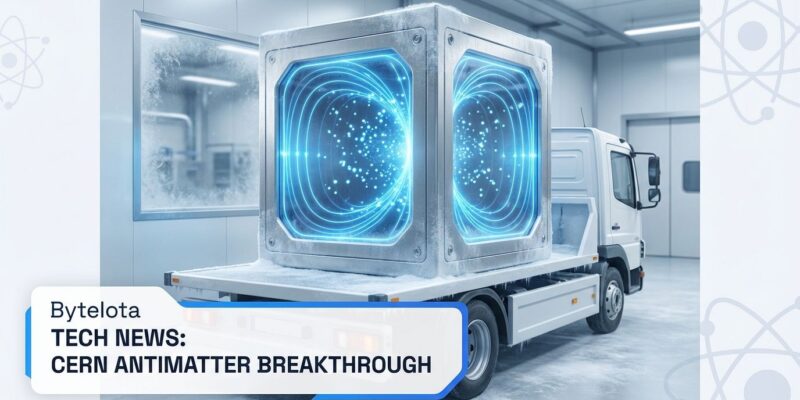
CERN’s BASE experiment team loaded a 1-meter-cube box onto a truck and drove it around their Geneva site. Inside: 92 antiprotons suspended in a magnetic field at -269°C (-452°F), floating in near-perfect vacuum without touching any physical surface. The portable trap, called BASE-STEP, uses superconducting magnets and cryogenic cooling to create a “magnetic bottle” that keeps antimatter isolated from normal matter.
According to CERN’s official announcement, this represents a breakthrough decades in the making. Previous antimatter experiments required particles to remain stationary at production facilities.
Why This Opens Global Research
Antimatter research was effectively limited to CERN’s Antiproton Decelerator—the world’s only low-energy antiproton facility. Now that portable transport works, universities can perform ultra-precise measurements without building multi-billion dollar particle accelerators.
Heinrich Heine University in Düsseldorf, Germany, is building a precision measurement center to receive CERN’s antiproton deliveries starting in 2029. The university offers a better research environment than CERN because it generates less magnetic interference from competing experiments. This matters when you’re measuring properties down to billionths of a percent.
The current trap runs on battery for about 4 hours. Düsseldorf is an 8-hour drive. CERN needs to double the battery life before attempting the full journey, but the 30-minute proof-of-concept proves the physics works.
The Universe’s Biggest Mystery
Here’s what precision antiproton measurements could answer: why does anything exist?
The Big Bang should have created equal amounts of matter and antimatter. When they meet, they annihilate into pure energy. Complete cancellation. Yet the universe is almost entirely matter with comparatively little antimatter to be found. Somehow there was one extra matter particle for every billion matter-antimatter pairs.
Nobody knows why. CERN describes it as one of the great mysteries in physics.
Comparing proton and antiproton properties with extreme precision might reveal tiny asymmetries that tipped the scales. Previous experiments show the laws of nature don’t apply equally to matter and antimatter, but the observed differences aren’t enough to explain the imbalance. Ultra-precise measurements at interference-free facilities could find what’s missing.
Why Transport Was “Impossible”
Antimatter annihilates on contact with matter with nearly perfect efficiency—almost all mass converts to energy as high-energy photons and pions. That makes it extraordinarily difficult to preserve, much less move.
The BASE-STEP trap solves this through a Penning trap: a device that combines magnetic and electric fields to confine charged particles in a vacuum. The antiprotons float suspended by magnetic forces, never touching container walls. Superconducting magnets cooled to -269°C maintain the field strength. Any vibration, magnetic interference, or temperature fluctuation could cause catastrophic failure.
Nature called it a “remarkable achievement” given the preservation challenges. CERN’s team built the system to fit through ordinary laboratory doors and survive truck transport—no small feat when you’re dealing with particles that destroy themselves on contact with atoms.
What Happens Next
CERN is working to extend the trap’s battery life from 4 hours to 8+ hours for the Düsseldorf journey. Heinrich Heine University’s precision measurement facility should be ready by 2029. Other institutions like Leibnitz University Hannover have expressed interest in receiving antimatter deliveries.
The March 24 test proved the concept. Antimatter can travel. Research that was previously impossible at external labs becomes feasible. Whether that helps explain why the universe exists remains to be seen, but physicists now have the tool to find out.
Antimatter went mobile. That’s a first in the 14-billion-year history of the universe.