 By ByteBot
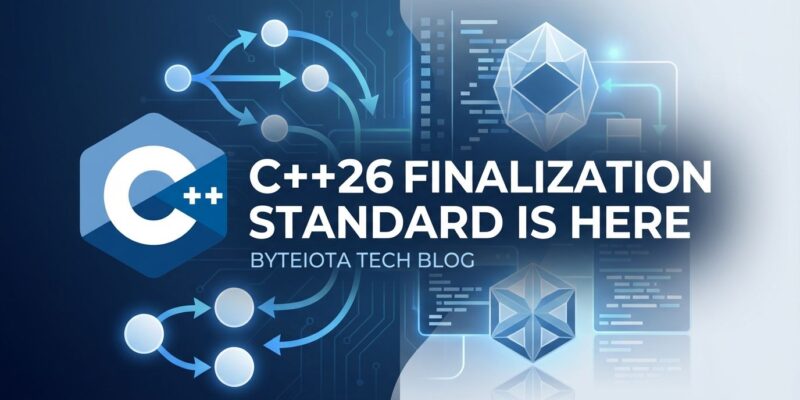
The ISO C++ committee finalized C++26 on March 29, 2026, in London after a six-day meeting with 210 experts from 24 nations. The standard introduces three transformative features: static reflection (compile-time introspection Herb Sutter called “C++’s decade-defining rocket engine”), contracts (language-supported preconditions and postconditions for safer code), and sender/receiver (composable async execution model). This is the most significant C++ update since C++20, positioning the language to compete with Rust on safety while maintaining performance and backward compatibility.
Static Reflection: The Decade-Defining Upgrade
Static reflection is the headline feature, and Sutter didn’t exaggerate when he called it “the biggest upgrade since templates.” C++ can now describe itself and generate code at compile time, eliminating entire categories of boilerplate that have plagued developers for decades.
Reflection introduces two new operators: the reflection operator (^) that produces a reflection value for any construct, and the splicer ([: refl :]) that creates grammatical elements from reflection values. Combine these with metafunctions like members_of and enumerators_of, and you unlock compile-time introspection that was previously impossible without macros.
The practical applications are immediate. Enum-to-string conversion becomes trivial: iterate over enum members at compile time and return their names. Serialization disappears as a problem: automatically convert struct members to JSON by reflecting on data members. Object-to-database mapping transforms from tedious SQL string concatenation to a function call that generates INSERT statements from your User struct.
This isn’t just convenience—it’s a paradigm shift. Code that once required macros or external tools now compiles away to zero-overhead runtime code. Reflection makes C++ introspectable in ways that match modern languages like Rust and Swift.
Contracts and Memory Safety Without the Rewrite
C++26 delivers a two-part answer to the FBI and CISA’s push to phase out unsafe languages by 2026: contracts for function-level safety guarantees and a hardened standard library that eliminates common undefined behavior.
Contracts introduce language-supported preconditions ([pre:]), postconditions ([post:]), and assertions (contract_assert). This is far more powerful than C’s assert macro. Developers can choose from four enforcement modes—ignore, observe, enforce, or quick-enforce—and switch between them at compile time or runtime. Development builds can enforce contracts strictly, catching bugs at function boundaries. Production builds can relax enforcement for performance or log violations without terminating.
Memory safety improvements complement contracts. C++26 eliminates undefined behavior from reading uninitialized local variables and introduces bounds checking for vector, span, string, and string_view. Apple and Google have already deployed these features across hundreds of millions of lines of code with minimal performance overhead.
But let’s be honest: C++26 doesn’t match Rust’s safety guarantees. Rust’s borrow checker eliminates 95% of memory bugs at compile time through ownership rules. C++26 provides runtime bounds checking and function-level contracts, which catch bugs but don’t prevent them the way Rust does. The trade-off is pragmatic. C++ maintains backward compatibility and doesn’t force wholesale rewrites. For organizations with millions of lines of legacy C++, that matters more than theoretical safety perfection.
Sender/Receiver: Modern Async Execution
The sender/receiver model, adopted in June 2024 and finalized for C++26, provides a unified framework for expressing concurrency and parallelism. If you’ve struggled with C++17 parallel algorithms’ limitations—CPU-only, no chaining—sender/receiver fixes everything.
Senders represent units of asynchronous work. Receivers are callbacks with three channels: value (success), error (failure), and stopped (cancellation). Schedulers are handles to execution contexts like thread pools or GPU streams. The killer feature is composability: chain GPU kernel execution to CPU post-processing to thread pool work without manual synchronization. Write your algorithm logic once and execute it on a single thread, thread pool, or GPU by swapping schedulers. The framework enforces data-race-free properties.
This is C++ catching up to modern async patterns found in Rust’s async/await and JavaScript’s promises, but with zero-cost abstractions and compile-time composition.
Compiler Support and Timeline
C++26 includes other features: pack indexing simplifies template metaprogramming, the #embed directive embeds binary resources, and the <simd> header standardizes SIMD operations across architectures.
Compiler support is ahead of schedule. GCC and Clang already implement roughly two-thirds of C++26 features. GCC 16 has reflection and contracts merged in trunk. Enable C++26 support with the -std=c++2c flag. The standard is now entering its Draft International Standard phase for ISO approval, with publication expected later in 2026.
C++26 positions C++ to compete with Rust on safety and modern languages on expressiveness without abandoning backward compatibility. Reflection alone justifies the upgrade. Contracts and memory safety address real-world production concerns. Sender/receiver modernizes async execution. This isn’t a minor point release—it’s C++ asserting relevance for the next decade.