 By
By On January 2, 2026, a developer published a manifesto that crystallized years of frustration with cloud-native complexity. “My 2026 Tech Stack is Boring as Hell (And That is the Point)” went viral on DEV.to, arguing developers should abandon Kubernetes, microservices, and serverless for simpler technologies—single VPS servers running SQLite or PostgreSQL. The post sparked fierce debate: supporters celebrated the return to sanity, while critics fired back that the author “still uses React, so you’re not boring enough.” But the controversy reveals a deeper truth the tech industry doesn’t want to admit: we’ve confused complexity with competence.
The Innovation Tokens Framework
Dan McKinley’s 2015 essay “Choose Boring Technology” introduced the innovation tokens framework: companies get roughly three tokens to spend on unconventional tech choices. Each non-boring decision—NodeJS when it’s new, MongoDB instead of PostgreSQL, Kubernetes for a small team—consumes one token. Once spent, tokens are scarce until the company stabilizes. McKinley’s principle was direct: “Technology for its own sake is snake oil. Embrace boredom.”
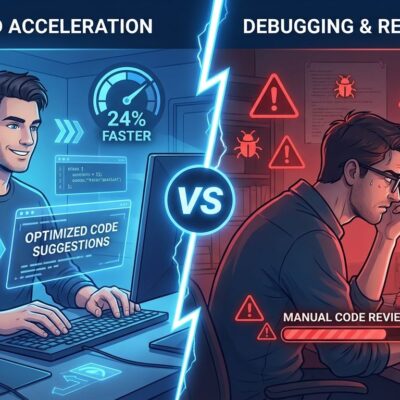
In the LLM era, this framework has gained new relevance. Charity Majors from Honeycomb updated the thesis in her 2023 analysis: “Choosing technology well-represented in training data is a massive productivity hack in 2026.” Boring tech like PostgreSQL, Python, and React dominate AI training sets, meaning developers get better code suggestions, more accurate documentation searches, and superior debugging assistance. Exotic technologies lack this advantage.
The framework explains why boring works—it’s not about avoiding innovation, it’s about spending innovation budget strategically. Every exotic choice adds operational burden, cognitive overhead, and unknown failure modes. Boring tech frees teams to innovate where it matters: in product features and business logic.
The Economics Are Brutal
Cloud waste has reached crisis levels. Organizations waste 32% of cloud budgets—$200 billion annually—on unused resources and overprovisioned instances, according to Flexera’s 2025 survey. A microservices setup with 10 services costs 2.5 to 3.75 times more than a monolith: $500 to $750 per month versus $200 per month for equivalent compute.
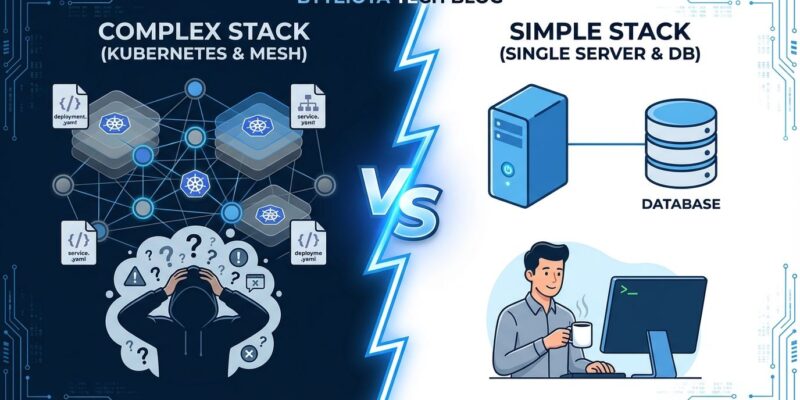
The cost breakdown is sobering:
Kubernetes Setup:
├── EKS cluster control plane: $72/month
├── 3 worker nodes (t3.medium): $100/month
├── Load balancer: $20/month
├── Logging/monitoring (Datadog): $100-500/month
└── TOTAL: $300-700/month + 10-20 hours/month ops

Boring Stack (Single VPS):
├── DigitalOcean droplet (4GB, 2 vCPU): $24/month
├── Automated backups: $5/month
├── Monitoring (UptimeRobot): $0 (free tier)
└── TOTAL: $30/month + 1-2 hours/month ops

SAVINGS: $270-670/month, 8-18 engineering hours/month
Even worse, AWS began billing for Lambda INIT phases in August 2025, increasing serverless costs 10 to 50 percent for functions with heavy startup logic. As one expert noted: “Organizations spend $500 per month on provisioned concurrency to solve what is effectively a $50 problem.” CFOs are demanding justification for infrastructure spending, and “we might need to scale someday” no longer cuts it.
Related: AWS Stealth GPU Price Hike: 15% Increase on a Saturday
The Great Microservices Rollback
Forty-two percent of organizations that initially adopted microservices have consolidated at least some services back into larger deployable units, according to a 2025 CNCF survey. The primary drivers: debugging complexity, operational overhead, and network latency issues. This isn’t theoretical—it’s a multi-million dollar lesson in over-engineering.
The performance penalty is measurable. Each internal service-to-service HTTP call adds 10 to 50 milliseconds of latency. A user request that triggers calls to five services sequentially adds 150 to 250 milliseconds of overhead from the network alone—versus less than one millisecond for in-process calls in a monolith. These microseconds compound into real user frustration.
Java Code Geeks noted in December 2025 a “fascinating shift: the emergence of sophisticated modular monoliths that challenge many assumptions about microservices superiority.” These aren’t your father’s monoliths—they’re architecturally disciplined applications that maintain separation of concerns without the operational overhead of distributed systems. Most organizations don’t have Netflix’s scale—tens of thousands of engineers, billions of requests. They over-engineered for problems they’ll never face.
Resume-Driven Development Is the Real Problem
Developers aren’t choosing Kubernetes for business reasons—they’re choosing it for their resumes. The viral DEV.to post challenges this directly: “Your users do not care about your tech stack. They care if the button works when they click it.” This cuts to the heart of a cultural dysfunction in tech.
The pattern is pervasive. Teams copy Netflix’s microservices architecture for todo apps. Companies build internal cloud providers—managing Kubernetes operational overhead, service meshes, distributed tracing—for applications that could run on a $50 per month VPS. As the post argues: “When you choose boring technology, you spend less time configuring and more time shipping. You’ll be shipping products while others are still configuring their YAML files.”
This reveals an incentive problem. Engineers get promoted for “architecting distributed systems,” not for shipping features efficiently. Performance reviews reward technical novelty over business outcomes. Until we fix the incentive structure, we’ll keep over-engineering. The industry has made complexity a status symbol, and simplicity a confession of mediocrity.
Related: AI Productivity Paradox: 19% Slower Despite Believing Faster
When Boring Actually Breaks
Boring tech isn’t universally applicable. There are real thresholds where complexity becomes justified. SQLite hits limits around 100 concurrent writes per second. Single VPS struggles with tens of thousands of concurrent users. Global distribution requires multi-region infrastructure. Context matters.
The decision criteria are concrete. Migrate from SQLite to PostgreSQL when writes become more than 5 percent of operations and latency spikes. Move from monolith to microservices when you have more than 50 engineers and need independent team ownership. Shift from single VPS to distributed systems when you hit more than 100,000 concurrent users with complex operations. Choose complexity over boring when regulatory compliance—HIPAA, SOC 2—requires multi-region redundancy.
Real examples prove boring scales. Shopify, GitHub, and Basecamp run massive scale on monolithic architectures. SQLite powers Cloudflare Workers and Expensify. For detailed performance comparisons, see DataCamp’s SQLite vs PostgreSQL analysis. The question isn’t “can boring scale?” It’s “what’s your actual scale requirement?” Most teams are building for scale they’ll never reach.
Boring Doesn’t Go Far Enough
The boring tech movement is right, but it doesn’t go far enough. The industry’s complexity addiction isn’t just about Kubernetes—it’s pervasive across the entire stack. Even the viral post gets called out: “You’re still using React when server-side rendering would be simpler.” The critics accidentally prove the point.
The complexity problem extends everywhere. React when you need simple server-side rendering. NoSQL when relational databases work fine. GraphQL when REST is sufficient. Docker when systemd handles processes perfectly well. Custom solutions when boring tools already exist. We’ve normalized complexity to the point where React—a library with massive ecosystem overhead—is considered “boring.”
This is about mindset shift. The most radical choice in 2026 isn’t picking the latest framework. It’s admitting your todo app doesn’t need Kubernetes, your content site doesn’t need GraphQL, and your startup doesn’t need microservices. Boring is a rebellion against cargo cult engineering.
Key Takeaways
- Innovation tokens are real: Companies get roughly three tokens to spend on unconventional tech. Each exotic choice (Kubernetes for small teams, MongoDB over PostgreSQL) consumes one token and adds operational burden.
- Economics favor boring: Cloud waste hits $200 billion annually (32% of budgets). Microservices cost 2.5 to 3.75 times more than monoliths. Single VPS deployments can save $270 to $670 monthly plus 8 to 18 engineering hours.
- The rollback is real: Forty-two percent of organizations are consolidating microservices back to monoliths. Network latency (10 to 50 milliseconds per service call) compounds into user-facing slowdowns. Modular monoliths provide discipline without distributed system overhead.
- Resume-driven development hurts business: Engineers optimize for career advancement, not product outcomes. The industry rewards architectural complexity over feature velocity. Most teams copy Netflix’s architecture without Netflix’s scale.
- Know when boring breaks: SQLite maxes out at 100 writes per second. Single VPS struggles past tens of thousands of concurrent users. Global distribution and compliance requirements justify complexity. Most teams will never hit these thresholds.
The boring tech rebellion challenges a decade of cloud-native orthodoxy. Complexity isn’t competence. Simplicity isn’t laziness. In 2026, the most technically sophisticated choice might be admitting you don’t need the sophisticated tech.