 By ByteBot
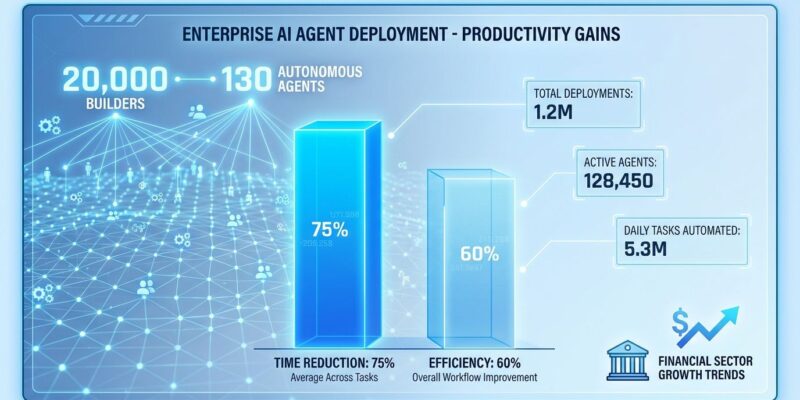
BNY Mellon announced on January 16, 2026, that it deployed 20,000 “Empowered Builders”—employees trained to create AI agents—supported by 130+ autonomous “Digital Employees” across its 52,000-person workforce. This isn’t an AI pilot. Legal contract review time dropped 75% (from 4 hours to 1 hour). Financial planning time fell 60%. These agents don’t just chat—they cross-reference databases, validate regulations, communicate via Microsoft Teams, and will soon autonomously fix trade settlement failures before they occur.
20,000 Builders, 130 Agents, 75% Time Savings—The Scale Is Real
The numbers matter because they’re measurable. BNY’s Contract Review Assistant processes 3,000+ vendor agreements annually. The workflow: upload contract → extract terms → cross-reference 3,000+ prior agreements → validate against global regulations → benchmark pricing → flag risks → notify legal team via Teams. Result: 4 hours of manual work compressed into 1 hour, maintaining attorney judgment while quadrupling throughput.
However, that’s not a productivity boost—it’s a productivity transformation. Financial planning saw similar gains: 60% time reduction for client plan preparation. The platform (Eliza) now runs 125+ live use cases in production. This is what AI delivering ROI looks like: concrete metrics, not vague promises.
These Aren’t Chatbots—They’re Autonomous Workflow Executors
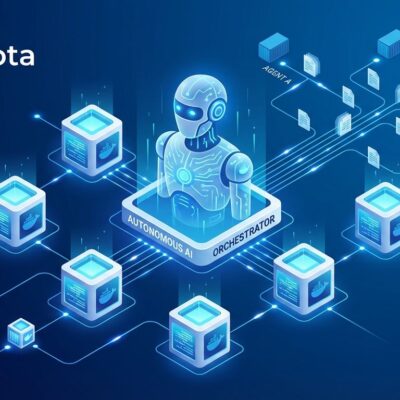
The difference between chatbots and agents? Chatbots wait for prompts. Agents execute. BNY’s agents monitor triggers, cross-reference databases, validate regulations, make decisions, and take actions—all without human prompting. The platform (Eliza 2.0) centers on “reasoning” and “agency,” not text generation.
Coming soon: Predictive Trade Analytics. These agents won’t just identify trade settlement risks in U.S. Treasury markets—they’ll autonomously initiate remediation protocols to prevent failures before they occur. Furthermore, trained on 10 months of proprietary settlement data, they forecast outcomes 24 hours in advance. That’s the shift from reactive (respond to events) to proactive (predict and prevent failures). No other bank has deployed predictive agents at this scale.
72% of Global 2000 Beyond Pilots—Enterprise AI Goes Mainstream
BNY’s deployment validates broader trends. As of Q1 2026, 72% of Global 2000 companies operate AI agent systems beyond experimental pilots. Moreover, Gartner predicts 40% of enterprise applications will feature task-specific agents by end of 2026—up from less than 5% in 2025. Multi-agent system inquiries surged 1,445% from Q1 2024 to Q2 2025. The global agentic AI market projects growth from $9.14B in 2026 to $139B by 2034.
Financial services—historically risk-averse due to compliance requirements—leading this adoption validates mainstream readiness. Consequently, if banks can deploy agents at scale with rigorous governance (Model-Risk Review, auditor-friendly explainability), other industries will follow. This isn’t hype. It’s pilot-to-production transition happening now.
But 75% Time Savings Means What for Workers?
Here’s the uncomfortable reality: 20,000 agents for 52,000 employees is a 2:5 ratio. Do the math. BNY’s 75% time savings in legal and 60% reduction in financial planning inevitably affect workforce dynamics. The company emphasizes “agents augment human judgment,” and that’s true for experienced attorneys handling complex negotiations. Nevertheless, junior roles—the paralegals who cross-reference contracts, the analysts who prepare financial plans—face real pressure.
The Contract Review Assistant processes 3,000+ annual agreements, work that previously required multiple full-time paralegals. “Freed up” often means “no longer needed” for new hires. This isn’t anti-AI. It’s realistic assessment. Developers building these agents need to acknowledge the impact. In fact, productivity gains at this scale don’t just change how work gets done—they change how many people do it.
Key Takeaways
BNY Mellon’s deployment proves several things:
- AI agents deliver measurable ROI: 75% time reduction in legal review, 60% in financial planning—not vague productivity claims
- The shift from chatbots to autonomous workflows is real: 72% of Global 2000 companies already moved beyond pilots
- Developers: demand for multi-agent orchestration skills is growing as enterprises build these systems in-house
- Workers: “augmentation” is true for senior roles requiring judgment, but junior positions handling data-heavy grunt work face genuine displacement risk
- This is the enterprise AI productivity revolution with receipts—and uncomfortable questions about workforce impact