Amazon, Google, Meta, Microsoft, xAI, Oracle, and OpenAI signed a “Ratepayer Protection Pledge” at the White House on March 4, committing to cover the full cost of new power generation and grid infrastructure for their AI data centers. The announcement came as these seven companies plan to spend $690 billion on data centers in 2026—and as Microsoft disclosed an $80 billion Azure backlog caused by power constraints.
A Pledge Without Teeth
However, the pledge has no enforcement mechanism. Harvard Law School’s Electricity Law Initiative was blunt: “The White House has the bully pulpit but no legal authority to impose new rate structures.” Implementation depends entirely on state utility regulators.
Energy industry analysts aren’t impressed. TD Cowen called the commitments “non-binding and not new.” Latitude Media quoted experts calling it “basically a big press event” without binding contracts. Moreover, White House officials admitted Wednesday that enforcement must come from state regulators, not federal action.
For developers planning cloud expansion, this matters. Your region’s electricity costs and service availability depend on your state’s regulatory response, not federal promises.
The $80 Billion Backlog Proves the Crisis
Microsoft revealed an $80 billion Azure backlog—orders it cannot fulfill because it lacks electricity. CEO Satya Nadella admitted the company has GPUs sitting idle because it “cannot turn the power on.” The company spent $37.5 billion on capex in Q2 FY2026 alone.
The infrastructure crisis extends beyond Microsoft. Power transformer lead times have stretched to 128 weeks. Furthermore, PJM Interconnection projects a 6-gigawatt shortfall by 2027. Consequently, Azure capacity constraints will persist at least through June 2026.
This explains why you can’t get GPU instances in certain Azure regions and why API rate limits keep tightening. Nevertheless, money alone won’t solve a two-year transformer lead time.
Election-Year Timing
The timing is deliberate. The pledge was announced ahead of midterm elections as voters face electricity bills rising at double the rate of inflation. Goldman Sachs forecasts residential electricity prices will rise 6% through 2027.
In addition, PJM’s capacity market shows data centers accounted for $9.3 billion in price increases in 2025-26, translating to $18 monthly bill increases in western Maryland. This pledge is political cover as much as energy policy.
What Self-Generation Actually Means
Meta’s Hyperion project illustrates the scale required. The Louisiana facility spans 2,250 acres and will scale to 5 gigawatts. It’s initially powered by three natural gas plants, with plans for nuclear capacity by the early 2030s. Estimated cost: over $10 billion.
However, nuclear plants take 7-10 years to build. Natural gas turbines have years-long equipment backlogs. Consequently, the infrastructure needed today won’t arrive until the next decade.
The Hidden Cost Shift
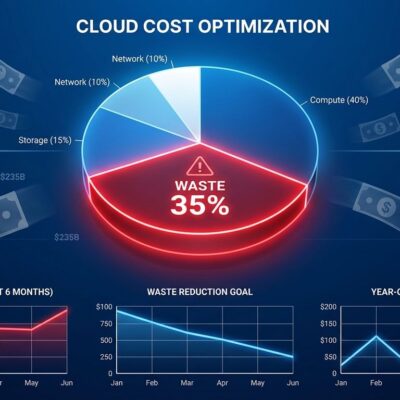
Hyperscalers are spending nearly 100% of their operating cash flows on capex, compared to a 10-year average of 40%. Cloud services aren’t charity. When hyperscalers pour $690 billion into data centers, those costs get embedded in Azure, AWS, and Google Cloud pricing.
Therefore, the pledge promises to protect “consumers,” but developers are consumers of cloud infrastructure. Your cloud bills will reflect these infrastructure investments through direct price increases or capacity constraints that force over-provisioning.
Key Takeaways
- The pledge is non-binding. Implementation depends on individual state regulators.
- Microsoft’s $80 billion Azure backlog demonstrates real power constraints. Capacity issues persist through at least mid-2026.
- Nuclear power plans target the early 2030s—too late for immediate capacity needs.
- Hyperscalers spending $690 billion in 2026 will pass costs through cloud pricing and API fees.
- Budget for cloud cost increases and regional capacity constraints.