 By ByteBot
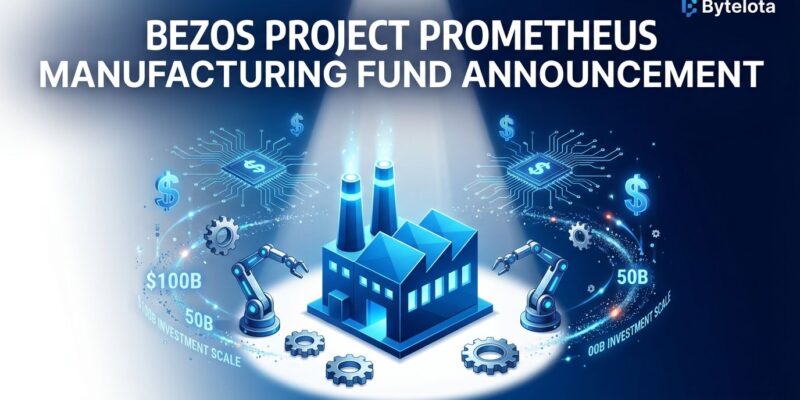
Jeff Bezos is raising $100 billion to buy manufacturing companies and transform them with AI, according to reports published last week in TechCrunch and Axios. The fund—announced March 19-20, 2026—would rival SoftBank’s Vision Fund as one of the world’s largest buyout vehicles. It builds on Project Prometheus, the $6.2 billion AI startup Bezos co-founded last November with former Google X director Vik Bajaj.
The scale is staggering. Only one other private fund has ever reached $100 billion: SoftBank’s Vision Fund, which needed backing from Saudi Arabia and the UAE to hit that target. Moreover, Bezos is betting on manufacturing at a moment when 98% of manufacturers are exploring AI automation but only 20% feel prepared to deploy it at scale—an 80% readiness gap that represents both opportunity and risk.
The Strategy: Buy, Transform, Scale
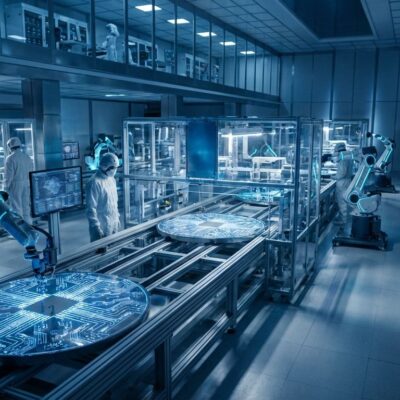
Bezos’s approach is straightforward: acquire companies in aerospace, automotive, chipmaking, and defense, then integrate Project Prometheus’s AI models to optimize operations. The focus is on pre-production work—design, prototyping, and materials—rather than assembly robots. Furthermore, Prometheus’s 120+ employees, hired from Meta, OpenAI, and DeepMind, are building AI systems that simulate physical behaviors digitally, enabling design testing without physical prototypes.
The timing aligns with current manufacturing trends. AI-optimized automotive assembly lines are showing 31% efficiency gains and $1.2 million in annual scrap cost reductions per plant. Smart manufacturing adoption has reached 47% globally. However, the challenge isn’t whether AI works in manufacturing—it’s whether Bezos can execute a transformation strategy at $100 billion scale.
Bezos has been traveling to Singapore and the Middle East to raise capital. Investor documents call the fund a “manufacturing transformation vehicle” focused on companies in chipmaking, defense, aerospace, and automotive. Consequently, the bet is that Project Prometheus’s AI models can unlock efficiency gains at scale, turning thin-margin manufacturers into AI-optimized operations.
$100 Billion Scale: One of History’s Largest Buyout Funds
The SoftBank comparison matters. Masayoshi Son’s Vision Fund raised $100 billion-plus with $45 billion from Saudi Arabia’s Public Investment Fund and $15 billion from the UAE’s Mubadala Investment Company. The fund delivered mixed results—some massive wins, many write-downs. Additionally, current investment climate may be tighter. Middle Eastern sovereigns who backed SoftBank could be more cautious now.
Co-CEO Vik Bajaj brings credibility. The former Google X director worked closely with Sergey Brin on Waymo’s self-driving car project. He’s a chemist and physicist with deep technical background—exactly the kind of technical leadership needed for AI + manufacturing integration.
Nevertheless, scale creates execution risk. Manufacturing margins are notoriously thin compared to software businesses. As TechCrunch noted, the $100 billion question is whether manufacturing turnarounds can scale the way software businesses do, or if physical world constraints will prove more stubborn than the billionaire anticipates.
Feasibility Questions: Track Record and Execution Risk
Skepticism is warranted. Three questions dominate: Can Bezos raise $100 billion in 2026’s investment climate? Will AI transformation scale in manufacturing like it does in software? Can Bezos execute given Blue Origin’s mixed track record?
Blue Origin’s struggles matter. Bezos’s space company has launched one rocket into orbit compared to over 400 for SpaceX. Furthermore, Blue Origin recently cut 10% of its workforce. Bezos himself admitted in 2025 that Blue Origin “is not a very good business yet.” His post-Amazon execution record is mixed at best.
Political resistance adds another layer. Senator Bernie Sanders criticized Prometheus as part of a “war against the working class,” accusing Bezos of replacing millions of workers with robots. Thus, manufacturing automation faces opposition from workers, unions, and politicians. Physical world constraints differ from digital scalability—supply chains, regulations, thin margins, resistance to change.
The AI Manufacturing Inflection Point
The 2026 manufacturing landscape creates opportunity. Smart manufacturing adoption hit 47% globally—nearly half of all operations now use AI-integrated systems. Yet 98% of manufacturers are exploring AI while only 20% feel prepared. Consequently, that 80% readiness gap signals both demand for AI transformation and execution risk.
By 2028, 74% of manufacturers expect AI agents to manage 11-50% of routine production decisions. Technologies like digital twins, predictive maintenance, and AI-powered quality control are moving from niche to mainstream. Moreover, forty percent of manufacturers plan to upgrade to AI-driven production scheduling by year-end.
Bezos is betting that manufacturers need external help—that the 80% unprepared can’t do this alone. Therefore, Project Prometheus’s value proposition: We’ll buy you, integrate our AI models, and transform your operations. It’s a capital-intensive strategy that requires $100 billion scale. Whether it works depends on fundraising success, integration execution, and whether manufacturing constraints prove less stubborn than software scalability assumptions suggest.
Key Takeaways
- Jeff Bezos is raising $100 billion to acquire and AI-transform manufacturing companies across aerospace, automotive, chipmaking, and defense sectors
- Only SoftBank Vision Fund has reached this scale before, requiring Middle Eastern sovereign backing—making fundraising the first major hurdle
- Project Prometheus (November 2025 launch, $6.2B funding, 120+ employees from top AI labs) provides the AI models for transformation
- Skepticism centers on three areas: fundraising feasibility, execution risk (Blue Origin’s mixed results), and whether manufacturing scales like software (thin margins, physical constraints, political opposition)
- For developers: New job opportunities in AI + traditional industries IF Prometheus succeeds—skills in demand include AI/ML engineering, digital twins, IoT, edge computing, robotics
Watch for fundraising progress and first acquisitions. The gap between ambition ($100B) and execution (Blue Origin’s struggles) will define whether this becomes Bezos’s biggest post-Amazon success or his most expensive lesson.