 By ByteBot
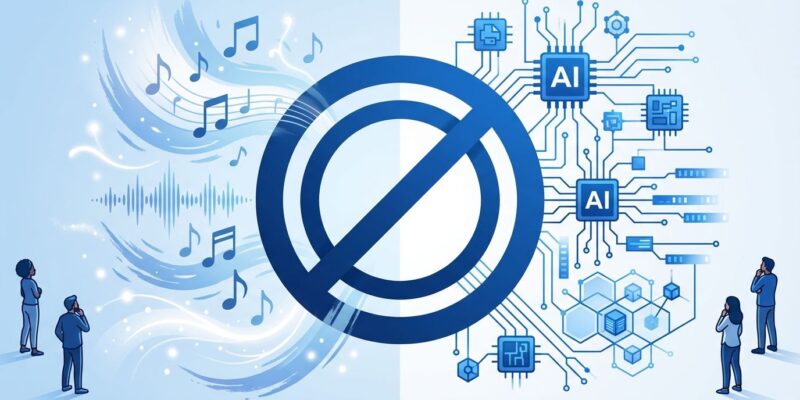
Bandcamp announced today (January 13, 2026) a blanket ban on AI-generated music, framing the policy as protecting “human artistry” and keeping the platform “human.” The move has sparked intense debate on Hacker News (384 comments, 472 points), with musicians and developers divided on whether this represents artist protection or platform gatekeeping. The policy prohibits music “generated wholly or in substantial part by AI” and gives Bandcamp discretionary authority to remove content “on suspicion” — with no clear standards, detection mechanism, or appeals process disclosed.
This isn’t just about music. Bandcamp’s move sets a precedent for every creative platform: if an indie music platform can ban AI-generated content, can GitHub ban AI code? Can Figma ban AI designs? The real question isn’t whether AI music should exist — it’s who decides what tools creators can use.
The Definitional Problem Nobody’s Solving
Bandcamp’s policy bans music “generated wholly or in substantial part by AI” but provides zero guidance on what “substantial part” means. Musicians routinely use AI for mixing, mastering, stem separation, vocal tuning, and ideation. Where’s the line? Is it 10% AI? 50% AI? The policy doesn’t say.
One Hacker News musician asked: “If you came across a song and fell in love with it, only to find out later that it was generated by AI, would you stop loving the song?” The question exposes the absurdity. Legitimate AI music tools like stem separation (iZotope RX), vocal tuning (Melodyne), and mixing assistants (iZotope Ozone) are AI-powered. Do these count as “substantial part” AI generation? Bandcamp won’t clarify.
Without clear definitions, Bandcamp can arbitrarily flag any music they suspect uses AI tools. Artists experimenting with AI-assisted workflows — not full generation — will self-censor out of fear of being banned. The policy doesn’t protect creativity; it chills it.
Platform Control Disguised as Artist Protection
Bandcamp positions the ban as “protecting human artistry” and artist-fan connection. The unstated motive is competitive positioning: differentiating from Spotify, which reportedly promotes AI “ghost artists,” and appealing to indie-conscious users. This isn’t altruism — it’s branding. Academic research confirms that “online platforms have become major enablers of music content flow with unparalleled gatekeeping powers,” with independent artists “forced to take whatever terms dominant platforms offer.”
Meanwhile, major labels are signing licensing deals with the same AI music companies Bandcamp is banning. Warner Music Group licensed Suno; Universal Music Group licensed Udio. The power imbalance is glaring: smaller artists must comply with platform rules, while bigger players negotiate. One Hacker News user switched to Bandcamp “specifically because Spotify’s promotion of AI music bothered me” — proving the competitive branding angle works.
Related: AI Verification Gap: 96% Don’t Trust Code, 48% Check
This reveals the ban as a strategic business decision, not moral advocacy. Platforms are choosing sides in the AI debate based on market positioning, not principles. The “protecting artists” narrative is marketing spin. When platforms have unilateral power to ban creative tools without transparency or accountability, creators lose agency.
Why the Synthesizer Analogy Doesn’t Work
Defenders invoke historical patterns: synthesizers, drum machines, and Auto-Tune all faced backlash before eventual acceptance. But AI music generation crosses a different line. Synthesizers and drum machines were tools that required human operation and creative intent. AI music generators like Suno can create complete songs in 10 seconds with a text prompt — simulating creativity wholesale, not augmenting it.
As one analysis put it: “AI-generated artists, in most cases, aren’t augmenting creativity; they’re simulating it wholesale.” In the 1970s, synthesizers were deemed “musical cheating” (Queen included “No Synthesizers!” on album covers). But a synthesizer still required a musician to compose, arrange, and perform. Suno renders “intentional human production nearly obsolete within its framework.”
This distinction matters. AI music IS qualitatively different from past technologies — which makes platform responses more understandable. But Bandcamp’s blanket ban is crude: banning the tool doesn’t address the real issues of quality, disclosure, or attribution. A nuanced policy would distinguish AI-tool (mixing assistant) from AI-creator (full generation). Bandcamp chose the easy route: ban everything and let the platform decide.
The Precedent Every Developer Should Watch
If Bandcamp can ban AI-generated music, what stops GitHub from banning AI-generated code? Or Figma from banning AI-generated designs? The developer community should pay attention: 85% of developers already use AI coding tools, and 41% of all global code is now AI-generated (256 billion lines in 2024). Some Y Combinator startups have codebases that are 91% AI-generated.
Related: AI Coding Productivity Paradox: Why Devs Are 19% Slower
The double standard is glaring: music AI banned, code AI celebrated. Why? The answer reveals the ban isn’t about principles; it’s about market dynamics. Code platforms benefit from AI (more repos, more activity), while music platforms see AI as a competitive threat (flooding, discoverability issues). Music creators face projected losses of $10-10.5 billion (2023-2028), while developer productivity is seen as “enhanced” not threatened.
Instead of a blanket ban, Bandcamp could have implemented transparency: require artists to tag AI-generated or AI-assisted content, create separate discovery categories, establish clear thresholds. This approach respects creator autonomy while giving users choice. But transparency requires nuanced governance. Bandcamp chose the nuclear option: blanket ban with discretionary enforcement. That’s control, not protection.
Key Takeaways
- Bandcamp’s AI ban prohibits music “generated wholly or in substantial part by AI” but defines neither threshold nor detection method, giving the platform unchecked discretion over what counts as “too much” AI
- The ban is competitive positioning disguised as artist protection — differentiating from Spotify while major labels license the same AI companies Bandcamp bans
- AI music generation is qualitatively different from past technologies (synthesizers, drum machines) because it simulates rather than augments creativity, but blanket bans don’t solve quality or disclosure problems
- This sets a precedent for every creative platform — if Bandcamp can ban AI music, GitHub could ban AI code despite 85% of developers using AI tools and 41% of code being AI-generated
- The real issue is platform control vs. creator autonomy — platforms are choosing competitive strategies, not protecting creators, and artists lose agency when platforms unilaterally ban tools without transparency
The question isn’t whether AI music should exist. It’s who decides what tools creators can use.