 By ByteBot
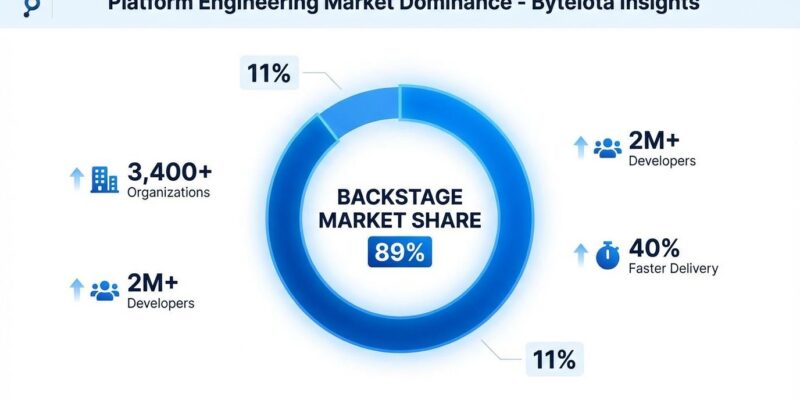
Backstage, Spotify’s open-source Internal Developer Platform framework, commands 89% market share among IDP solutions as of January 2026—serving 3,400+ organizations and 2 million+ developers outside Spotify. This consolidation arrives as platform engineering transitions from experimental to mandatory: Gartner forecasts 80% of large software organizations will establish platform teams by year-end, up from 45% in 2022. Organizations using IDPs ship updates 40% faster while slashing operational overhead nearly in half. However, average internal adoption rates remain stuck at 10%, creating a paradox that defines the current IDP landscape.
The business case for IDPs is proven. Implementation realities are brutal. Teams choosing Backstage need to understand both.
Why Backstage Won the IDP Market
Backstage’s dominance stems from enterprise validation, open-source philosophy, and timing. Moreover, Spotify’s deployment manages 14,000+ backend services—proof the framework scales to massive complexity. The open-source model eliminates vendor lock-in while enabling a plugin ecosystem that now exceeds 250 community contributions. Furthermore, CNCF accepted Backstage into incubation in 2022; by 2024, it ranked as a top-five project by activity and velocity.
Timing mattered as much as technology. Platform engineering adoption exploded in 2025—55% of organizations adopted it that year alone. Consequently, Backstage benefited from being first to market with enterprise credibility as the category matured. In addition, March 2026 marked another maturation signal: the New Frontend System became default after a multi-year migration, signaling production readiness for risk-averse enterprises.
The plugin architecture sealed Backstage’s market victory. Every feature is a plugin operating as an independent microservice. This enables organizations to customize extensively while maintaining clean separation between components. In contrast, competitors offering rigid, opinionated platforms couldn’t match Backstage’s flexibility.
The Business Case: ROI Metrics That Justify Investment
Platform engineering delivers measurable productivity gains. Organizations using IDPs ship updates 40% faster and cut operational overhead by roughly 50%. DoorDash reported 35% productivity improvements measured via the SPACE framework. Uber saw 40% gains using the same methodology. A 25-person team case study documented $2.76 million in annual benefits: $390,000 from toil reduction, $1.56 million from AI productivity integrated into the platform, $468,000 saved on incident response, and $337,000 from faster time-to-market.
However, the “free” open-source option is the most expensive choice for most organizations. When accounting for engineering time required for customization, maintenance, and ongoing upgrades, self-hosted Backstage costs 4-10x more than commercial alternatives according to Roadie’s analysis. Successful implementations require 3-5 dedicated engineers, including at least one comfortable with React and TypeScript. POC to production typically spans months to over a year.
The hidden costs surprise teams accustomed to thinking “open-source equals free.” Engineering leader time, opportunity costs from platform team focus, and ongoing maintenance burden must factor into total cost of ownership calculations. Meanwhile, commercial alternatives like Port, Cortex, or managed Backstage services (Roadie, Spotify Portal) often deliver lower TCO despite subscription fees.
The 10% Adoption Paradox
Helen Greul, head of engineering for Backstage at Spotify, identified the core problem: “The average Backstage adoption rate is stuck at 10%, often because adopters don’t make it past the proof of concept because they fail to understand the challenges developers are facing.” Additionally, over 70 steps and 100+ plugin options overwhelm teams during initial setup. Cultural and organizational barriers frequently exceed technical challenges—Backstage success requires organizational buy-in to the developer portal concept itself, not just implementation skills.
Most teams fail by treating Backstage as a project rather than a product. The pattern is consistent: Leadership approves POC, platform team spends weeks configuring, launches to internal users, adoption stalls around 10%, team moves to maintenance mode, platform becomes shelfware. In contrast, successful teams operate differently—they conduct user research before technical implementation, build dedicated teams of 3-5 engineers, secure executive sponsorship, and plan Day 2 operations from Day 0.
The 72% of Backstage adopters actively developing their instances (versus 28% in maintenance mode) demonstrates that engaged teams do succeed. The split reveals a bifurcated market: organizations that invest properly see strong returns, while under-resourced efforts fail at the POC stage.
When Backstage Makes Sense vs Alternatives
Backstage fits specific organizational profiles: enterprises with 50+ developers managing hundreds of microservices, teams with dedicated platform engineering groups and executive sponsorship, and organizations needing standardization through Scaffolder templates and compliance scoring. However, small teams under 20 developers rarely justify the overhead—tool sprawl and service discoverability aren’t acute problems at that scale.
Wrong fit scenarios include organizations unable to commit 3-5 engineers to platform work, immature DevOps practices (fix basic CI/CD first, then layer Backstage), and short-term thinking that treats platform engineering as a one-off project. The framework demands sustained investment.
Port offers a contrasting approach: proof-of-concept implementations run 4x faster than Backstage according to comparison studies, and the no-code visual interface accommodates teams without React expertise. Cortex focuses specifically on service quality and reliability with strong Scorecards for tracking operational maturity. Furthermore, managed Backstage services (Roadie, Spotify Portal) reduce engineering burden dramatically while limiting customization depth—a reasonable trade-off for many organizations.
The build-versus-buy decision has shifted. Five years ago, teams chose between building custom tooling or living with fragmentation. Today, the choice is self-hosted Backstage (maximum flexibility, maximum cost), managed Backstage (balanced approach), or commercial alternatives optimized for specific use cases (Port for workflow flexibility, Cortex for service quality). All three paths are valid depending on organizational resources and priorities.
The Future: AI Integration and Continued Growth
Backstage’s 89% market share will likely expand as platform engineering adoption accelerates toward Gartner’s 80% year-end forecast. The more significant trend is AI integration becoming table stakes. 92% of CIOs are planning AI integrations into platform capabilities, and 76% of DevOps teams had integrated AI into CI/CD pipelines by late 2025. IDPs are evolving into control planes for AI agent orchestration and LLMOps workflows, not just traditional DevOps tooling.
The Backstage roadmap for 2026 prioritizes faster time-to-value (reducing POC-to-production timelines), improved plugin quality standards, better upgrade experiences, and native AI/LLM integrations. These improvements target the 10% adoption rate problem directly. As complexity decreases and AI capabilities expand, Backstage strengthens its position as the default platform engineering choice—similar to how Kubernetes became the default for container orchestration despite early complexity complaints.
Platform engineering has moved from “should we build an IDP?” to “build, buy, or hybrid?” Backstage’s market dominance, proven ROI metrics, and expanding AI capabilities make it the baseline against which all alternatives are measured. Therefore, teams evaluating IDPs in 2026 aren’t debating whether Backstage is viable—they’re calculating whether they have the resources to maximize its potential or should opt for lower-overhead alternatives.
Key Takeaways
- Backstage achieved 89% market share in January 2026, becoming the de facto IDP standard as platform engineering adoption approaches 80%
- ROI is real—40% faster updates, 50% less overhead—but hidden costs run 4-10x commercial alternatives when engineering time is factored
- Average 10% internal adoption rate exposes the paradox: market dominance doesn’t guarantee successful deployment without product thinking and dedicated teams
- Enterprise scale (50+ devs, microservices) justifies Backstage; small teams should evaluate Port, Cortex, or managed alternatives
- AI integration trend makes IDPs the control plane for modern development, strengthening Backstage’s position as platform engineering matures