 By
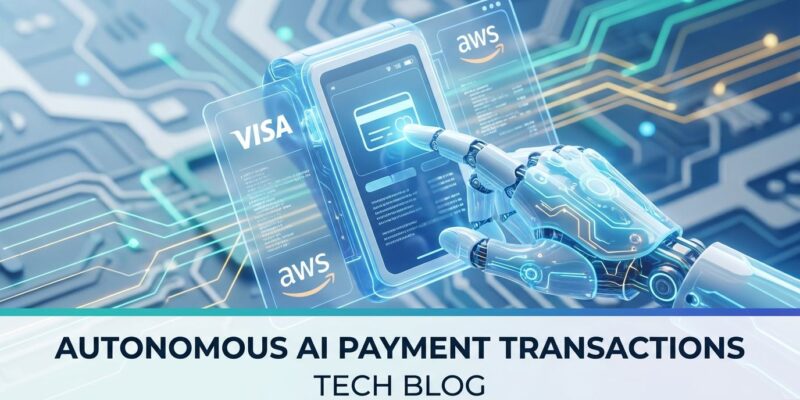
By AI agents just got payment superpowers. At AWS re:Invent 2025, Visa and AWS announced a partnership enabling AI agents to conduct autonomous financial transactions—not just recommend purchases, but actually complete them on your behalf. Tell your agent “Buy me basketball tickets if the price drops below $150” and it will monitor prices, authenticate the purchase, and complete the transaction autonomously.
This isn’t another vaporware AI announcement. Visa and AWS are combining Visa’s global payment infrastructure—processing 67 billion transactions annually—with AWS Bedrock AgentCore to create what Visa calls “the trust layer for the agent economy.” Open blueprints are published on the Amazon Bedrock AgentCore public repository right now. Industry partners including Expedia Group, Intuit, lastminute.com, and Eurostars Hotel Company are already committed.
From Assistants to Autonomous Agents
Most AI agents today are sophisticated assistants. They recommend actions, generate content, answer questions. But they don’t transact. This partnership crosses that line. The technical foundation combines Amazon Bedrock AgentCore—a serverless runtime supporting frameworks like LangGraph, CrewAI, and OpenAI Agents SDK—with Visa’s Intelligent Commerce platform.
Developers get access to Visa’s APIs through Model Context Protocol servers. No custom integration code required. The system handles tokenization to replace card details, step-up verification for authentication, and controls to ensure payment requests match user instructions. AgentCore provides identity management, memory infrastructure, and OpenTelemetry-compatible observability.
Real Use Cases, Real Partners
The blueprints target three domains. Retail shopping workflows cover product discovery, price comparison, checkout, and order tracking. Travel booking integrates with Expedia Group, lastminute.com, and Eurostars for search, compare, book, and track operations. B2B payments through Intuit enable payment reconciliation and invoice automation.
These aren’t prototype demos. Real companies are building real implementations on infrastructure that’s available today. That’s the shift from AI hype to AI infrastructure.
The Developer Opportunity Is Now
The AI agents market is projected to grow from $5-8 billion in 2024-2025 to $42-53 billion by 2030, a 41-46% CAGR according to Grand View Research and MarketsandMarkets. Current adoption is already significant: 82% of enterprises use AI agents, and 98% plan wider rollouts within a year.
The developer advantage: framework-agnostic architecture means you choose your tools. Open blueprints on GitHub provide starting points. The Visa Acceptance Agent Toolkit uses plain-language prompts, so even non-technical users can trigger workflows. First-mover advantage exists right now, before the market saturates.
But Security Risks Are Amplified
Here’s the critical part that most announcements downplay: 80% of organizations have already encountered risky AI agent behaviors, including improper data exposure and unauthorized system access. McKinsey warns that “a compromised agent doesn’t just leak information—it could autonomously execute unauthorized transactions.”
Autonomous financial transactions amplify risk exponentially. Visa’s tokenization, authentication, and controls provide a security foundation. AWS AgentCore Identity adds access management. But the fundamental challenge remains: autonomy invites unpredictability, and unpredictability is a security risk. Gartner predicts 40% of agentic AI projects will be scrapped by 2027 due to cost and risk concerns.
Developers building on this infrastructure need to understand the threat model. Session isolation, comprehensive observability, and strict access controls aren’t optional—they’re existential.
The Bigger AWS Agentic AI Push
The Visa partnership is part of AWS’s broader agentic AI strategy unveiled at re:Invent. AWS Transform now includes agentic capabilities for legacy code modernization, accelerating .NET, mainframe, and VMware application updates by 4-5x while eliminating up to 70% of maintenance costs. Air Canada reduced modernization time and cost by 80% using the service to update thousands of Lambda functions.
AWS is positioning agentic AI as the shift from prompt-dependent systems to autonomous agents capable of reasoning, planning, and executing multi-step processes without constant human intervention. The Visa partnership demonstrates that strategy applied to commerce infrastructure.
Infrastructure Is Ready. Understand the Risks.
This announcement marks a genuine inflection point: autonomous transactions are now infrastructure, not experiments. The tools are available. The market opportunity is real and growing at 40%+ annually. Major partners are committed.
But developers need clear-eyed pragmatism. Build on this infrastructure, absolutely. Explore the GitHub blueprints and test the Visa MCP integration. Just don’t treat security as an afterthought. The agents you deploy today will be making autonomous financial decisions tomorrow. That’s both opportunity and responsibility.