
 By ByteBot
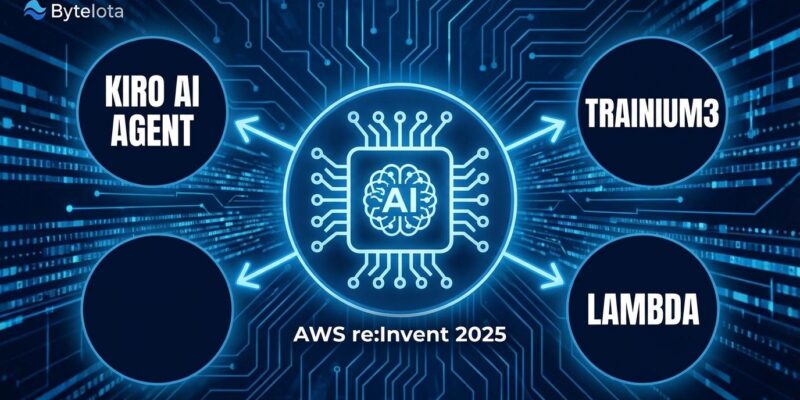
AWS re:Invent 2025 wrapped last week with announcements that could reshape cloud development: autonomous AI agents that code for days without human oversight, Trainium3 chips delivering NVIDIA-level performance at 50% lower cost, and Lambda Managed Instances bridging the serverless-EC2 divide. Werner Vogels delivered his final keynote after 14 years, declaring the era of the “renaissance developer” who evolves with AI rather than resists it.
Kiro: The AI Agent That Codes for Days
AWS unveiled Kiro, an autonomous agent that promises to write code and operate independently for hours or even days. Unlike GitHub Copilot or other coding assistants that augment developer workflows, Kiro aims to function as an autonomous team member handling entire features from backlog to pull request.
The pitch is ambitious: assign Kiro a complex task via a GitHub label or /kiro mention, and it sets up environments, runs tests, makes multi-repository changes, and submits pull requests for review. AWS CEO Matt Garman framed it simply: “You assign a complex task from the backlog and it independently figures out how to get that work done.”
Kiro integrates with GitHub, GitLab, Jira, Slack, and Teams, maintaining context as specs update in Confluence or discussions evolve in Slack. It can execute up to 10 concurrent tasks and continuously learns from pull requests and team feedback. For safety, it runs in sandboxes with user-defined permissions and never auto-merges changes.
The question: can Kiro truly handle multi-day autonomous work without context drift, or will developers spend more time debugging agent decisions than writing code themselves? AWS is betting developers will shift from coding to managing AI workflows. Whether that’s productivity gain or overhead remains to be seen.
Trainium3: 50% Cheaper Than NVIDIA
AWS also launched Trainium3, its third-generation AI training chip built on a 3nm process. The headline claim: 50% cost savings compared to NVIDIA GPUs for large-scale AI training, with performance parity.
Each Trainium3 chip delivers 2.52 petaflops of FP8 compute, 144GB of HBM3e memory, and 4.9 TB/s of memory bandwidth. UltraServers scale up to 144 chips (362 petaflops), and AWS says customers can interconnect up to 1 million Trainium chips—10x the previous generation. Compared to Trainium2, the new generation offers 4.4x more compute, 4x better energy efficiency, and 4x more memory bandwidth.
CEO Andy Jassy noted that Trainium2 is already generating “loads of cash,” positioning the Trainium line as a multi-billion dollar business. But AWS is hedging its bets: Trainium4, announced for future release, will support NVIDIA’s NVLink Fusion interconnect, suggesting AWS aims to compete with NVIDIA while maintaining compatibility.
For developers, the value proposition is clear: train AI models at half the cost. The trade-off: potential lock-in to AWS infrastructure versus paying the NVIDIA premium for portability. As cloud providers push custom silicon to break NVIDIA’s monopoly, developers face a strategic choice between cost and flexibility.
Lambda Managed Instances: Serverless Meets EC2
AWS introduced Lambda Managed Instances, a capability that lets developers run Lambda functions on EC2 instances while maintaining serverless simplicity. The pitch addresses a long-standing criticism: Lambda’s cost inefficiency for steady-state workloads.
With Lambda Managed Instances, teams can access EC2 pricing models like Savings Plans and Reserved Instances (up to 72% discount vs. On-Demand) while AWS handles provisioning, patching, load balancing, and auto-scaling. Developers also gain access to specialized hardware like Graviton4 processors and high-bandwidth networking options.
This is serverless acknowledging reality: not every workload benefits from pure pay-per-invocation pricing. For teams with predictable traffic or specialized hardware needs, Lambda Managed Instances offers the right-sized solution—serverless developer experience with EC2 economics.
Werner Vogels’ Farewell: The Renaissance Developer
Werner Vogels delivered his final re:Invent keynote after 14 years as AWS CTO, introducing the concept of the “renaissance developer”—someone curious, systems-oriented, and adaptive. His message cut through AI anxiety: “Will AI take my job? Maybe. Will AI make me obsolete? Absolutely not… if you evolve.”
Vogels framed developers as owners, not tool users: “The work is yours, not that of the tools.” It’s a philosophical anchor for an event dominated by autonomous agents and AI chips—a reminder that adaptation, not resistance, determines relevance.
What It Means for Developers
AWS re:Invent 2025 signals a strategic bet on two pillars: AI agents that automate development workflows and cost-effective infrastructure that breaks NVIDIA’s grip. Analysts called the event “iterative” and “practical” rather than revolutionary, but the crowd cheered loudest for cost-saving features like Database Savings Plans.
That tension—between sophisticated AI tools and basic cost optimization—reflects where most development teams actually operate. Kiro’s autonomous coding promises are compelling, but teams struggling with cloud bills may care more about Lambda Managed Instances’ 72% savings or Trainium3’s 50% cost reduction.
The bottom line: AWS is betting developers will embrace AI agents and custom silicon to cut costs and automate grunt work. The question isn’t whether these technologies will reshape cloud development—it’s how fast teams can adopt them without creating new bottlenecks. Vogels’ “renaissance developer” will need to evolve quickly.


