
 By ByteBot
AWS just made AI agents safe for production with Policy in AgentCore, announced at re:Invent 2025. The system intercepts every agent action in real time and enforces boundaries using Cedar—AWS’s open-source policy language. Natural language policies convert to deterministic code that blocks unauthorized actions before they happen. This matters because autonomous agents are replacing chatbots across enterprises, and 80% of organizations have already encountered risky agent behaviors. Most platforms have no answer for “how do we stop our agent from doing something stupid?” AWS does: deterministic policies, not more AI.
The Agent Security Crisis Nobody’s Talking About
Enterprises are rushing to deploy autonomous AI agents, but the numbers are alarming. According to Akto’s 2025 State of Agentic AI Security Report, only 21% of executives have complete visibility into what their agents are actually doing. One in five organizations deployed agents with no guardrails or monitoring at all. The consequences? 80% have already encountered risky behaviors—improper data exposure, unauthorized system access, the works.
This isn’t a hypothetical future problem. 45% of enterprises are running at least one production AI agent with access to critical systems, a 300% increase from 2023. The industry is shifting from AI assistants (ChatGPT answering questions) to autonomous agents that operate independently for hours or days. AWS CEO Matt Garman puts it bluntly: “AI assistants are starting to give way to AI agents that can perform tasks and automate on your behalf.”
Most companies are deploying these agents anyway, hoping nothing breaks. AWS Policy in AgentCore is the first serious answer to the control problem.
How Policy in AgentCore Actually Works
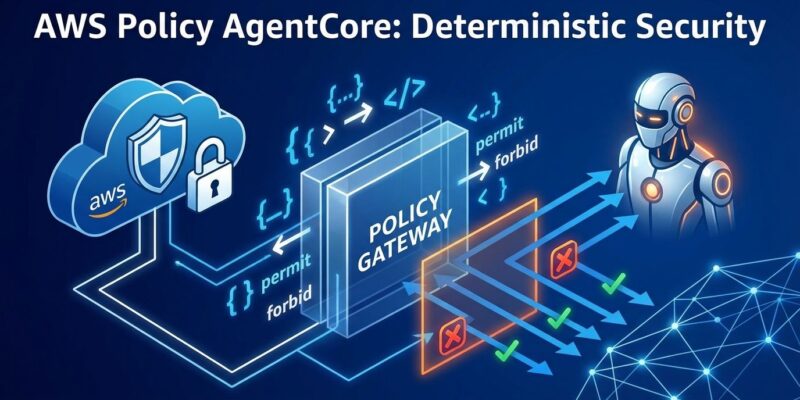
Policy in AgentCore intercepts agent tool calls at the gateway layer and evaluates them against Cedar policies in real time—blocking unauthorized actions before they execute. The architecture is straightforward: all agent traffic flows through AgentCore Gateway, where a policy engine stores deterministic rules written in Cedar, AWS’s open-source policy language.
Every tool call gets intercepted and evaluated. The decision is binary: PERMIT or DENY. If permitted, the tool executes. If denied, the action is blocked before anything happens. You can run in enforce mode (actually block) or log-only mode (test policies before production).
Cedar is the critical innovation here. It’s a formal policy language with declarative syntax—you define what’s allowed or denied, and Cedar handles the rest. Unlike LLMs, Cedar policies are provable. You can test every edge case, version control policies in Git, and run them through CI/CD pipelines.
Here’s a simple example: a customer service agent that can auto-approve refunds under $100 but requires human approval above that threshold.
permit(
  principal,
  action == Action::"processRefund",
  resource
)
when {
  context.refundAmount < 100
};
That’s deterministic control. No hoping the agent “understands” limits. No probabilistic behavior. Just code that either permits or denies based on rules you define.
Real-World Use Cases That Matter
Policy in AgentCore enables five critical scenarios for production agents. Financial thresholds: auto-approve purchases under $X, require human approval above. Data access controls: restrict which databases and APIs agents can touch, with read-only or read-write permissions based on context. Third-party app permissions: control Salesforce, Slack, and GitHub access with rate limiting and audit trails.
Role-based access is huge for enterprises. Junior agents get read-only access and no external API calls. Senior agents get read-write with limited external access. Admin agents get full capabilities. All enforced deterministically at the gateway layer.
The stakes are higher than you think. AWS’s Kiro autonomous agent writes code independently for hours or days. In one Amazon project, Kiro reduced an 18-month timeline with 30 developers to 76 days with 6 developers. Without Policy controls, Kiro could potentially push code to wrong repositories, access production databases, or call expensive external APIs without limits. Cedar policies prevent these scenarios before they happen.
Why AWS’s Approach Is Different
AWS is the only major platform with deterministic, code-independent policy enforcement for AI agents. OpenAI has no external policy layer—their December 2025 “Code Red” internal memo suggests they’re aware of the gaps. Google Gemini has safety layers built into the model (650M monthly active users), but it’s still probabilistic, not deterministic. Anthropic’s Constitutional AI focuses on principles-based alignment, but there’s no tool-level policy enforcement.
AWS’s bet is Cedar as an open-source standard, similar to how they open-sourced Firecracker for serverless and Bottlerocket for containers. The enterprise focus is clear: security, compliance, and audit trails come first. Deterministic controls provide provable safety versus probabilistic behavior.
Most platforms are racing to make agents faster and smarter. AWS is racing to make them safe and controllable. In 12-18 months, control will matter more than raw performance.
Policy-as-Code Becomes Standard
This is bigger than a feature launch. Policy-as-code for AI agents is becoming standard practice, just like infrastructure-as-code (Terraform) became standard for cloud deployments. Regulatory pressure is accelerating adoption—ISO 42001, NIST AI RMF, and GDPR now mandate controls for autonomous systems. The first major fines for uncontrolled agents are likely coming in 2026.
Cedar’s formal policies meet compliance requirements in ways LLM-based safety can’t. The ecosystem will grow: third-party tools, tutorials, integrations. Cedar could become the de facto standard, like Kubernetes for orchestration. Agent security becomes its own category—new startups will emerge building “Agent Security Platforms,” similar to how API security became its own space post-microservices.
Matt Garman’s prediction: “I believe that in the future, there’s going to be billions of agents inside of every company.” Billions of agents need billions of policies.
The Bottom Line
AWS Policy in AgentCore solves a problem most platforms are ignoring: autonomous agents need deterministic boundaries, not wishful thinking. Cedar’s formal policy language provides provable safety, which matters when 80% of organizations are already experiencing risky agent behaviors. As agentic AI moves from demos to production—and Garman’s prediction of billions of agents becomes reality—security guardrails matter more than speed. AWS isn’t first to market with AI agents, but they might be first to make them production-ready.


