 By
By AWS just dropped Lambda Managed Instances at re:Invent 2025—giving developers Lambda’s operational simplicity with EC2’s hardware flexibility and pricing. You can now run Lambda functions on specific EC2 instance types like Graviton4 while AWS handles all the infrastructure management. This is either serverless maturing or AWS admitting Lambda’s core promise wasn’t enough.
What Lambda Managed Instances Actually Delivers
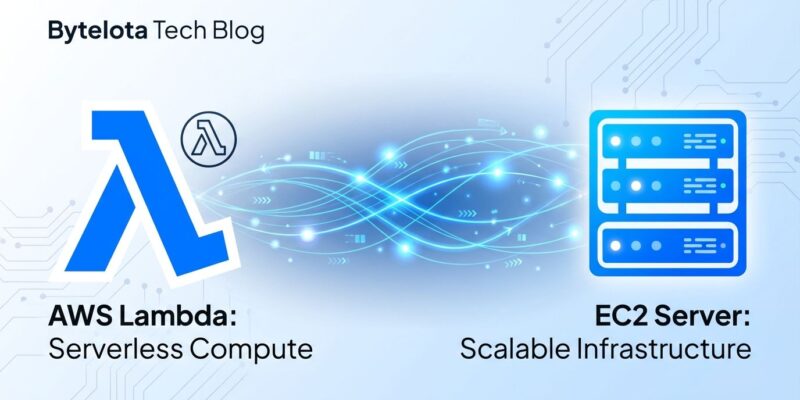
Lambda Managed Instances lets you run Lambda functions on your choice of EC2 instance types—Graviton4, network-optimized instances, custom CPU configurations—while AWS manages patching, scaling, and load balancing. You pay EC2 pricing plus a 15% management fee and can leverage EC2 Savings Plans or Reserved Instances.
The operational model stays pure Lambda: no servers to manage, automatic scaling, multi-concurrent invocations where one environment handles multiple requests simultaneously. But now you choose the hardware. Traditional Lambda locked you into AWS-managed compute with no say in CPU architecture or pricing models. Managed Instances fixes that—at the cost of reintroducing infrastructure decisions.
The Cost Math That Actually Matters
For low-traffic applications, traditional Lambda remains dramatically cheaper. A workload with 5,000 daily hits costs $0.16 on Lambda versus $4.25 on EC2—just 4% of the infrastructure cost. Lambda’s pay-per-millisecond model dominates when utilization is low or unpredictable.
But scale changes everything. At 5 million monthly hits with 200ms execution and 1GB memory, traditional Lambda costs $17.67 while a t3.micro EC2 instance costs $7.62. Lambda Managed Instances would cost approximately $8.76 (EC2 pricing plus the 15% management fee)—still more than raw EC2 but less than half the traditional Lambda cost.
The sweet spot: high-volume, predictable workloads where you’ve already committed to EC2 Savings Plans or Reserved Instances. You leverage existing commitments while keeping Lambda’s operational benefits. For IO-heavy applications like web services or batch jobs, multi-concurrency improves utilization beyond what traditional Lambda offers.
What You’re Trading Away
Traditional serverless promised complete infrastructure abstraction. Don’t think about CPUs, memory ratios, or instance families—just write code. Lambda Managed Instances walks that back. You’re choosing instance types again. You’re configuring capacity providers. You’re making infrastructure decisions.
This isn’t serverless evolution. It’s serverless compromise. AWS is acknowledging Lambda couldn’t serve all workloads without reintroducing the infrastructure thinking serverless was supposed to eliminate. That’s pragmatic and honest, but it challenges the “serverless for everything” narrative that’s dominated cloud architecture discussions.
Is it still serverless if you’re picking instance types? The label matters less than the operational reality: you get automation and simplicity, but you sacrifice pure abstraction.
When to Actually Use This
Use Lambda Managed Instances for high-volume, predictable traffic where you have EC2 commitments to leverage or need specific CPU architectures like Graviton4. It makes sense for steady-state Lambda workloads that have grown expensive under per-invocation pricing.
Stick with traditional Lambda for event-driven architectures, unpredictable spikes, or low-volume applications. The original model still dominates when compute demand varies widely or you want zero infrastructure thinking.
Skip both and use EC2 directly if you need sustained high compute, GPU support (Managed Instances doesn’t offer this), or you’re running existing containerized workloads where Lambda’s function model doesn’t fit.
What This Signals About Serverless
Lambda Managed Instances makes official what practitioners already knew: serverless didn’t replace traditional compute. It complements it. AWS is admitting Lambda’s limitations—no specialized hardware, cost inefficiency for sustained workloads—were pushing customers back to EC2. Managed Instances keeps them in Lambda’s ecosystem while addressing what they actually needed.
The cloud is in its “post-serverless era” where cost optimization trumps architectural purity. Hybrid approaches are the norm, not the compromise. Lambda Managed Instances formalizes that reality. Serverless grew up, and growing up means acknowledging trade-offs.