 By ByteBot
AWS launched Kiro, an AI IDE that challenges a core assumption of the AI coding boom: that speed matters more than structure. While developers debate Cursor versus Claude Code capabilities, Kiro’s spec-driven approach forces you to write requirements, architecture, and tasks before touching code. Early adopters report quality gains and fewer rework cycles, but performance concerns and a steep learning curve raise questions. Is this the discipline AI coding needs, or just waterfall development with better marketing?
The Cognitive Load Crisis Nobody Talks About
Here’s the problem Kiro actually solves: developer cognitive load hit crisis levels. The explosion from simple IDEs in 2000 to Docker, Kubernetes, Terraform, cloud platforms, and now AI tools created unsustainable context switching. Research shows 76% of organizations admit their software architecture’s cognitive burden lowers productivity. Another study found 97% of developers report toolchain sprawl forces constant, productivity-killing context switching.
AI coding tools promised relief. Instead, they added new complexity. They’re powerful but chaotic—hallucinations, lost context, no team standards. Developers now debate pricing models as intensely as capabilities. One developer told an AI assistant to “clear the cache.” It deleted his entire D: drive. That’s not an edge case—that’s what happens when AI hallucinations meet system-level autonomy without guardrails.
The industry responded. Gartner forecasts 80% of large software organizations will establish platform engineering teams by 2026 to reduce cognitive load through abstraction and automation. DORA research confirms AI’s impact depends less on individual tools and more on organizational systems. The “move fast, prompt things” mentality risks building technical debt at AI speed.
How Kiro’s Spec-Driven Approach Works
Kiro tackles this with structure. Built on VS Code and powered by Claude Sonnet 4.5, it transforms prompts into three specification files before generating code:
requirements.md defines what to build using EARS notation (Easy Approach to Requirements Syntax). Example: “When ‘deploy’ button is clicked, the system shall validate all Terraform configurations.” EARS eliminates natural language ambiguity through five structured patterns—event-driven, state-driven, optional features, unwanted behaviors, and ubiquitous requirements.
design.md creates the technical blueprint: components, data models, TypeScript interfaces, data flow diagrams. Architecture before implementation.
tasks.md breaks work into a sequenced checklist with dependencies linking back to requirements. Automated by AI, verified by humans.
The philosophy: “Bridging the flow of vibe coding and the clarity of specs.” You get rapid AI development with rigorous planning, not choosing between them.
Kiro adds guardrails competitors lack. Agent hooks trigger event-driven automation—save a file, tests run automatically. Steering files enforce team standards: naming conventions, security policies, architectural patterns. Native Model Context Protocol integration connects to docs, databases, and APIs (MCP hit 97 million monthly SDK downloads, with OpenAI, Google, and Microsoft supporting it natively).
Compared to Cursor or Claude Code, which generate code directly from prompts, Kiro enforces structure first. Compared to GitHub Copilot’s individual productivity focus, Kiro targets team governance at scale.
The Vibe Coding Versus Spec-Driven Debate
This is where it gets interesting. “Vibe coding”—writing code by feel with large language models—dominated 2025. Collins Dictionary named it Word of the Year. Express goals in natural language, AI generates code. Fast, democratizing, great for prototypes.
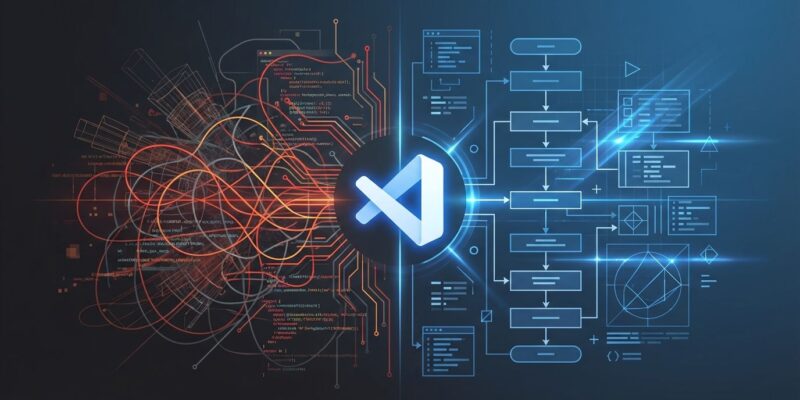
But developers discovered problems. Vibe coding creates a false sense of speed. AI writes code quickly upfront, but that velocity gets offset by debugging time. Code “looks right” but contains subtle bugs requiring hours to fix. For complex or long-term projects, context gets lost, requirements drift, and you end up with what developers call “spaghetti chat” history nobody can audit.
Spec-driven development optimizes differently. It’s slower upfront—writing and revising specs takes time. But clear specs mean fewer surprise rework cycles later. Teams establish shared context before implementation, so AI agents and developers build exactly what was intended. One analysis framed it perfectly: “Vibe coding optimizes for the first iteration; spec-driven development optimizes for the next hundred iterations.”
Martin Fowler, who analyzed three SDD tools (Kiro, GitHub’s spec-kit, and Tessl), raised valid concerns. Fixed workflows don’t accommodate varying problem sizes. Excessive markdown documentation creates tedious review experiences. Despite detailed specs, AI agents frequently ignore instructions or misinterpret requirements. We tried code generation from specs before—Model-Driven Development failed in the 2000s for similar reasons.
The 2026 consensus: these aren’t opposing camps—they’re different tools for different contexts. Use vibe coding for prototypes, experiments, learning, solo work. Use spec-driven for production systems, team projects, compliance needs, complex architecture.
Real-World Applications and Developer Experience
DevOps and Infrastructure-as-Code emerged as Kiro’s killer application. An AWS solution architect reported spec-driven development with Kiro “brought code relevancy and quality to a whole new level” for Terraform and Python workflows. IaC hallucinations create costly cloud resources—precision matters more than speed. Agent hooks trigger infrastructure validation on save. Steering files enforce security standards automatically.
Developer testimonials are mixed but informative. Positive: “Built secure application in 2 days from requirements alone.” “Saved hours of manual scaffolding.” “Spec feature is surprisingly useful thinking partner.” “Feels like Cursor but built for production.” “Automatically applies SWE best practices.”
Critical: “Steep learning curve of unique workflow.” “Session timeouts on large tasks.” “Performance issues and uneven maturity expected from public preview.” “For fast-moving vibe-coded sessions, Kiro’s structure gets in the way.” Access wait times run about a month due to high demand.
Kiro offers free preview access with usage limits (~50 interactions monthly), Pro tier at $19/month (~1,000 interactions), and Pro+ at $39/month (~3,000 interactions). Credit-based consumption provides real-time spend monitoring.
Who should try it? Best for teams needing governance, DevOps workflows, production applications, and cognitive load reduction. Skip if you prioritize rapid prototyping, work solo, hate documentation, or need maximum iteration speed.
The Verdict: Structure Versus Speed
Kiro gets some things right. It tackles a real problem—cognitive load crisis and AI coding chaos. It provides guardrails AI desperately needs through steering files and agent hooks. Team standardization at scale matters more than individual productivity gains. Documentation becomes a byproduct, not an afterthought—critical for compliance and maintenance.
But uncertainties remain. Performance issues could be fatal if not resolved—nobody tolerates tools that slow them down more than chaos does. Cultural adoption is unclear. Will developers embrace documentation discipline, or reject it as bureaucratic overhead? If AI hallucinations persist despite specs, the entire value proposition collapses. Spec maintenance could become its own form of debt.
AWS backing signals enterprise demand (AWS doesn’t ship toys), but raises questions about genuine innovation versus me-too product strategy. The Terraform and serverless integration shows clear infrastructure focus.
Most likely outcome: context-dependent adoption, not universal victory. Enterprises and regulated industries will adopt for governance. Startups prioritizing rapid iteration will stick with vibe coding. Hybrid teams will use both—Kiro for critical paths, Cursor for experiments.
Kiro’s bet on structure might prevent AI coding from creating a technical debt crisis at AI speed. Or it might be discipline nobody asked for. The early performance issues matter. If structure slows you down more than chaos, the trade-off fails. But if you’re tired of hallucinating agents deleting your drives, maybe bureaucracy is the lesser evil. Try the free preview at kiro.dev and decide for yourself.