 By
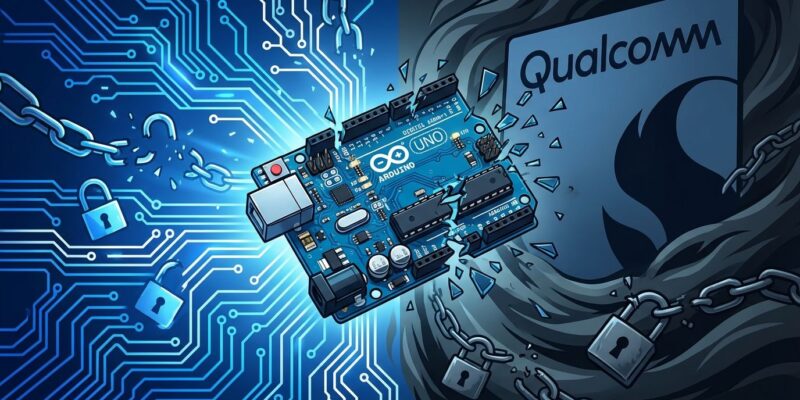
By One month after Qualcomm acquired Arduino in October 2025, the iconic maker platform introduced Terms of Service changes that Adafruit founder Limor Fried called “incompatible with open source.” The new ToS grants Arduino perpetual, irrevocable licenses over user uploads, bans reverse engineering, shields Qualcomm from patent analysis, and implements surveillance-style monitoring of AI features. For a platform built on “openly hackable systems,” the timing couldn’t be more damning.
The Five Clauses That Killed Arduino’s Soul
Arduino’s November 2025 ToS update introduced five toxic restrictions. First, Arduino now claims perpetual, irrevocable licenses over anything users upload—licenses that survive even after you delete your projects. Second, reverse engineering of Arduino Cloud services is banned outright. Third, users cannot identify potential patent conflicts with Qualcomm’s IP portfolio. Fourth, broad AI surveillance monitors users with vague scope. Fifth, data gets retained for years post-deletion and integrated into Qualcomm’s global ecosystem.
Moreover, Limor Fried put it bluntly: “Why is reverse-engineering prohibited at all for a company built on openly hackable systems?” She’s right to call this out. These clauses directly violate the Open Source Definition’s Criterion 6, which prohibits field-of-use restrictions. Consequently, genuine open source doesn’t let you say “this code is open, but you can’t reverse engineer it.” That’s not open source—that’s corporate control dressed in open-source branding.
Arduino’s “Still Open” Defense Is Gaslighting
Arduino responded to backlash by claiming “anything that was open, stays open,” arguing these restrictions only apply to the proprietary Arduino Cloud platform. However, this defense ignores reality: Arduino Cloud IDE is now the default experience for new users. Additionally, it’s the growth platform. Arduino actively steers beginners toward Cloud for collaboration, remote builds, and IoT features.
Furthermore, Fried demolished this defense: “Arduino downplays how central the cloud and web tools have become to the Arduino experience. When Arduino says ‘These restrictions only apply to SaaS,’ that still means the restrictions apply to the tools many new users are being steered into as their primary Arduino environment.” The standalone IDE may technically remain open, but it’s being phased out. Therefore, saying “the old stuff is still open” while funneling users into proprietary tools is textbook bait-and-switch.
The Timeline Proves This Was Planned
October 7: Qualcomm acquires Arduino, promises “independence.” October 25: Arduino UNO Q launches with Qualcomm’s Dragonwing chip. November: ToS changes silently introduced. December 14: Hacker News explodes with 99 upvotes as the community finally notices.
In fact, this wasn’t a slow drift or accidental policy change. Qualcomm bought the platform and immediately started locking it down. Indeed, the one-month gap from acquisition to ToS restrictions shows corporate intent: acquire, extract, monetize. Consequently, Arduino’s 30 million users just became Qualcomm’s data pipeline.
This Is a Pattern: Corporate Acquisitions Kill Open Source
Arduino isn’t alone. HashiCorp changed Terraform’s license, spawning the OpenTofu fork. Similarly, Red Hat restricted CentOS source code, leading to Rocky Linux and AlmaLinux. Likewise, Redis relicensed, triggering Valkey. The pattern is consistent: corporate takeover, licensing changes, community abandonment. As a result, Jeff Geerling called it in 2024: “Corporate Open Source is Dead.”
Every time a chip giant or enterprise vendor promises to “preserve open source principles,” the community gets burned. Therefore, voluntary pledges mean nothing when quarterly profits are on the line. Ultimately, Qualcomm bought the commons and is now charging rent.
What Developers Should Do: Vote With Your Projects
Fortunately, you’re not stuck with Arduino. The maker ecosystem has superior alternatives. ESP32 boards offer WiFi/Bluetooth built-in, cost $5-15, and remain fully open-source. Additionally, Raspberry Pi Pico delivers ARM power for $4-6 with complete RP2040 schematics available. Moreover, Adafruit’s CircuitPython boards provide Python-based development on hardware from a company that actually defends open source instead of undermining it.
Educators can switch curricula. Hobbyists can migrate projects. Companies can choose platforms that won’t trap their prototypes in proprietary ecosystems. Furthermore, if Arduino loses market share, they’ll either reverse course or fade into irrelevance. In fact, the community is bigger than any one platform—even Arduino.
Open Source Needs More Than Promises
Arduino has betrayed the maker community. The ToS changes aren’t compliance updates or legal housekeeping—they’re corporate capture of a community platform. Indeed, Qualcomm didn’t buy Arduino to preserve open source. They bought access to 30 million users and the data those users generate.
Self-regulation has failed repeatedly in tech. Social media didn’t self-regulate misinformation. Crypto delivered scams instead of safety. Privacy only improved after GDPR forced compliance. Consequently, open source needs similar protections: independent audits before acquisitions, mandatory disclosure of licensing changes, community veto power over corporate takeovers.
Until then, the best defense is voting with your projects. Choose platforms run by companies that actually respect open source. Fork when necessary. Resist corporate capture early, before platforms become too entrenched to escape. Ultimately, Arduino had 20 years to prove that maker platforms can stay independent. Qualcomm killed that dream in 30 days.