 By ByteBot
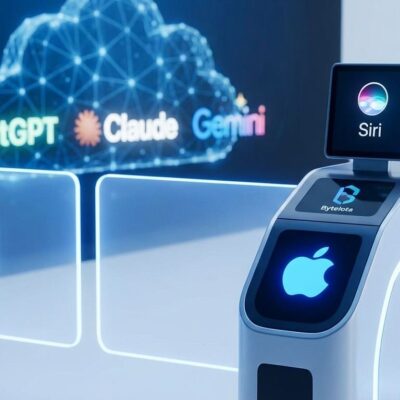
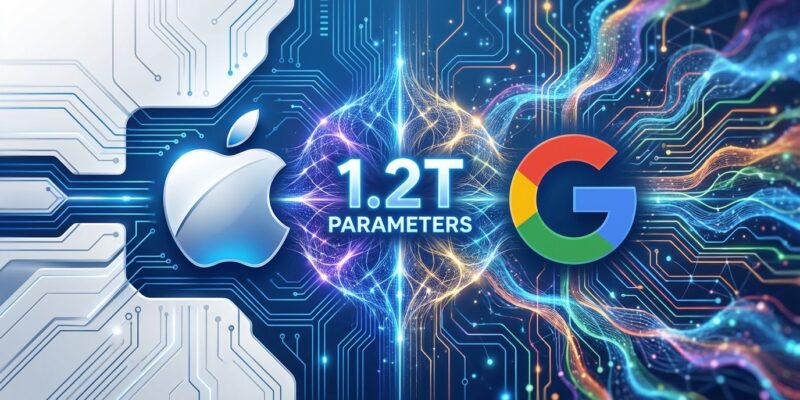
Apple announced on January 12, 2026 that it’s paying Google approximately $1 billion annually to use Google’s 1.2 trillion parameter Gemini AI model to power the next-generation Siri, launching with iOS 26.4 in March 2026. This marks the first time Apple has outsourced a core intelligence capability to a direct competitor.
The Strategic Admission
Apple’s 150 billion parameter cloud model couldn’t compete with Google’s 1.2 trillion parameter Gemini—an eight-fold difference. According to Bloomberg, this partnership comes after multiple Siri AI delays: Fall 2024 to Spring 2025 to May 2025 to March 2026. Apple cited “performance issues” and “engineering challenges.”
Apple chose to pay a competitor $1 billion per year rather than continue delaying. That’s a strategic admission: building competitive LLMs requires infrastructure and timeline Apple doesn’t have. For iOS developers, this raises a question: you’re now building on Google-trained models. What happens when Apple switches to its in-house 1 trillion parameter model in 2027?
Split-Brain Architecture Raises Privacy Questions
The technical architecture is complex. Apple trains models on Google Cloud TPUs—8,192 TPUv4 chips for the server model. But inference runs on Apple’s Private Cloud Compute, not Google’s servers.
The three-tier system: On-device processing (60% of tasks) using Apple’s 3B parameter models. Private Cloud Compute for complex requests. Gemini integration for “world knowledge” queries—all running on Apple’s infrastructure.
Apple claims data is anonymized, IPs masked, and the contract forbids Google from training on Apple traffic. However, the training phase raises questions. If Apple trains on Google Cloud TPUs, what data flows there? The split-brain architecture—Google trains, Apple deploys—creates a trust gap developers need to navigate.
Google separately asks users for permission to train Gemini on personal Gmail and Photos. Apple promises your Siri data stays private even though Google trained the underlying model. Developers are building on Google’s foundation with Apple’s privacy promises.
What This Means for iOS Developers
CoreML and App Intents frameworks will be optimized for Gemini’s reasoning patterns. Developers building “Siri-aware” apps can expect more consistent behavior.
The bigger opportunity is “Agentic Apps”—applications controlled by AI, not just used by humans. Personal context, on-screen awareness, and deeper app integration coming in iOS 26.4 enable multi-step commands that weren’t possible with Apple’s 150B parameter models. Firebase AI Logic SDKs allow direct Gemini API calls from iOS apps.
The uncertainty is timeline. Apple is building a 1 trillion parameter model for 2027. When Apple switches, will apps built around Gemini’s reasoning patterns need refactoring?
Multi-Vendor AI is the New Normal
Apple isn’t alone. Microsoft maintains a 27% stake in OpenAI ($135 billion) while spending $500 million annually on Anthropic. Microsoft uses OpenAI in Office 365, but Anthropic powers specific features in Word and Excel.
No single AI vendor dominates. Industry analysts predict 2026 will be the year Gemini and Grok take real share from OpenAI and Anthropic. Apple’s approach differs: no equity stake, no revenue sharing, and explicitly temporary.
Apple chose speed-to-market over pride. Siri has been embarrassingly behind ChatGPT and Gemini for two years. Getting a competitive assistant to 1+ billion iOS users in March 2026 matters more than preserving the myth that Apple builds everything in-house.
What’s Next
iOS 26.4 launches in March 2026 with Gemini-powered Siri. Expect personal context understanding, on-screen awareness, and multi-step task execution. WWDC 2026 will likely feature developer sessions on “building for the new Siri.”
Apple builds a 1 trillion parameter model for 2027, replacing Gemini. Until then, developers are building on Google’s foundation with Apple’s deployment. The $1 billion question is whether this split-brain architecture can deliver both the intelligence users expect and the privacy Apple promises.