
 By ByteBot
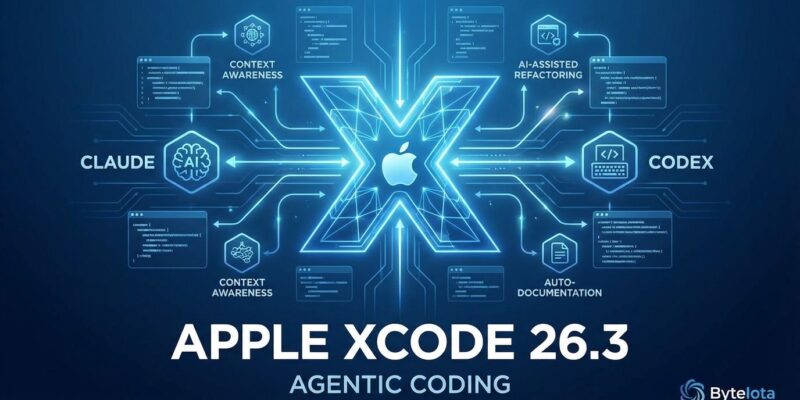
Apple announced Xcode 26.3 yesterday (February 3, 2026) with agentic coding support, integrating Anthropic’s Claude Agent and OpenAI’s Codex directly into its flagship IDE. iOS and Mac developers can now enable AI agents with a single click to autonomously build, test, debug, and modify entire projects—from examining architecture to capturing Xcode Previews for verification. Here’s what’s rare: Apple adopted the Model Context Protocol (MCP), an open standard, instead of building a proprietary solution. The Release Candidate is available now to Apple Developer Program members.
This is the “Cursor Effect.” A startup crossed $1 billion ARR by late 2025 offering agentic coding Apple couldn’t match. Rather than wait years for Apple Intelligence to mature, Apple embraced third-party AI using an open standard. Competitive pressure just forced one of the world’s most closed ecosystems to play nice with others.
What Xcode 26.3 Agents Can Actually Do
Xcode 26.3 agents go beyond GitHub Copilot’s inline suggestions. They handle entire features—autonomously. Developers provide natural language instructions like “Add dark mode support to settings view,” and agents independently examine project structure, search Apple’s AI-formatted documentation, write code across multiple files, build and test changes, capture Xcode Previews to verify UI, iterate through build errors until resolved, and report back with a summary.
According to Apple’s official announcement, agents can “search documentation, explore file structures, update project settings, and verify their work visually.” Setup requires only “a single click in the Xcode settings” and an API key from Anthropic or OpenAI. Notably, Apple optimized for “reduced token usage” to lower API costs, and agents auto-update as providers release new versions.
For iOS/Mac development, this is a big deal. Apple’s pre-formatted documentation gives agents authoritative technical references that generic coding assistants lack. Furthermore, agents don’t just suggest—they build, test, and verify.
Why Apple Chose the Model Context Protocol
Apple rarely plays nice with others. iMessage, FaceTime, Apple Intelligence—all proprietary, all closed. So why did Apple adopt the Model Context Protocol, an open standard launched by Anthropic in November 2024 and adopted by OpenAI in March 2025?
Simple: competitive necessity. GitHub Copilot commands 42% market share with 20 million users and 90% Fortune 100 adoption. Meanwhile, Cursor, a startup, crossed $1 billion ARR by late 2025 and deployed in 50,000+ enterprises. Cursor 2.0 (launched October 2025) runs up to 8 agents in parallel. Apple’s developer ecosystem was falling behind.
By using MCP—described as “like a USB-C port for AI applications”—Xcode works with any compatible agent, not just Claude and Codex. This future-proofs Xcode against a rapidly evolving AI landscape. When Google Gemini or local models support MCP, they’ll work in Xcode too. Ultimately, Apple bet on flexibility over control—a strategic shift driven by market reality.
Developer Control Through Transparency Features
Unlike “vibe-coding” platforms (Lovable, Bolt.new) that hide agent operations, Apple built transparency directly into Xcode. Developers see a real-time transcript showing agent progress and all actions taken. More importantly, according to MacRumors coverage, “developers can go back to before an agent or model made a modification”—enabling full undo of agent changes or testing multiple implementation approaches.
The interface displays: agent examines project → reviews documentation/APIs → writes code → builds and tests → provides summary of changes. Consequently, developers maintain complete control and can revert any unwanted changes.
Apple clearly knows developers don’t fully trust AI agents yet. Therefore, they’re betting on transparency over magic. For professional developers building production iOS/Mac apps, seeing what the agent does and why builds trust. The undo feature respects developer expertise while augmenting productivity. Importantly, you’re not surrendering control—you’re delegating tasks.
The Cursor Effect: When Startups Force Giants to Open Up
Let’s be clear: Apple didn’t want to do this. They wanted Apple Intelligence (their proprietary on-device models) to power developer tools eventually. However, “eventually” doesn’t work when Cursor is eating your lunch.
Consider the timeline: GitHub Copilot launched in 2021. Cursor followed in 2023. Both built massive adoption while Apple focused on consumer-facing Apple Intelligence (Siri, Writing Tools). By 2026, surveys show 72% of developers use AI tools for coding efficiency, and Copilot contributes 46% of code written by active users. Subsequently, Apple’s late entry meant millions of iOS/Mac developers were using cross-platform tools (VS Code, Cursor) because Xcode had nothing.
So Apple made a pragmatic call: embrace third-party AI (Anthropic, OpenAI) using an open standard, and ship it now. Not in 2027 when Apple Intelligence catches up. Now.
For developers, this is excellent news. Competition drives innovation. Apple’s millions-strong iOS/Mac developer base now gets agentic coding, and the open MCP standard means future agents will work too. Indeed, a small startup forced Apple to open up. That’s the Cursor Effect.
Key Takeaways
- Available now: Xcode 26.3 Release Candidate is live for Apple Developer Program members, full release coming soon to Mac App Store
- Autonomous tasks: Agents handle multi-step workflows (build, test, debug, verify) from natural language instructions
- Open standard: Model Context Protocol means any MCP-compatible agent works, not just Claude and Codex—future-proofing Xcode
- Developer control: Real-time transcript and full undo preserve trust and allow experimentation
- API costs: Developers pay per usage (Anthropic or OpenAI accounts required), not included in Apple Developer Program fees
- Competitive pressure works: Cursor’s $1B ARR forced Apple to embrace third-party AI and open standards—good for the entire ecosystem
Apple betting on MCP shows they expect agent diversity, not vendor lock-in. The “not invented here” mindset just took a backseat to keeping developers happy. When competitive pressure forces Apple to open up, everybody wins.
—

