 By ByteBot
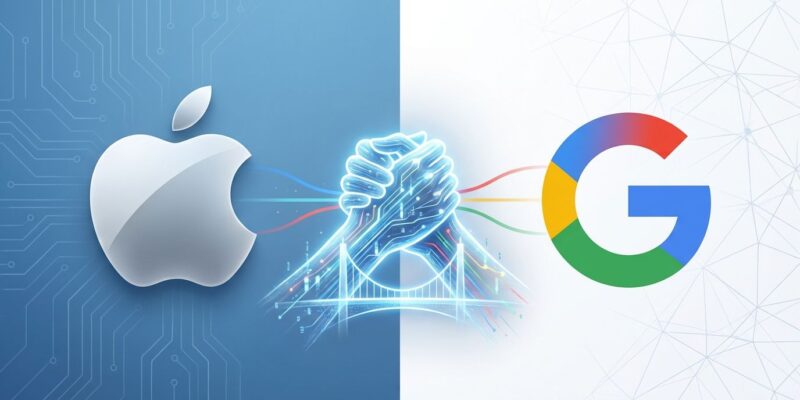
Apple and Google announced a multi-year partnership on Sunday, January 12, 2026, making Google Gemini the foundation for next-generation Siri and Apple Intelligence features. Moreover, the deal—worth approximately $1 billion per year—involves a custom 1.2 trillion parameter Gemini model, 8x larger than Apple’s current models. The partnership follows an 18-month delay after internal testing revealed Siri 2.0 had a 33% failure rate: one in three requests failed.
This isn’t a strategic alliance. It’s Apple admitting it can’t build competitive AI despite spending over $10 billion. For developers, the implications are stark—building on Apple Intelligence now means building on Google + OpenAI infrastructure, not Apple’s own AI.
One in Three Requests Failed
Internal testing of Siri 2.0 revealed the kind of failure rate that ends careers: 33%. One in every three requests failed. According to Bloomberg, Apple VP Craig Federighi expressed frustration that nearly one-third of features failed during internal tests, a failure rate too risky to ship to millions of users.
Apple’s engineers struggled merging legacy Siri architecture with new AI features, watching error rates climb to “around 33 percent.” Consequently, that’s not a bug—it’s a fundamental architectural failure. Apple initially planned to launch Siri 2.0 in iOS 18.4 (March 2025). After the testing disaster, they delayed to iOS 26.4 (March/April 2026)—18 months late.
The 33% failure rate explains why Apple turned to Google. Furthermore, this wasn’t about choosing “best of breed” AI or strategic flexibility. It was necessity: Apple couldn’t deliver working AI, so they outsourced the core intelligence layer to their biggest competitor.
8x Bigger: From 150 Billion to 1.2 Trillion Parameters
Google is building a custom 1.2 trillion parameter Gemini model exclusively for Apple. To understand the scale: Apple’s current Intelligence models use 150 billion parameters. Therefore, the custom Gemini model is 8x larger. That jump reveals how far behind Apple was—and why their models kept failing.
The technical architecture runs on Google Cloud infrastructure but processes through Apple’s Private Cloud Compute to maintain privacy claims. Apple pays approximately $1 billion annually for access, according to TechCrunch. Additionally, the deal is non-exclusive—Apple also partners with OpenAI for ChatGPT integration—suggesting Apple is hedging its bets rather than committing fully to either provider.
Launch target: spring 2026 (iOS 26.4, March or April). If Apple hits that timeline, Siri will finally have capabilities matching Google Assistant and Alexa. However, the catch: it’s powered by Google, not Apple.
Developer Reality: Building on Google + OpenAI Infrastructure
Building on Apple Intelligence in 2026 means building on two external AI providers, not Apple’s proprietary technology. Specifically, Google Gemini powers Siri’s core: summarization, planning, context understanding, and multi-turn conversations. OpenAI ChatGPT handles user-facing conversational queries. Meanwhile, Apple provides on-device processing for simple tasks and the Private Cloud Compute privacy layer.
For iOS developers using SiriKit and App Intents, requests now route through Gemini’s LLM backend. In other words, if you’re integrating AI features into apps, you’re depending on Apple’s relationships with Google and OpenAI remaining functional. If either partnership sours, Apple Intelligence breaks.
This is unprecedented for Apple’s usually self-reliant ecosystem. The company that built its own chips, operating systems, and cloud infrastructure now depends on competitors for its core intelligence layer. The partnership extends beyond Siri—Gemini will power broader Apple Intelligence features including personal context and on-screen awareness when they finally ship.
$10 Billion Spent, Years Behind Competitors
Apple spent $10 billion chasing AI plus $5 billion annually across 30 acquisitions. Nevertheless, the result: Apple “remains years behind its competition,” according to Computerworld. The leadership toll was severe: AI chief John Giannandrea announced retirement in December 2025, and Apple Intelligence executive Ruoming Pang left for Meta’s Superintelligence Labs.
The investment gap tells the story. Apple’s 2024 capital expenditures: $9.5 billion (2.4% of revenue). Microsoft spent $80 billion. Amazon spent $100 billion. In fact, Apple was outspent 8-to-10x by competitors, and it shows. Apple became 2025’s worst-performing Big Tech stock, down 15%, while Microsoft, Nvidia, and Meta posted gains.
The failure stems from systemic problems: weak leadership, conflicting priorities, flawed decision-making, and problematic team integration. Furthermore, Apple’s “privacy-first” approach may have hobbled AI development—you can’t train competitive models without massive data, and Apple won’t harvest user data like Google and Meta do. That ethical stance is admirable. It’s also expensive: $1 billion per year to Google, permanently.
Privacy Narrative Challenged: Apple AI on Google Models
Apple’s joint statement with Google insists “Apple Intelligence will continue running on Apple devices and Private Cloud Compute” with “industry-leading privacy standards.” The technical architecture goes: user query → Apple device → Private Cloud Compute → Gemini processing → back to user. Apple maintains data isolation throughout.
However, the optics are brutal. Apple’s brand is privacy. “What happens on your iPhone, stays on your iPhone.” Except now the intelligence processing happens on Google’s AI models and cloud infrastructure, even if Apple controls the data flow. Hacker News discussion (541 comments) focused heavily on this tension: how much data actually flows to Google versus staying on Apple’s infrastructure?
Apple is betting Private Cloud Compute provides sufficient isolation. Ultimately, trust now depends on believing Apple’s architecture prevents Google from accessing user data, despite Google’s models doing the actual AI processing. It’s technically feasible. Whether it’s sufficient for Apple’s brand promise is a different question.
Key Takeaways
Apple’s 33% Siri failure rate forced the Google partnership—this was necessity, not strategy. The $1 billion annual deal brings a custom 1.2 trillion parameter Gemini model, 8x larger than Apple’s inadequate 150 billion parameter models. Consequently, iOS developers now build on Google + OpenAI infrastructure, not Apple’s proprietary AI.
The context matters: $10 billion in AI investment failed due to underinvestment (8-10x less than Microsoft/Amazon), leadership departures, and systemic dysfunction. Spring 2026 launch (iOS 26.4) marks an 18-month delay, and even then, Apple depends on external providers for core intelligence.
The question isn’t whether Apple made the right call partnering with Google—they had no choice after the 33% failure rate. Rather, the question is whether this $1 billion annual payment is Apple’s permanent future or a very expensive Band-Aid while they rebuild internally. Either way, Apple’s AI independence is over.