 By ByteBot
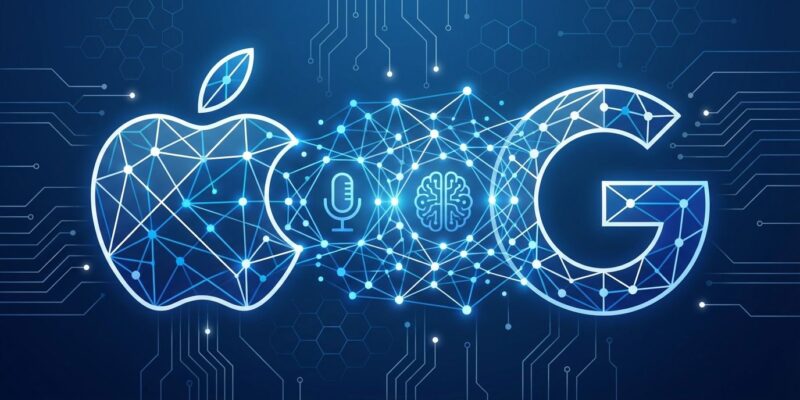
Apple announced yesterday that Google Gemini will power the next generation of Siri, launching spring 2026. The multi-year partnership marks a striking reversal for Apple’s “privacy champion” positioning—after spending over $20 billion on in-house AI development over five years, Cupertino admitted it can’t build competitive foundational models alone. The deal costs Apple approximately $1 billion annually and affects 1.56 billion iPhone users worldwide who’ve come to expect privacy from Apple, not Google.
The Privacy Contradiction Nobody’s Talking About
Apple built its brand on privacy. “What happens on your iPhone, stays on your iPhone.” Private Cloud Compute promises “no one can access your data, not even Apple.” Yet Siri’s advanced intelligence now runs on Google Gemini—models trained and served from Google Cloud infrastructure.
Apple insists its Private Cloud Compute architecture maintains privacy through stateless computation, no data retention, and verifiable transparency. However, the fundamental question remains: Can you trust “privacy” when Google powers the AI? Users on Hacker News (230 comments and counting) are asking the same thing. One skeptical commenter wrote: “Keep google hands off my data. no thanks.” Another asked: “How will Apple maintain privacy with Google backend?”
The reality is that privacy-first AI couldn’t compete at scale. Apple spent five years and $20+ billion trying to prove otherwise. They failed. Moreover, 1.56 billion users with privacy expectations are about to rely on Google’s cloud infrastructure, Apple’s carefully worded privacy guarantees notwithstanding.
This Is What a $20 Billion AI Failure Looks Like
The partnership reveals the brutal economics of frontier AI development. Apple invested an estimated $20 billion in AI over the past five years, spends roughly $30 billion annually on AI R&D, and acquired 20 AI-related companies for over $3 billion. Despite this massive spending, Apple’s in-house models lost to year-old GPT-4o in blind user tests. Furthermore, Siri’s promised AI upgrade missed its March 2025 launch, then delayed repeatedly throughout the year.
The $1 billion annual payment to Google is cheaper than continuing failed internal development. It’s also significantly less than Anthropic’s rejected demand of $1.5 billion per year for its technically superior Claude models. Consequently, Apple found Anthropic’s technology more impressive but couldn’t justify the premium when Google—already receiving $20 billion annually for default search placement—offered a more economical package deal.
Wedbush analyst Dan Ives called it “what the Street has been waiting for,” addressing the “elephant in the room” of Apple’s “invisible AI strategy.” Wall Street sees it as pragmatic. Nevertheless, it also signals strategic dependency on a competitor. Apple’s AI team, despite internal turnover and leadership challenges, becomes less relevant when the company outsources its foundational models.
Market Consolidation: Google, OpenAI, Anthropic Win Distribution
The partnership confirms what the AI market already suspected: distribution belongs to those with existing platform control. Google gains 1.56 billion iOS users for Gemini. OpenAI has ChatGPT integration across Apple and Microsoft ecosystems. Meanwhile, Anthropic, despite losing this deal, maintains partnerships with Amazon and enterprise customers.
Smaller AI model providers have no path to consumers. You can build the most efficient model, the fastest inference engine, or the most novel architecture—but without distribution through Apple, Google, Microsoft, or Amazon, you’re invisible to end users. The barrier to entry isn’t building competitive models anymore. Rather, it’s securing partnerships with the big five tech companies who control every major consumer platform.
This reduces competition and innovation. A three-player market (Google/OpenAI/Anthropic) is less dynamic than a dozen startups pushing boundaries. Apple initially considered OpenAI for the Siri partnership but rejected it for strategic reasons. Anthropic wanted too much money. Google won because of an existing $20 billion relationship and competitive pricing, not because Gemini was technically superior to all alternatives.
What Developers Should Know
Gemini 3 Pro brings legitimate capability improvements. The model tops the LMArena Leaderboard with a 1501 Elo score, achieves 74.2% on LiveCodeBench coding challenges, and outputs at 250+ tokens per second. Additionally, it handles 3-hour video inputs and maintains 87% accuracy at 128K token contexts. For developers building on SiriKit, this means better natural language understanding, enhanced multimodal capabilities, and improved context retention.
However, it also raises questions. Will existing SiriKit integrations maintain backward compatibility? What user data flows to Google servers despite Apple’s privacy claims? How reliable will Gemini-powered APIs be for production applications? Similarly, Apple’s developer documentation will need updates before the spring 2026 launch.
The good news: enhanced Siri capabilities unlock better app integrations. The bad news: developers now depend on Google’s infrastructure reliability and Apple’s ability to manage a third-party AI backend without breaking existing implementations.
Key Takeaways
- Apple’s “privacy champion” positioning couldn’t survive contact with cloud AI reality—after $20 billion and five years of trying, Cupertino admitted it needs Google’s help
- The $1 billion annual cost is cheaper than continued failure, but creates strategic dependency on a competitor and undermines Apple’s privacy marketing
- The market is consolidating fast: Google, OpenAI, and Anthropic control distribution through partnerships with Apple, Microsoft, and Amazon while smaller AI providers are squeezed out
- For developers, Gemini-powered Siri APIs arrive spring 2026 with better capabilities but new questions about compatibility, privacy, and reliability
- The privacy-first AI dream is dead—Apple proved you can’t build it at competitive scale, even with unlimited resources
Apple proved you can’t build privacy-first AI at competitive scale, even with unlimited resources. Welcome to the cloud AI era, where privacy is marketing and infrastructure is reality.