
 By ByteBot
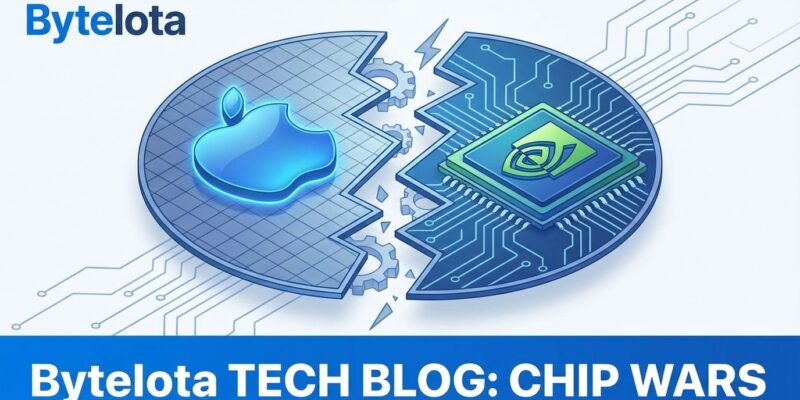
Apple is no longer TSMC’s priority customer. After 15 years of dominance, Apple now competes for manufacturing capacity and pays premium prices as Nvidia overtook Apple as TSMC’s largest customer in 2025. TSMC CEO CC Wei personally visited Apple’s Cupertino headquarters last August to deliver unwelcome news: the company would face “the largest price rise in years” and could no longer count on guaranteed capacity access.
Nvidia Overtakes Apple as TSMC’s Top Customer
The numbers tell the story. Nvidia’s fiscal year growth through January 2026 hit 62%, while Apple’s product revenue grew just 3.6% over the same period. TSMC’s revenue climbed 36% to $122 billion in 2025, driven almost entirely by high-performance computing—AI chips—which surged 48% following 58% growth the prior year. Meanwhile, smartphone revenue grew only 11%, down from 23% previously.
Nvidia is projected to hold roughly 20% of TSMC’s revenue share in 2026, compared to Apple’s 16%. TSMC CFO Wendell Huang declined to confirm specific customer rankings, but the revenue trajectory makes the shift undeniable. Apple’s era of privileged status is over.
Why One Nvidia GPU Displaces Six iPhones
It’s not just revenue—it’s physics. A single Nvidia Blackwell or Rubin GPU die occupies 800+ square millimeters of silicon. Apple’s A20 chip, by comparison, is estimated at 100-120mm². That’s a 6-to-8x difference in physical wafer consumption. When TSMC allocates a 2nm wafer to Nvidia, they’re choosing one GPU over six to eight iPhone chips.
This creates zero-sum capacity competition. TSMC’s 2nm production reached 50,000+ wafers per month in January 2026 and aims for 120,000-140,000 by year-end—but all capacity is already sold out. Nvidia’s willingness to pay premium prices for immature nodes means they can outbid Apple regardless of volume. Apple can’t simply buy more capacity. There is none.
Apple Pays Premium Prices, Loses Priority Status
TSMC’s 2nm process commands a 50% price premium over 3nm, with wafer costs estimated around $30,000. CEO Wei’s August visit wasn’t a courtesy call—it was a reality check. Apple accepted the “largest price rise in years” because they had no choice. TSMC achieved a 62.3% gross margin in Q4 2025, approaching software company levels and up 280 basis points from the previous quarter.
Higher chip costs mean higher iPhone and Mac pricing or compressed margins. Apple historically negotiated favorable pricing through early node adoption and massive volume commitments. Those privileges are gone. TSMC now operates capacity allocation like an auction: highest bidder wins, customer loyalty be damned.
Apple Diversifies to Intel’s 18A Process
Apple isn’t sitting idle. The company announced a foundry partnership with Intel in mid-January 2026 to manufacture entry-level M-series chips on Intel’s 18A process starting in 2027. This marks Apple’s first major diversification away from exclusive TSMC reliance in 15 years.
Intel’s 18A (1.8nm-class) process was validated with the “Panther Lake” launch at CES 2026. Apple expects to ship 15-20 million chips annually for MacBook Air and iPad Pro-tier products, with first units arriving early-to-mid 2027. High-end chips—A-series Pro and M-series Pro/Max—likely remain with TSMC, but diversifying entry-level products provides insurance against capacity constraints and geopolitical risks. Intel’s U.S.-based facilities also align with CHIPS Act incentives.
It’s a risky bet. Intel’s 18A remains unproven at Apple’s scale. But the alternative—complete TSMC dependency while Nvidia consumes capacity—is riskier.
AI Infrastructure Trumps Consumer Devices
This isn’t a temporary blip. TSMC projects 55%+ annual growth for AI segments through 2029, compared to low-single-digit growth for smartphone chips. The company is investing $52-56 billion in capital expenditure for 2026, a 32% year-over-year increase. New process nodes launching in H2 2026—N2P and A16—favor AI applications.
Apple’s “anchor tenant” status won’t protect it when margins and growth diverge this dramatically. Consumer electronics companies now compete with AI infrastructure leaders for foundry capacity, and the economics aren’t close. AI wins: higher margins, faster growth, larger chips, premium pricing. This is the new semiconductor hierarchy.
Key Takeaways
- Nvidia overtook Apple as TSMC’s largest customer in 2025, projected to hold 20% revenue share vs Apple’s 16% in 2026
- Physical capacity crunch: One Nvidia GPU consumes 6-8x more wafer space than an Apple chip, creating zero-sum competition
- Apple faces “largest price rise in years” with 2nm wafers costing 50% more than 3nm ($30,000 per wafer)
- Apple is diversifying to Intel’s 18A process for entry-level Macs and iPads starting 2027
- TSMC projects AI segment growth at 55%+ annually through 2029, permanently shifting industry priorities toward AI infrastructure over consumer devices



[…] now accounts for roughly 20% of the foundry’s revenue, a shift captured in the framing of Apple Loses TSMC and Nvidia Takes Share. That same analysis notes that Nvidia’s fiscal year growth through […]