 By ByteBot
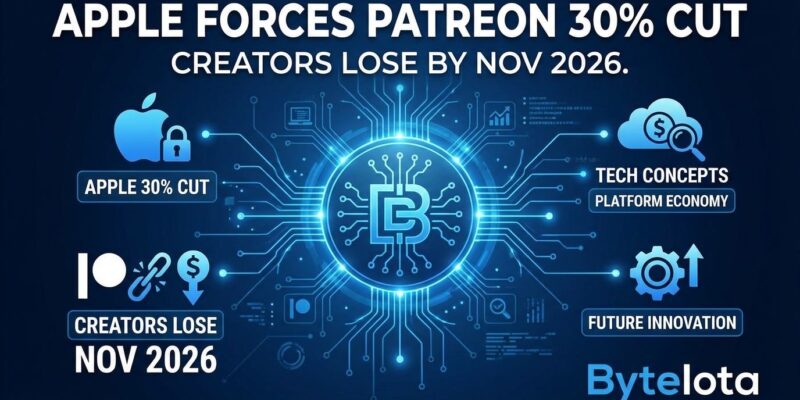
Apple set a hard deadline yesterday—November 1, 2026—for all Patreon creators to switch to Apple’s in-app purchase system, imposing a 30% commission (dropping to 15% after one year) on all iOS app transactions. The announcement, reported January 28, affects over 250,000 active creators and 8 million monthly paying patrons. Creators face a stark choice: absorb the 30% revenue cut, raise iOS prices by 45-50%, or push patrons to subscribe through Patreon’s website instead.
This isn’t just about Patreon. It’s Apple extending commission enforcement from traditional digital goods to creator-fan relationships—a new frontier in the App Store monopoly debate.
The 30% Commission Hits Harder Than It Sounds
A creator earning $5,000 monthly from 1,000 patrons at $5 each currently takes home $4,400 after Patreon’s 12% fee. However, under Apple’s mandate, that drops to $3,080 in year one—a 30% revenue loss, or $1,320 per month, $15,840 annually.
The double-fee structure amplifies the pain. iOS subscriptions flow through Apple (30%) then Patreon (5-12%), leaving creators with 58-65% of iOS subscription revenue compared to 88-95% for web subscriptions. Moreover, if 35% of a creator’s patrons use iOS, that’s a 10.5% total revenue hit assuming uniform pricing across platforms.
For creators with iOS-heavy audiences—podcasters, app developers, Apple ecosystem content creators—the impact is devastating. Thousands in lost annual income or forcing price increases that drive away supporters.
Three Choices: Absorb, Raise, or Redirect
Patreon gives creators three options, none ideal. First, raise iOS prices 45-50% higher than web to offset both Apple’s 30% and Patreon’s fee. A $10 web membership becomes $14.50 on iOS. Consequently, creators maintain revenue per patron but risk price shock driving cancellations.
Second, absorb the 30% fee and keep pricing consistent. Simple, no confusion, but creators eat significant revenue loss—potentially 10-30% of total income if their audience skews iOS.
Third, push patrons to web subscriptions that bypass Apple’s cut entirely. The catch? App Store anti-steering rules prohibit Patreon from telling iOS users about cheaper web alternatives inside the app. Therefore, creators must communicate externally—email, social media, YouTube videos—to drive patron migration.
Spotify successfully rolled out direct payment links in its iOS app in May 2025 after Epic Games’ court victory, but Patreon hasn’t secured similar approval. The information asymmetry is stark: Patreon can’t even explain to iOS users why prices are higher.
From Digital Goods to Creator Relationships
Apple’s enforcement extends beyond games, apps, and media subscriptions to recurring patronage that funds independent creators. Furthermore, this follows years of legal battles with Epic Games and Spotify, but marks a philosophical expansion: taxing creator-fan relationships, not product sales.
Tim Sweeney, Epic Games CEO, framed it bluntly in August 2024 on Hacker News: “Now Apple is demanding a 30% cut of all Patreon DONATIONS. This is fundamentally different from digital goods—it’s a creator-fan relationship, not a product sale.”
Epic’s lawsuit forced Apple to allow external payment links, yet Apple still collects a 27% commission on those external transactions. The November 2025 Patreon deadline was paused in May 2025 after creator backlash. Apple reimposed it nine months later, suggesting sustained enforcement despite resistance.
This sets precedent. If Apple succeeds with Patreon, every creator platform—Substack, Ko-fi, Buy Me a Coffee—faces identical mandates. The $290 billion creator economy becomes an extractable revenue stream for platform gatekeepers.
Why EU Creators Pay 5-13% While US Pays 30%
European creators benefit from the Digital Markets Act (DMA), which forced Apple to reduce fees to 5-13% for alternative payment systems by June 2025. Meanwhile, the November 2026 Patreon deadline applies to US and non-EU markets, creating a two-tiered system where identical creators pay radically different commissions based on geography.
RevenueCat’s June 2025 analysis details Apple’s EU business model: 2% initial acquisition + 5-13% Store Services + 5% Core Technology Commission. Meanwhile, US creators face the full 30% (year 1) or 15% (year 2+) commission.
The disparity is stark evidence of regulatory arbitrage. The same company charges 5-13% in the EU and 30% in the US because the EU has enforcement teeth. In fact, it’s fuel for “we need a US Digital Markets Act” arguments and a reminder that monopoly pricing is negotiable—when governments force the negotiation.
Key Takeaways
- November 1, 2026 is a hard deadline—creators must switch to in-app purchases or be auto-migrated
- Web subscriptions bypass Apple’s 30% cut, but anti-steering rules prohibit in-app promotion of this option
- Creators lose 30-45% more revenue on iOS than web due to double-fee structure (Apple + Patreon)
- EU creators pay 5-13% due to DMA enforcement; US creators face full 30%—same platform, different rules
- This sets precedent for Apple taxing the entire creator economy, not just Patreon
The creator economy is worth $290 billion in 2026, projected to hit $528 billion by 2030. Consequently, Apple is positioning itself as gatekeeper to extract hundreds of millions annually from platforms like Patreon, Substack, and beyond. For developers building creator tools, factor in the 30% iOS tax from day one—or build web-only and skip App Store distribution entirely.