 By ByteBot
Antigravity has debuted at #1 in LogRocket’s December 2025 AI development tool power rankings with a capability no competitor offers: multi-agent orchestration. While GitHub Copilot, Cursor, and Windsurf rely on single AI models handling everything from code generation to debugging, Antigravity deploys multiple specialized agents working together on complex development tasks. The disruption? It’s completely free during preview, undercutting competitors charging $10-120 per year.
Multi-Agent Orchestration Changes the Game
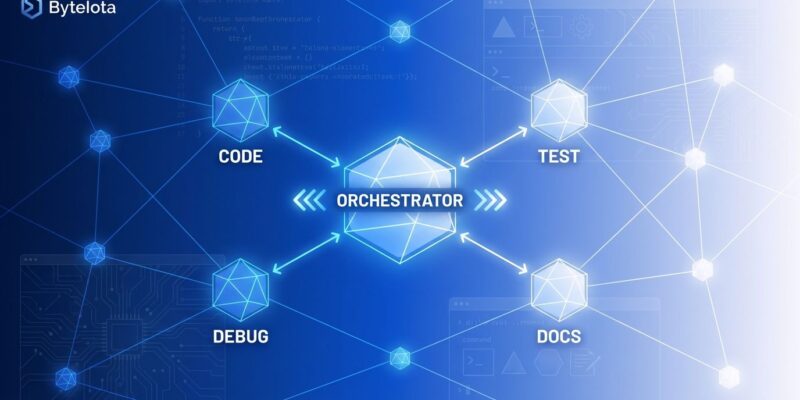
Here’s what sets Antigravity apart: instead of a single AI model juggling code generation, testing, debugging, and documentation, it uses specialized agents for each task. An orchestrator agent breaks complex requests into subtasks and delegates to the right specialists. One agent writes code. Another reviews it for bugs and security issues. A third generates tests. A fourth handles documentation.
This isn’t incremental improvement over existing tools. It’s a different architectural approach that solves the core limitation of single-agent systems: they struggle with complex, multi-step workflows that require different types of expertise. When you ask Copilot or Cursor to build a feature end-to-end with tests and docs, you’re asking one model to context-switch between vastly different tasks. Antigravity’s agents stay focused on what they do best, and they verify each other’s work.
Technical Stack: Models, Automation, and Integration
Antigravity supports Gemini 3 Pro, Claude Sonnet 4.5, Claude Opus 4.5, and GPT-OSS models, giving developers flexibility without vendor lock-in. The tool includes Chrome browser automation for autonomous testing—aligning with Google’s recent Chrome DevTools Model Context Protocol public preview. Built on VS Code, it offers a familiar environment plus live preview, design-to-code conversion, and 3D graphics support.
The browser automation is particularly noteworthy. AI coding assistants have historically operated blind: they generate code but can’t see what it does in a browser. Antigravity’s Chrome integration means agents can navigate pages, fill forms, and validate UI behavior autonomously. This eliminates manual testing loops that slow development.
Competitive Landscape: Single Agents Everywhere Else
Windsurf, which ranks well for Git integration and collaborative editing, still uses a single-agent approach. Cursor, the AI-first editor built as a VS Code fork, relies on one model. GitHub Copilot, the market leader at roughly $10 per month, focuses on code completion with a single agent. Wave 11’s recent voice interaction update is compelling, but it’s still one model listening and responding.
Antigravity is the only tool in LogRocket’s December 2025 rankings offering multi-agent orchestration. That’s either first-mover advantage or a bet that the market wants complexity tools can’t currently handle. Given that OpenAI, Anthropic, and Google just formed the Agentic AI Foundation, multi-agent approaches look less like experimentation and more like the industry’s next evolution.
The Free Preview Gambit
Antigravity is free during its preview period. This matters because the AI dev tool market has been consolidating around paid models. VS Code recently killed its free IntelliCode feature and moved AI assistance to a $120-per-year paid tier. GitHub Copilot charges $10 monthly. Premium tools hit $120 annually. Antigravity is betting on market share over immediate monetization.
The “preview period” qualifier is worth noting. This isn’t permanent free access. It’s a land-grab strategy: get developers hooked on multi-agent workflows, build dependency, monetize later. Smart play, but developers should extract value while it lasts and have migration plans when pricing arrives.
What This Signals About AI Dev Tools
Multi-agent orchestration isn’t just Antigravity’s differentiator. It’s a signal that basic code autocomplete isn’t enough anymore. Developer expectations have risen. We need tools that handle complex workflows: generate code, write tests, review security, update docs, deploy changes. Single-agent tools make developers break these workflows into separate prompts, losing context and wasting time.
Browser automation becoming standard is another trend indicator. Chrome DevTools MCP, Browser MCP, and now Antigravity all recognize that AI coding assistants need to see what their code does. The blind-coding era is ending.
Should You Try It?
If your current AI coding tool struggles with complex, multi-step tasks, Antigravity is worth evaluating. Multi-agent orchestration handles workflows that overwhelm single-model tools. The free access removes the cost barrier. Just don’t assume free lasts forever—preview periods end, and tools that disrupt pricing eventually need revenue models.
Antigravity represents where AI development tools are heading: specialized agents, integrated testing, comprehensive workflows. Whether it dominates the market or forces competitors to match its capabilities, multi-agent orchestration is about to become table stakes.