 By
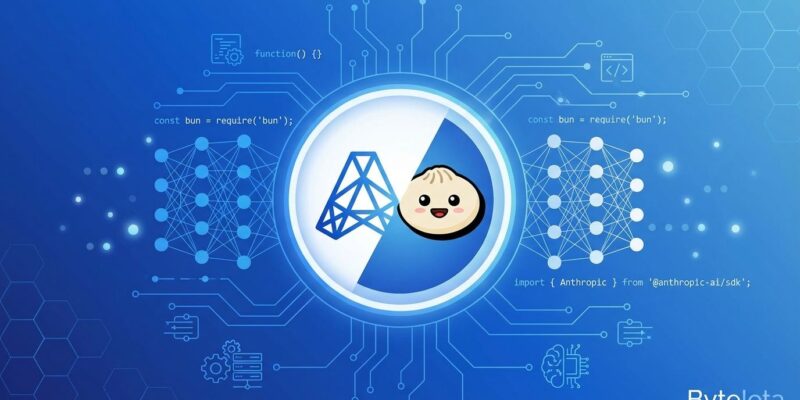
By Anthropic just made its first acquisition, and it’s not another AI model or dataset—it’s Bun, the fast JavaScript runtime powering millions of developers. The move signals a strategic shift: AI companies are no longer content to build tools that sit on top of existing infrastructure. They want to own the foundation.
Why Anthropic Needs Bun
The timing reveals the stakes. In November, Claude Code hit $1 billion in annualized revenue—just six months after launch. That’s the fastest growth in AI coding tools, outpacing even GitHub Copilot’s trajectory. But there’s a dependency: Claude Code ships as a Bun executable to millions of users.
Anthropic’s rationale is blunt: “If Bun breaks, Claude Code breaks.” When your billion-dollar product relies on someone else’s open-source runtime, acquisition starts to look less like ambition and more like insurance. The deal, reportedly valued in the low hundreds of millions, buys Anthropic control over essential infrastructure.
The numbers back the urgency. Claude Code revenue jumped 5.5x between May and August 2025. Enterprise customers like Netflix, Spotify, and KPMG have integrated it into engineering workflows. Bun itself grew 25% month-over-month in October, hitting 7.2 million downloads. Neither side could afford instability.
What Bun Brings to the Table
For developers unfamiliar with Bun: it’s an all-in-one JavaScript runtime that combines what Node.js spreads across multiple tools. Runtime, package manager, bundler, and test runner in a single binary. Written in Zig and powered by JavaScriptCore (Safari’s engine), it’s built for speed.
The performance claims are real. Bun handles roughly 52,000 HTTP requests per second compared to Node.js’s 13,000—a 4x advantage. Package installation runs 10x faster than npm in large repositories. Startup time drops from five seconds in Node to under two in Bun. For AI coding tools generating and testing code at scale, that speed compounds.
Founded in 2021 by Jarred Sumner, Bun raised $26 million in VC funding while generating zero revenue. It’s a classic infrastructure play: build something developers need, worry about monetization later. Anthropic just provided the exit.
What This Means for Developers
Anthropic promises Bun will remain open-source under its MIT license, with the same team continuing development. That’s the official line. The question is whether “open source” retains its meaning when an AI company controls the roadmap.
The upside is clear. Bun now has the funding and strategic backing to accelerate. AI-powered debugging, automatic optimization, tighter integration with Claude Code—these features become plausible with Anthropic’s resources. Developers already using Bun get a faster, better-funded runtime.
The downside is vendor lock-in. If Bun evolves primarily to serve Claude Code, does it stay neutral infrastructure or become part of Anthropic’s ecosystem? The AI coding market is fragmenting, and runtimes might fragment with it. Node.js and Deno aren’t standing still.
AI Companies Are Going Down the Stack
This acquisition isn’t isolated. AI companies are moving from building on top of existing tools to owning the tools themselves. The AI Developer Tools Market is projected to grow from $4.5 billion to $10 billion by 2030, with coding tools accounting for 55% of departmental AI spend—$4 billion annually.
The pattern is visible across the industry. AMD acquired Silo AI. Snyk bought DeepCode. Adobe purchased Rephrase.ai. AI companies are integrating vertically, controlling more of the stack. Anthropic’s move just happens to target a layer closer to the metal: the runtime itself.
Bun founder Jarred Sumner sees it clearly. In a recent interview, he predicted “a future where programming languages are designed for language models instead of language models adapting to existing programming languages.” That’s not a minor adjustment. It’s a redefinition of what code is for.
What Gets Acquired Next?
If runtimes are strategic, what else is on the acquisition list? Build tools like Vite or Webpack? Testing frameworks like Playwright? CI/CD platforms? Package registries themselves?
The logic is straightforward: AI coding tools need fast, reliable infrastructure. Owning that infrastructure removes dependencies and enables optimization that third parties won’t prioritize. Every layer of the stack is potentially strategic.
For developers, this raises an uncomfortable question. When AI companies own the runtimes, package managers, and build tools, does the term “open source” still carry weight? Or does it become a license technicality while control concentrates?
The New Phase
Anthropic’s acquisition of Bun marks phase two of AI in software development. Phase one was AI-assisted coding—Copilot, Claude Code, Cursor—tools that sit alongside developers. Phase two is AI companies owning the infrastructure developers rely on.
Bun staying open source is important, but it doesn’t change the trend. AI companies are no longer content to be assistants. They’re building—or buying—the foundation. Developers should pay attention to what gets acquired next, because the stack is being redrawn with AI at the center, not the edge.