 By ByteBot
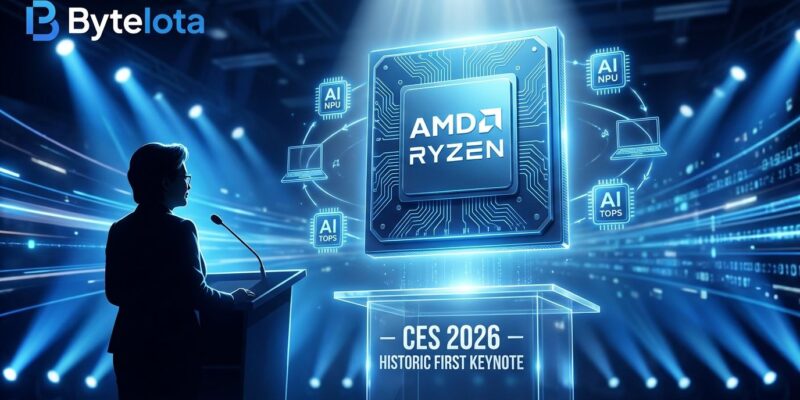
AMD CEO Dr. Lisa Su made history on January 5, 2026, delivering AMD’s first official keynote at CES in Las Vegas. Su opened the show with a bold declaration: “AI is the most important technology of the last 50 years.” She unveiled the Ryzen AI 400 Series processors featuring up to 60 NPU TOPS, 12 Zen 5 cores at 5.2 GHz, and claims of 70% better battery efficiency than Intel’s competing chips. The announcement came just days after Intel launched its Panther Lake processors, setting up an intense CPU battle for 2026.
AMD’s Historic CES Moment
This was AMD’s first official keynote at CES in the event’s 58-year history. Su opened CES 2026 on January 5, delivering the first official day keynote slot—a position typically reserved for industry titans like Intel, Samsung, and Nvidia. The keynote, titled “AI Everywhere, For Everyone,” featured high-profile guests from OpenAI, Luma AI, Liquid AI, and World Labs, plus White House OSTP Director Michael Kratsios.
OpenAI President Greg Brockman warned that “truly universal AI would require billions of GPUs—far beyond today’s infrastructure,” highlighting the compute shortage driving AMD’s AI PC push. AMD doubled down with a $150 million commitment to bring AI into classrooms and communities, plus partnerships with the White House Genesis Mission, deploying AMD-powered AI supercomputers at Oak Ridge National Laboratory.
This keynote marks AMD’s journey from near-bankruptcy in 2015 to the CES stage in 2026. It’s not just about new chips—it signals AMD’s transformation from “Intel alternative” to AI PC leader. For developers, it shows AMD’s commitment to AI tools, not just hardware specs.
Ryzen AI 400 Specs: What You Get
The Ryzen AI 400 Series features up to 60 NPU TOPS on the flagship Ryzen AI 9 HX 475, with 12 Zen 5 CPU cores at up to 5.2 GHz boost clocks and Radeon 880M integrated graphics. AMD claims 24-hour battery life on lower-tier models. The 60 TOPS rating is 50% higher than Microsoft’s Copilot+ PC minimum and 20% higher than the previous Ryzen AI 300 Series.
AMD’s performance claims against Intel Core Ultra 9 288V are aggressive: 30% better multitasking, 70% faster content creation, 70% better battery efficiency, and 12% higher gaming FPS at 1080p. However, critics like PCWorld called it a “minor refresh”—the GPU is identical to Ryzen AI 300, and the architecture is mostly a clock bump rather than a revolutionary leap.
Systems ship Q1 2026 from Dell, HP, Lenovo, ASUS, and Acer, with over 120 OEM designs throughout the year. Desktop variants arrive Q2 2026, marking AMD’s first Copilot+ desktop CPUs. The 60 TOPS NPU enables on-device AI features without cloud dependency: Copilot+ features, local LLM inference, and AI-assisted development. For developers, ROCm 7.2 support brings official Windows and Linux compatibility for local model training and inference.
AMD vs Intel: The 2026 CPU War Heats Up
AMD’s announcement came just days after Intel launched Panther Lake at the same CES. Intel’s chips are built on the 18A process—Intel’s most advanced node, manufactured in the US—and claim 77% better gaming performance and 80% better graphics than AMD HX 370. The strategies diverge sharply: AMD targets developers and content creators with multitasking and battery life, while Intel focuses on gaming and graphics.
Leaked Geekbench scores show AMD Ryzen AI 9 465 ahead of Intel Core Ultra 7 365: 13% single-core advantage, 24% multi-core advantage. However, Intel counters with NPU optimization claims—4.3x faster LLM inference despite a lower 50 TOPS rating. These are pre-release marketing claims from both sides, so independent reviews will determine the real winner.
Related: Nvidia Cosmos & GR00T: Is This the ChatGPT Moment for Robotics?
This is the most competitive x86 CPU battle in years. Developers must choose: AMD for multitasking, battery, and AI, or Intel for gaming, 18A, and NPU optimization. The competition benefits consumers with more OEM choices and better pricing. One Tom’s Hardware commenter captured community skepticism: “AI 400 series: Yawn. Boring. Minor refresh of AI 300 series, with exact same 890M/880M iGPU. Hopefully they’re cheaper because the lineup pales quite badly compared to Intel’s Panther Lake.”
What This Means for Developers
Ryzen AI 400 brings practical AI development tools: ROCm 7.2 software stack for Windows and Linux, 60 TOPS for local LLM inference without cloud costs, and Copilot+ features for AI-assisted coding. For developers needing larger models, AMD announced Ryzen AI Max+ with 128 GB unified memory and 120+ TOPS for the Ryzen AI Halo Developer Platform.
The Ryzen AI 9 HX 475 can run GitHub Copilot with on-device acceleration, perform local LLM inference for testing and debugging, and handle AI-assisted code completion without latency. The 24-hour battery life enables conference travel, remote work, and offline development without battery anxiety. ROCm support means Linux AI developers aren’t locked into CUDA.
This shifts AI development from cloud-dependent to local-first. Developers save on cloud inference costs by running models locally. Privacy-sensitive work—enterprise code, proprietary data—stays on-device. However, the “minor refresh” criticism sticks: the GPU is unchanged, and architectural improvements are incremental. For developers who already own Ryzen AI 300, there’s little reason to upgrade. Wait for next-generation chips or opt for Ryzen AI Max+ if you need serious on-device AI horsepower.
Key Takeaways
- AMD’s first CES keynote marks transformation from underdog to AI PC leader, signaling industry recognition and commitment to AI compute beyond data centers
- Ryzen AI 400 delivers 60 TOPS, 12 Zen 5 cores, and 24-hour battery life, shipping Q1 2026 from Dell, HP, Lenovo, and ASUS with 120+ OEM designs throughout the year
- Direct Intel competition intensifies: AMD focuses on multitasking and battery efficiency (30% and 70% advantages), Intel targets gaming and graphics (77% and 80% claimed advantages)
- ROCm 7.2 support enables local AI development on Windows and Linux, shifting inference from cloud to on-device and reducing API costs
- The “minor refresh” criticism is valid—GPU unchanged from Ryzen AI 300, incremental improvements don’t justify upgrade for existing owners