 By
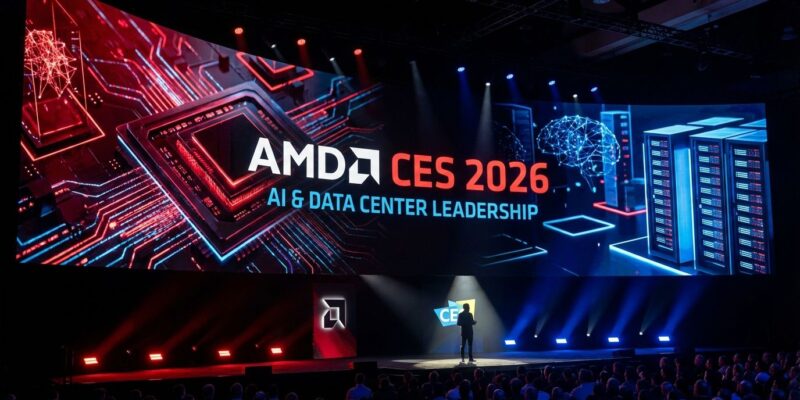
By AMD CEO Dr. Lisa Su takes the stage January 5 at 6:30 PM PT for the official CES 2026 keynote, presenting AMD’s AI vision from consumer PCs to data centers. All three chip giants—AMD, Intel, and Nvidia—reveal their 2026 roadmaps on the same day, giving developers the complete competitive landscape in 24 hours.
The Three-Way Battle on January 5
Unprecedented timing puts the chip industry’s 2026 roadmap into a single day. At 3:00 PM PT, Intel unveils Panther Lake, its first 18A chip. Three hours later, Lisa Su presents AMD’s vision. Meanwhile, Jensen Huang delivers a 90-minute Nvidia keynote at 1:00 PM PT on physical AI and Cosmos.
Developers choose between AMD’s open HPC approach, Intel’s enterprise reliability, or Nvidia’s CUDA ecosystem. AMD positions as a complete stack provider (CPUs plus GPUs from consumer to cloud), Intel bets on 18A process leadership (15% better efficiency, 30% chip density), and Nvidia owns 80% of the AI accelerator market.
AMD is targeting double-digit data center AI market share with revenue projected to hit $100 billion annually within five years—stated strategy against Intel’s declining data center business and Nvidia’s accelerator dominance.
Expected AMD Product Announcements
The Ryzen 7 9850X3D hits 5.6 GHz boost clocks with early benchmarks showing 4.7% better performance than the 9800X3D. More important for development: better single-threaded performance for compilation and builds. Zen 5 delivers a 16-19% IPC uplift over Zen 4. Launch timing and pricing are what matter most.
Ryzen AI 400 “Gorgon Point” competes with Intel’s Panther Lake for the AI PC market—expect AI 9 465, AI 7 450, and AI 5 430 models. AI PCs will be 65-75% of the market within 2-3 years. Which OEM partnerships AMD announces determines if these chips ship in developer laptops.
Strix Halo desktop variants get confirmation—16 cores, 40 RDNA 3.5 compute units, 50 TOPS NPU for high-performance workstations. Pricing determines if this competes with Intel’s high-end or stays niche.
Data center brings EPYC “Venice” CPU updates and Instinct MI350/MI400 GPU roadmap clarity. AMD claims MI400X delivers 10x performance versus MI300X. Q3 2025 numbers back momentum: $4.3 billion data center revenue (up 22%) versus Intel’s $4.1 billion (down 1%).
AMD’s Strategic Positioning
AMD runs a cautious strategy emphasizing refinements over revolutions—”balance between ambition and caution” to build trust. The unified AI approach spans consumer Ryzen AI 400, Threadripper 9000 workstations (up to 96 cores), EPYC CPUs, and Instinct GPUs. AMD sells hardware plus software as a combo, creating ecosystem lock-in like Nvidia’s CUDA.
Market share data supports the strategy. AMD gained 16.6% CPU share while Intel lost 10%. Analysts predict AMD could capture 50% of desktops by 2030. But Intel dominates enterprise and OEMs, Nvidia owns AI accelerators. AMD is the challenger everywhere—execution matters more than announcements.
Why Zen 5 Architecture Matters for Developers
Zen 5 shows the biggest gains in workstation tasks, not gaming. Blender runs 23% faster versus Zen 4. Handbrake encoding sees 41% improvement versus Intel’s 14900K. These are compilation, build, and rendering wins—developer workloads.
Architecture improvements include two-ahead branch prediction, 40% larger execution window (448 operations), doubled L2 bandwidth, and L3 latency reduced by 3.5 cycles. The trade-off: very efficient for workstation tasks, less so for gaming. Optimized for productivity and development, not frame rates.
What to Watch During the Keynote
Pricing and availability matter most. When does Ryzen 9850X3D launch? Which OEMs ship Ryzen AI 400 laptops? Strix Halo desktop SKUs and pricing? Threadripper 9000 details could define the high-end dev market.
Data center brings Instinct MI350/MI400 launch windows, EPYC Venice specs, OpenAI partnership details (chip supply deal, 10% stake option), and ROCm software updates. ROCm improvements versus CUDA matter as much as hardware for AI workloads.
Watch for cloud provider partnerships, OEM announcements, and competitive positioning against Intel and Nvidia.
The keynote livestreams on amd.com/ces and YouTube at 6:30 PM PT January 5. For developers making 2026 hardware decisions, this is required viewing alongside Intel’s Panther Lake and Nvidia’s physical AI announcements. One day, three companies, the entire chip roadmap for the year.