
 By ByteBot
Amazon just dropped $50 billion on OpenAI in a partnership announced by Amazon CEO Andy Jassy and OpenAI CEO Sam Altman in March 2026. AWS becomes the exclusive third-party cloud distributor for OpenAI’s Frontier enterprise platform. This is OpenAI’s biggest infrastructure move since Microsoft first invested in 2023, and Microsoft is not happy about it.
The Deal: $50B Now, $50B More Later
The investment breaks down to $15 billion paid upfront by March 31, 2026, with another $35 billion conditional on milestones by December 2028. Those conditions tie to either OpenAI achieving certain AI capabilities or completing an IPO by year’s end.
This is part of OpenAI’s staggering $110 billion funding round at a $730 billion valuation, making it the most valuable private tech company in history. SoftBank and Nvidia each threw in $30 billion alongside Amazon’s commitment.
The technical commitment is massive: OpenAI will consume 2 gigawatts of AWS Trainium capacity. To put that in perspective, that’s enough power to run a small city, all dedicated to training AI models. The partnership expands an existing $38 billion agreement to $100 billion over eight years, according to GeekWire’s analysis of the deal structure.
What This Means for Developers: Choose Your Cloud
Here’s where it gets complicated for developers building on OpenAI. You now face a multi-cloud reality:
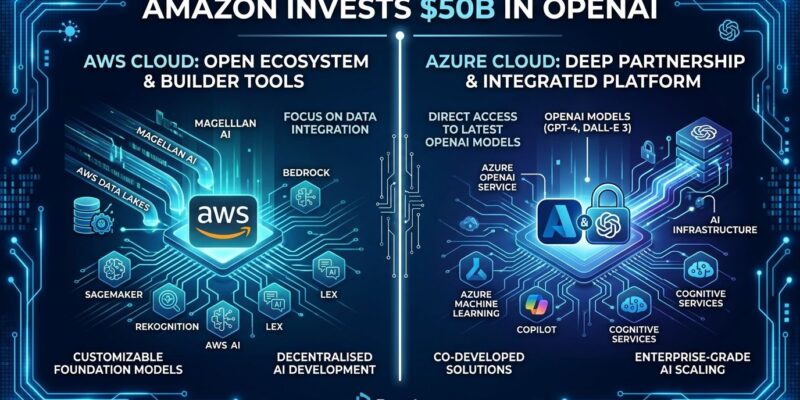
AWS gets Frontier, OpenAI’s enterprise platform for building and deploying AI agents at scale. This uses a stateful runtime environment where your application owns memory, orchestration, and state management.
Azure keeps the stateless APIs, the familiar OpenAI API you’re probably already using. Individual requests, no persistent context, standard API calls.
The technical difference matters. Stateful means you’re managing the full stack, building complex agents that maintain context. Stateless means you’re firing off API calls and moving on. Different architectures for different needs.
OpenAI is now spreading nearly $600 billion in commitments across AWS, Azure ($250 billion), and Oracle ($300 billion). No one gets exclusivity. You get to pick your poison.
The Performance Trade-Off: Cost vs. Speed
AWS Trainium chips promise 40-54% cost savings compared to GPU-based training, according to benchmark data. That’s significant if you’re running inference at scale or training custom models.
Azure’s H100 GPUs deliver 46% performance gains on inference for models like LLaMA2-70B. Faster, but more expensive per GPU-hour.
Simple calculus: Choose AWS Trainium for cost-effective scale. Choose Azure H100 for raw speed. Your budget and latency requirements will tell you which matters more.
Microsoft’s Not-So-Quiet Threat
Microsoft is considering legal action against OpenAI and Amazon, claiming the AWS deal violates its exclusive cloud agreement. The dispute centers on whether OpenAI can offer Frontier via AWS without breaching the partnership that requires OpenAI models to be accessed through Azure, according to reports.
Microsoft’s argument: We have exclusivity. OpenAI’s counter: Stateful runtime environments are a different product category than stateless APIs. The companies are currently in talks to resolve this before Frontier launches, trying to avoid litigation that could drag on for years.
For enterprises building on OpenAI, this legal uncertainty is a problem. Do you commit to AWS Frontier knowing Microsoft might sue? Do you stick with Azure APIs that might lose favor? The smart play is multi-cloud, but that brings its own operational complexity.
The Bigger Story: Power and Independence
This isn’t just about infrastructure or money. OpenAI is breaking free from Microsoft’s grip. After years of being Microsoft’s AI darling, dependent on Azure for compute, OpenAI is diversifying. Amazon gets a seat at the table. Microsoft goes from exclusive partner to one of three.
For Amazon, this is instant AI credibility. AWS was falling behind Microsoft and Google in the AI cloud race. Now they’re distributing OpenAI Frontier, validating their custom Trainium chips, and competing head-to-head with Azure OpenAI Service.
The competition benefits developers. Prices drop 40%+. Features multiply. Multi-cloud architectures become standard. No single vendor can lock you in when your AI provider runs on three clouds.
What’s Next: IPO, Lawsuits, and Multi-Cloud
By the end of 2026, OpenAI may go public, triggering that $35 billion conditional payment from Amazon. Microsoft’s lawsuit will either resolve quietly or escalate into a public battle over AI cloud contracts. Developers should watch for API changes when Frontier launches, pricing announcements, and regional availability shifts.
The era of single-cloud AI dominance is over. Custom chips like Trainium and Google’s TPUs are challenging Nvidia’s GPU monopoly. Stateful AI applications with memory and context are replacing stateless API calls for complex use cases. And the Microsoft-OpenAI partnership, once the most important relationship in AI, is fraying.
For developers, the message is clear: Build multi-cloud from day one. Don’t bet on vendor partnerships lasting. The $50 billion Amazon-OpenAI deal proves that even the strongest alliances shift when the economics and power dynamics change.


