
 By ByteBot
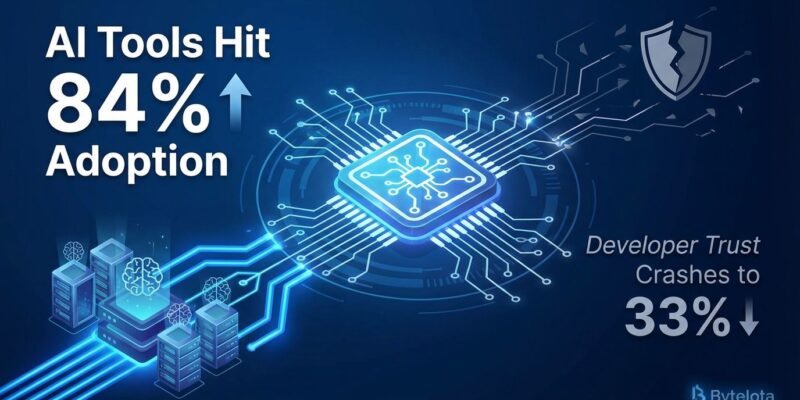
The 2025 Stack Overflow Developer Survey, published in July, reveals a critical paradox: while AI coding tool adoption has surged to 84%—up from 76% last year—developer satisfaction has plummeted 12 points from 72% to just 60%. Even more alarming, trust in AI accuracy dropped from 42% to 33%, with 46% of developers now actively distrusting AI outputs, a 15-point increase from last year. Based on responses from 49,000+ developers across 177 countries, the survey exposes a widening gap between adoption and satisfaction that signals AI coding tools are entering their trough of disillusionment.
This is the emperor-has-no-clothes moment for AI coding tools. After years of hype and billions in investment, developers are experiencing the messy reality: tools that feel productive but create more problems than they solve.
The “Almost Right, But Not Quite” Crisis
The survey identifies developers’ primary frustration with AI tools: 66% report code that is “almost right, but not quite.” This isn’t a minor annoyance—it’s creating a perverse outcome where debugging AI-generated code takes longer than writing it from scratch, cited by 45% as their second-biggest frustration.
When code looks correct, compiles successfully, but fails in edge cases or breaks backward compatibility, developers spend hours tracking down subtle bugs they wouldn’t have introduced themselves. Stack Overflow’s analysis shows this pattern is nearly universal. AI generates plausible code quickly, creating the illusion of productivity, then developers discover subtle logic errors or context misunderstandings that are harder to debug than starting from scratch.
Moreover, this explains a striking finding from the METR productivity study: developers were measurably 19% slower with AI tools despite perceiving a 20% speedup. The “almost right” problem is unfixable without fundamental improvements in AI reasoning—current models lack the deep contextual understanding needed to generate truly correct code for complex scenarios.
Trust Collapses Despite Increased Familiarity
Counterintuitively, developer trust in AI accuracy is declining as familiarity increases. Trust fell from 42% in 2024 to just 33% in 2025, while active distrust rose from 31% to 46%. Only 3% of developers report “high trust” in AI tools.
The survey reveals more developers now distrust AI (46%) than trust it (33%)—a trust crisis that worsens with experience, not improves. Furthermore, most developers who use AI daily (51% of professionals) maintain deep skepticism about its outputs. When asked what they’d do when doubting AI answers, 75% said they would ask a human for help—revealing AI hasn’t replaced human judgment even for its heaviest users.
This inverts the expected learning curve. Normally, trust increases with familiarity as users discover capabilities and limitations. However, with AI coding tools, the opposite is happening: the more developers use them, the more they discover edge cases, subtle bugs, and fundamental limitations. Consequently, this suggests AI tools are systematically overpromising and underdelivering in production scenarios.
The Perception-Reality Gap: Developers Feel Faster, But Actually Slower
Developers report subjective productivity gains—69% feel more productive with AI—yet rigorous measurement shows they’re actually slower on complex tasks. The METR study, published in July, found developers predicted a 24% speedup, estimated afterward they were 20% faster, but were measurably 19% slower. Therefore, this creates a 39-point perception-reality gap.
The Stack Overflow survey helps explain why. While 84% of developers adopt AI tools, only 29% say they handle complex tasks well, down from 35% in 2024. Additionally, developers feel faster because AI reduces cognitive load and generates code quickly, but they’re actually slower because they spend 9% of their time reviewing AI outputs and 4% waiting for generations. The “almost right” problem compounds this: debugging nearly-correct code takes longer than writing correct code initially.
This perception gap is dangerous for organizations. Companies are investing billions based on developers’ subjective reports of increased productivity, while objective metrics show zero company-level performance improvements. In fact, the Faros AI productivity report confirms this disconnect: 75% of engineers use AI tools, yet most organizations see no measurable gains. Teams with high AI adoption complete 21% more tasks and merge 98% more pull requests, but PR review time increases 91%—creating bottlenecks that cancel out individual gains.
Competitive Pressure Overrides Rational Decision-Making
Despite trust collapsing and productivity declining, 69% of developers continued using AI tools after experiencing these issues. Notably, the METR study documented this irrational behavior: developers kept using tools that measurably slowed them down.
The explanation lies in competitive dynamics. The JetBrains State of Developer Ecosystem report found 68% of developers anticipate AI proficiency will become a job requirement. Consequently, developers aren’t using AI because it makes them more productive—they’re using it because everyone else is, and they fear falling behind. This creates a prisoner’s dilemma: individual developers adopt AI even when it slows them down, because not adopting could signal they’re technologically behind.
The survey data confirms this FOMO-driven adoption. While only 31% actively use AI agents (daily, weekly, or monthly), and 38% have no plans to adopt them, general AI coding assistant adoption remains at 84%. Developers distinguish between experimenting with cutting-edge tools (agents) and adopting table-stakes features (autocomplete, code generation) that everyone expects.
What This Means for the Industry
The 10-12 point sentiment crash in a single year is unprecedented. Developer surveys typically show gradual, incremental changes. However, a double-digit sentiment drop signals the industry has pivoted from the hype phase to the disillusionment phase of AI coding tools.
The “almost right, but not quite” problem appears unfixable with current approaches. AI models fundamentally lack the deep contextual understanding, business logic awareness, and edge case handling required to generate truly correct code for complex production scenarios. Until reasoning capabilities improve dramatically, developers will continue experiencing the frustration of code that looks right but fails subtly.
Furthermore, organizations should pay attention to the perception-reality gap. If 84% of your developers use AI tools but you’re seeing no measurable performance improvements—or worse, slower PR review times and increased bug rates—the issue isn’t your measurement. It’s that individual productivity theater doesn’t equal organizational value.
The future likely involves sentiment stabilizing around 50-55% as expectations calibrate to reality. Adoption will plateau around 85-90%, not reach 100%, as developers learn which scenarios benefit from AI assistance and which don’t. The industry will settle on “AI-assisted” workflows with strong human-in-the-loop verification, not the autonomous coding revolution that was promised.
Key Takeaways
The Stack Overflow 2025 survey exposes the messy reality of AI coding tools:
- Developer sentiment crashed 12 points (72% to 60%) despite adoption rising to 84%
- Trust collapsed from 42% to 33%, with 46% actively distrusting AI outputs
- The “almost right, but not quite” problem (66%) creates more debugging work than it saves
- Developers feel 20% faster but measure 19% slower—a 39-point perception gap
- Competitive pressure drives continued adoption despite measurable productivity losses
- Individual perception doesn’t predict organizational value—most companies see zero gains
If 84% of developers adopt a tool but only 33% trust it and satisfaction drops 10+ points, that’s not a successful technology adoption. It’s a hype bubble colliding with reality.


