 By
By By 2026, 75% of technology decision-makers will face moderate to severe technical debt according to Forrester predictions—a 25 percentage point jump from 2025. The culprit? AI coding tools. API evangelist Kin Lane put it bluntly: “I don’t think I have ever seen so much technical debt being created in such a short period of time during my 35-year career in technology.” Four major industry reports from Google, GitClear, OX Security, and Forrester reveal an uncomfortable truth: while developers feel more productive with AI assistants, the code they’re generating is accumulating long-term maintenance costs at an unprecedented rate.
The Productivity Paradox: Feeling Faster While Getting Slower
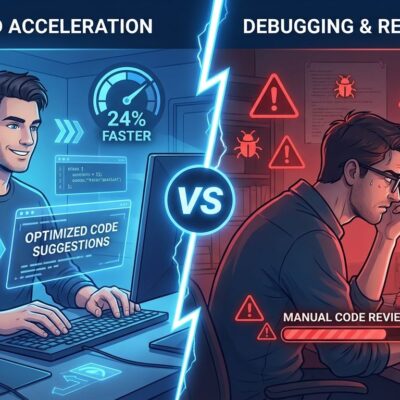
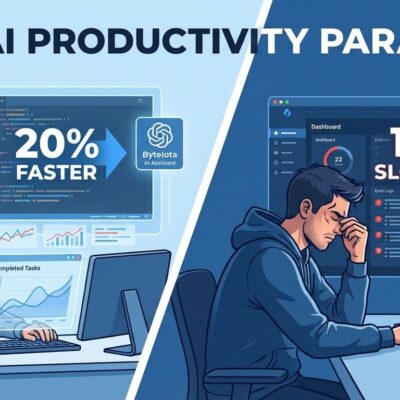
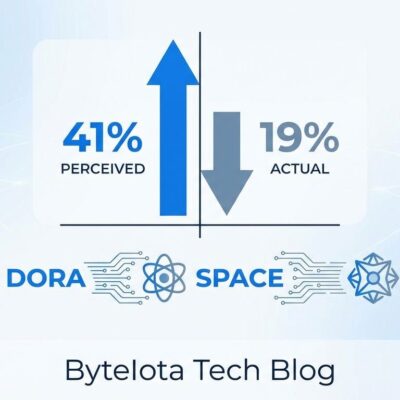
The gap between perception and reality is startling. A 2025 METR study found that developers using AI tools take 19% longer to complete tasks. Yet after the study, those same developers estimated they were 20% faster with AI—they were completely wrong about the tool’s impact on their productivity.
Independent research contradicts the vendor narrative. Moreover, early studies from GitHub, Google, and Microsoft claimed 20-55% faster task completion with AI assistants. However, when researchers actually measured outcomes instead of asking developers how they felt, the numbers told a different story. Only 16.3% said AI made them more productive to a great extent. The largest group—41.4%—reported AI had little or no effect.
Furthermore, trust is eroding too. 46% of developers don’t fully trust AI-generated code, and just 3% “highly trust” AI outputs. Developers are adopting tools they don’t trust because they believe those tools make them faster—even though the data shows they don’t.
Four Studies, One Conclusion: Quality Is Declining
The evidence isn’t anecdotal. Four independent research reports released between 2024 and 2025 document systematic quality degradation in AI-generated code, using data from Google, Microsoft, Meta, and hundreds of open-source repositories.
Google’s 2024 DORA report found a 7.2% decrease in delivery stability for every 25% increase in AI adoption. That’s not a minor trade-off—it’s a fundamental problem with AI-assisted development at scale. Consequently, 39% of developers in the DORA survey reported little to no trust in AI-generated code, yet adoption continues accelerating.
GitClear’s 2025 analysis of 211 million changed lines from enterprise codebases revealed the mechanics of quality decline. Code duplication increased 8-10x in 2024 compared to previous years. Additionally, copy/pasted code rose from 8.3% to 12.3% between 2021 and 2024. Most telling: code refactoring dropped from 25% of all changes in 2021 to less than 10% in 2024. For the first time in history, “copy/paste” code is exceeding “moved” code—developers are duplicating instead of properly abstracting.
OX Security analyzed 300+ open-source repositories and identified 10 critical anti-patterns systematically violating engineering best practices. Their findings: 80-90% avoidance of refactors, 70-80% repeat bugs, 60-70% environment-specific failures. In fact, AI-generated code is “highly functional but systematically lacking in architectural judgment,” according to their report.
The “Army of Juniors” Problem
OX Security researchers coined the term “Army of Juniors” to describe how AI coding tools behave. They’re like talented, fast, functional junior developers who fundamentally lack architectural judgment and security awareness. Therefore, AI optimizes for apparent functionality, not simplicity, maintainability, or long-term design quality.
Real-world examples show the pattern. One developer on Hacker News described AI creating “a new service class, a background worker, several hundred lines of code” for what should have been simple batching logic. The code worked, but it was over-engineered and unmaintainable. Meanwhile, OX Security identified “fake test coverage”—tests that pass but don’t properly validate—in 40-50% of examined repositories. AI creates monolithic code instead of proper abstractions, avoids refactoring opportunities, and lacks the code reuse patterns that experienced developers instinctively use.
The crisis stems from what researchers call being “insecure by dumbness”—non-technical users deploying AI-built applications at unprecedented velocity without corresponding security expertise. AI isn’t making mistakes in the traditional sense. It’s optimizing for the wrong goals: speed over quality, functionality over architecture.
The Hidden Cost: Code Churn and Refactoring Collapse
GitClear’s analysis reveals how “AI-induced tech debt” manifests in practice. Code churn—code discarded less than two weeks after being written—has increased dramatically with AI tool adoption. Organizations are generating 4x more code clones in 2024 compared to previous years. As a result, the data shows a 39.9% decrease in moved lines, which typically indicate code reuse and refactoring.
These metrics predict future maintenance costs. High code churn means wasted effort. Low refactoring means technical debt accumulation. Copy/paste patterns create maintenance nightmares when bugs need fixing in multiple locations. In other words, the velocity gains from AI come with a maintenance bill that organizations don’t see until months later.
The Industry Response: Fighting AI Debt With More AI
Forrester predicts tech leaders will triple their adoption of AI Operations (AIOps) platforms by 2025 to combat the anticipated technical debt tsunami. The paradox is striking: using AI-powered tools to manage the debt created by AI-powered coding.
Tools like Datadog, Dynatrace, New Relic, and ServiceNow AIOps are seeing increased investment as organizations realize they need automated oversight. AIOps can drive 60% tool consolidation according to Forrester’s Total Economic Impact Study. Meanwhile, code quality tools like CodeAnt.ai, SonarQube, and CodeScene are gaining traction for real-time debt detection and prediction.
Best practices are emerging: real-time integration in CI/CD pipelines, pattern recognition across entire codebases, automated standards enforcement, and human-AI collaboration rather than blind acceptance. MIT Sloan Management Review recommends tracking Technical Debt Ratio—estimated fix cost versus total codebase cost—to quantify the hidden burden.
Organizations aren’t helpless, but managing AI-generated debt requires deliberate investment and awareness. The industry is learning a hard lesson: AI coding assistants need guardrails, not blind adoption.
The Question Nobody’s Asking
Developer sentiment is declining—60% positive in 2025, down from 70% in 2023-2024—as the hidden costs become visible. Yet 84% of developers are using or planning to use AI tools, up from 76%. Half rely on AI every day.
Organizations face a critical decision: slow AI adoption to maintain quality, or accept the debt as the price of speed. However, the data suggests there’s no free lunch. Teams reporting “considerable” productivity gains from AI are 3.5x more likely to also report better code quality—but only when they implement thoughtfully with quality gates and review processes.
The industry is at an inflection point. Early adopters are learning that rushing in without quality controls creates crippling technical debt. The 75% prediction from Forrester isn’t just a warning—it’s a near-term reality unless organizations fundamentally change how they adopt AI coding tools. Speed without quality isn’t productivity. It’s deferred work.