 By ByteBot
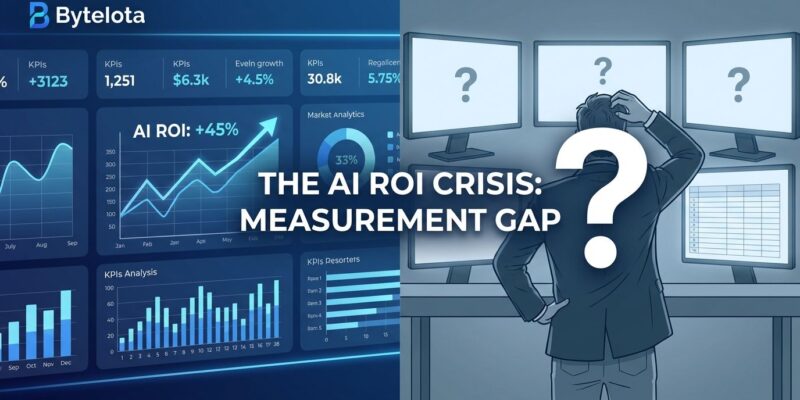
Financial markets declared January 27, 2026 “The Great AI Pivot”—the moment AI shifted from massive infrastructure build-out to operational ROI accountability. However, the inflection point reveals a measurement crisis: 78% of enterprises use AI in at least one business function, yet only 23% actively measure ROI. That means 77% of organizations deploying AI literally cannot prove whether it delivers value.
After three years and billions invested, most enterprises are flying blind. Moreover, 61% of business leaders report MORE pressure to prove ROI now versus a year ago. Additionally, 53% of investors demand proof within 6 months, down from multi-year timelines. Consequently, budget decisions hinge on AI ROI measurement—and most teams don’t have frameworks to quantify value.
The 95% Failure Rate Isn’t About Technology
MIT research reveals a 95% failure rate for enterprise GenAI projects, defined as “no measurable P&L impact within 6 months.” Headlines screamed “AI is failing,” but the root cause isn’t technology—it’s measurement. The study analyzed 150 leader interviews, 350 employee surveys, and 300 public deployments. The verdict: Lack of integration, learning, and alignment with corporate workflows explains the failures, not model quality.
Here’s the kicker: 49% of organizations report their biggest AI challenge isn’t talent or technology—it’s the inability to estimate and demonstrate value. Furthermore, only 34% say AI produces measurable financial impact. The 5% that succeed achieve rapid revenue acceleration. The 95% that fail stall with little to no P&L impact. Both groups deployed AI. The difference? Measurement discipline.
This distinction matters because the AI skepticism debate misses the point. Skeptics cite the 95% failure rate as proof AI doesn’t work. Evangelists counter with success stories from the 5-6% high performers achieving ≥5% EBIT impact. Nevertheless, both are right. Projects fail because enterprises don’t measure, not because AI lacks capability. Therefore, measurement methodology determines outcomes, not model sophistication.
The Productivity Paradox: 40% of Gains Lost to Rework
Workday’s January 2026 research surveyed 3,200 employees and found 85% report saving 1-7 hours per week using AI. That sounds like a win until you examine the hidden cost: 40% of those productivity gains are lost to rework—correcting errors, rewriting content, and verifying outputs. Specifically, for every 10 hours of AI efficiency, 4 hours are wasted fixing AI output. This “AI tax on productivity” explains why time savings on paper don’t translate to bottom-line results.
Only 14% of employees consistently get clear, positive net outcomes from AI. The rest experience gains offset by quality control burdens. Meanwhile, 77% of daily AI users review output as carefully (or more) than human work. Organizations deploy AI faster than they redesign work around it. In fact, 89% of enterprises updated fewer than half of roles to reflect AI capabilities. You can’t bolt AI onto existing workflows and expect transformation. Workflow mismatch kills ROI.
The rework problem quantifies what developers feel but can’t articulate. Speed boosts exist. CFOs see no business impact. The gap isn’t psychological—it’s structural. AI accelerates tasks but introduces quality variability. Without redesigned processes that account for verification overhead, productivity gains evaporate. The 40% figure isn’t an AI limitation—it’s an implementation failure.
What the 23% Who Measure AI ROI Do Differently
Leading enterprises moved beyond single-metric calculations to the “Three-Pillar Framework,” measuring AI value across financial returns, operational efficiency, and strategic positioning. Organizations with structured ROI measurement achieve 5.2x higher confidence in their AI investments. The 5-6% “AI high performers” share common traits that separate them from the 95% that fail.
First, they redesign workflows BEFORE deployment, not after. Workflow redesign is the #1 factor linked to measurable ROI. Second, they buy from specialized vendors (67% success rate) rather than build internally (33% success rate). That’s counterintuitive—most enterprises assume building in-house provides competitive advantage. MIT’s data shows otherwise. Third, they focus on back-office automation over sales and marketing. Fourth, they define measurement KPIs upfront with specific targets: accuracy ≥95%, task completion ≥90%, expected ROI timeframe 90-180 days.
The Three-Pillar Framework itself provides structure missing from vague “improved efficiency” goals. Financial returns track traditional ROI metrics—infrastructure costs, license fees, revenue increases, operational savings. Operational efficiency measures cycle time reduction, error rates, throughput, and quality improvements. Strategic positioning captures long-term value beyond short-term financial metrics—competitive advantage, new capabilities enabled, market timing benefits. This comprehensive approach prevents tunnel vision on isolated metrics that miss broader business impact.
The CFO Timeline Compression: 6 Months or Budget Cuts
ROI timeline expectations compressed dramatically in 2026. Specifically, 53% of investors now demand proof within 6 months or less, down from multi-year timelines a year ago. Additionally, 61% of CEOs report increasing pressure to show AI returns. Furthermore, 65% of CFOs face explicit pressure to accelerate returns across their technology portfolios. The top CFO concerns are security threats (66%) and long time to ROI (56%). This isn’t gradual evolution—it’s a seismic shift from “let’s experiment” to “prove value now.”
AI budgets continue growing—companies will double spending in 2026 to 1.7% of revenue—but consolidate to fewer proven vendors. However, only 26.7% of CFOs plan to raise GenAI budgets in the next 12 months, down from 53.3% a year ago. ROI now drives every spending decision. Enterprises are splitting into two camps: those doubling down on measured wins and those pulling back after failed pilots. Consequently, budget consolidation creates winners and losers. Vendors demonstrating measurable results capture most enterprise spending. Those without proof face revenue stagnation or decline.
For developers, this timeline compression changes the game. Pilot projects without clear measurement frameworks won’t get renewed. Experimentation budgets are drying up. The 6-month ROI demand represents the gap between realistic value delivery (90-180 days for properly scoped projects) and investor impatience (≤6 months). Teams that can demonstrate ROI quickly will thrive. Those that can’t will lose budget. This isn’t theoretical future planning—it’s 2026 budget decisions happening right now.
The Skeptic vs Evangelist Debate: Both Are Right
Nobel laureate Daron Acemoglu claims GenAI will “at best automate profitably only 5% of all tasks” with a modest 0.05% annual productivity gain. His reasoning: reliability issues, lack of human-level judgment, inability to automate physical jobs. He predicts 1.1-1.6% GDP increase over 10 years, not the doubling others forecast. Meanwhile, enterprise surveys show 74% report real ROI when they actually measure properly. Both claims are true—the difference is measurement methodology.
Acemoglu’s skepticism assumes current deployment patterns: no measurement frameworks, no workflow redesign, general-purpose agents without defined scope. His analysis is correct for the 77% who don’t measure systematically. Evangelist data reflects the 23% who measure with discipline. They’re describing different populations. Therefore, the question isn’t “does AI work?” but “are you in the 23% who measure, or the 77% who don’t?”
This reframing cuts through the AI hype versus AI doom binary. Developers trapped in unproductive “is AI overhyped?” debates need pragmatism. Acemoglu is right about most current deployments. Evangelists are right about measured deployments. The gap is execution, not capability. Consequently, measurement discipline, workflow redesign, and bounded scope separate success from failure. The technology works when deployed systematically. It fails when deployed carelessly. Pick which side you want to be on.
What Developers and CTOs Should Do Now
Build measurement frameworks BEFORE deployment, not retroactively. Use the Three-Pillar approach—track financial, operational, and strategic dimensions simultaneously. Avoid single-metric tunnel vision. Define specific KPIs upfront: accuracy targets (≥95%), completion rates (≥90%), expected ROI timeframe (90-180 days). Review weekly during implementation, monthly during operations.
Redesign workflows before deploying AI. Don’t bolt AI onto existing processes and hope for transformation. Update job roles to reflect AI capabilities—89% of organizations didn’t, which is why they failed. Embed AI directly into workflows, not as separate tools. Moreover, address the 40% rework problem by implementing quality gates and validation processes. Invest in employee development, not just technology. Currently, 39% of companies reinvest AI savings into more tech, only 30% into people. That’s backwards.
Choose vendors over internal builds for better odds. 67% success rate for vendor partnerships versus 33% for internal development. Focus on back-office automation over sales and marketing for higher ROI. Start with well-defined, limited-scope projects demonstrating clear business value. Document learnings to inform future projects. Be in the 23% who can prove value, not the 77% who guess. The Great AI Pivot means measurement discipline now determines who gets budget and who doesn’t.