 By ByteBot
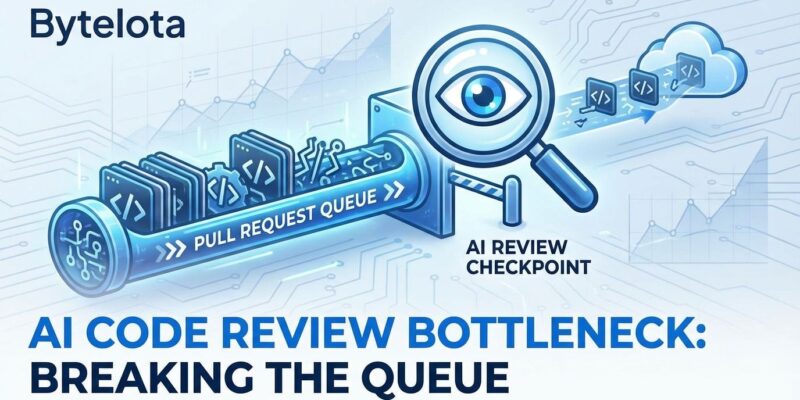
AI coding assistants have hit 84% adoption among developers, with vendors promising 10x productivity gains. But LinearB’s 2025 benchmarks—analyzing 8.1 million pull requests across 4,800 teams—reveal an inconvenient truth: AI-generated PRs wait 4.6x longer for code review. As a result, developers code faster but ship slower. The bottleneck isn’t coding anymore. It’s review.
The Review Paradox
Once a reviewer starts examining an AI-generated pull request, they move through it twice as fast as manual code. However, getting someone to start? That takes 4.6 times longer. The acceptance rate tells the rest: 32.7% for AI code versus 84.4% for manual.
Reviewers know AI code needs deeper scrutiny, so they push it to the bottom of the queue. When PRs wait, developers context switch and accumulate unreviewed work. Research tracking 26,000 engineers found code stuck in review for five days on average. Consequently, AI PRs compound this bottleneck.
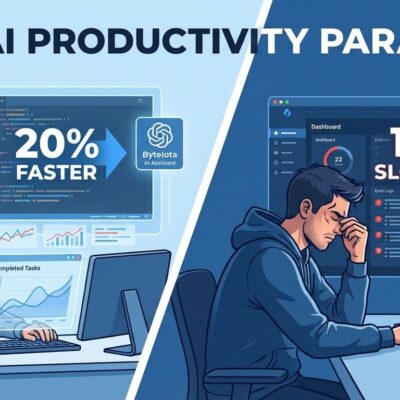
The productivity illusion: teams measure code generation speed while ignoring review delay. Marketing celebrates faster coding. Reality delivers slower shipping. That gap explains why AI sentiment crashed from 70% to 60% this year.
Why AI Code Review Takes Longer
The scrutiny is data-driven. Qodo’s State of AI Code Quality 2025 report found AI PRs average 10.83 issues per pull request versus 6.45 for human code—1.7x more defects. The breakdown: 1.75x more logic errors, 1.64x more maintainability problems, 1.57x more security findings, and 1.42x more performance issues.
Moreover, AI code produces 1.4x more critical issues and 1.7x more major issues. That variance means reviewers can’t predict what they’ll find. Some AI PRs sail through. Others explode with problems.
The quality issues follow patterns. AI code is verbose—more lines for the same functionality. It produces non-idiomatic solutions like complex nested loops where a developer would use a library function. Furthermore, it doesn’t match team style conventions. Variable names confuse. Documentation gaps appear.
Industry guidance reflects this: review AI code “like a colleague with questionable coding skills.” That caution takes time. Developers encountering inconsistent AI output are 1.5x more likely to flag “code not in line with team standards” as a frustration.
The Productivity Cost
The review bottleneck hits DORA metrics hard. Deployment frequency drops when PRs pile up. Lead time increases despite faster code generation. Change failure rates climb with AI’s higher defect density. Elite teams benchmark at under one day for lead time—the review bottleneck makes that impossible.
Focus time suffers too. Developers need 52 minutes uninterrupted to reach flow state, but average only 2.5 hours daily, fragmented by Slack and meetings. In addition, AI PR review adds more context switching and mental overhead.
Queue management compounds the problem. When PRs wait, developers move to the next feature, creating inventory. Reviewers face daunting backlogs. AI PRs—already deprioritized—sink further. The top 25% of organizations get PRs reviewed in under four hours. Most teams aren’t close.
This explains the sentiment crash. The 60% AI sentiment score in 2025 isn’t about tool capability. It’s about the gap between marketing promises and workflow reality—faster coding that doesn’t translate to faster shipping.
Tool Quality Varies
Not all AI coding assistants create equal review burden. Devin’s acceptance rate has been rising since April 2025. GitHub Copilot’s has been slipping since May. The gap is substantial enough to impact team velocity.
Teams tracking acceptance rates by AI tool can identify which create less review friction. The difference between a 40% acceptance rate and 25% is the difference between manageable review load and overwhelming rework.
What Elite Teams Do Differently
Teams with optimized AI workflows achieve 19% faster cycle times. At five months of disciplined AI adoption, they save 41 engineering days. By six months, that grows to 75 days—roughly 2.5 hours weekly per developer. The gains require workflow evolution, not just tool adoption.
Best practices: Make code review top priority. The top quartile achieve under four hours to first review. Keep PRs small—a 50-line AI PR is manageable, a 500-line one is a day-long session. Automate quality gates. AI-powered review tools cut PR review from 2-3 hours to 20-30 minutes, eliminating 80% of trivial issues before human review.
Track what matters. Acceptance rate by tool identifies quality patterns. Time to first review reveals queue effectiveness. Cycle time—not coding time—measures actual productivity. Elite teams optimize for shipping speed, not generation speed.
The Review Frontier
The AI coding revolution succeeded at code generation. It created a new bottleneck at code review. Developers type faster but ship slower. The 60% sentiment score reflects this: workflow friction exceeds automation gains.
The path forward isn’t abandoning AI tools—adoption is too high and benefits too valuable. It’s recognizing review process optimization as the critical constraint. Teams measuring coding speed celebrate the wrong metric. Teams measuring cycle time see the real picture.
The 4.6x review delay isn’t a tool problem. It’s a workflow problem with a workflow solution. Elite teams prove it: same AI tools, optimized review processes, 19% faster cycle times. The productivity gains exist. They’re just on the other side of the review queue.