 By
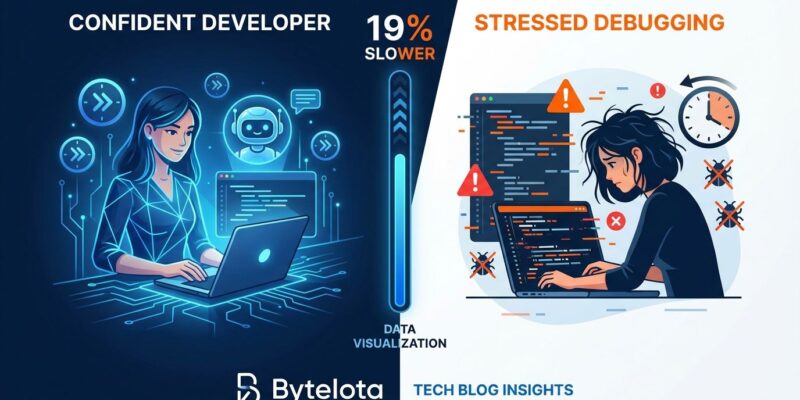
By A randomized controlled trial released in July 2025 by the METR institute delivered a finding that should make every developer question their AI workflow: experienced developers using AI coding tools took 19% longer to complete tasks than those coding without assistance. More startling—developers expected AI to make them 24% faster and afterward still believed it had accelerated their work by 20%. That’s a 39-43 percentage point gap between perception and reality. Stack Overflow’s 2025 Developer Survey of 49,000+ developers confirms the paradox: 84% now use AI tools (up from 76%), yet trust has collapsed from over 70% to just 60%, with 46% actively distrusting AI accuracy. With 41% of all code in 2025 now AI-generated, the industry is making billion-dollar decisions based on how tools feel, not how they perform.
The Numbers Don’t Lie: 19% Slower, 20% Faster Perceived
The METR study wasn’t a casual observation—it was a rigorous randomized controlled trial with 16 experienced open-source developers averaging 22,000+ GitHub stars per repository. Researchers assigned 246 real issues from their own codebases, randomly allowing AI tools (Cursor Pro with Claude 3.5/3.7 Sonnet) for some tasks and prohibiting them for others. Each task averaged two hours. The methodology mirrors medical trials: controlled, measured, and designed to separate signal from noise.
The results expose a mathematical absurdity. Developers predicted a 24% speed increase before starting. Measurements showed a 19% slowdown—tasks took nearly one-fifth longer with AI than without. Yet post-task surveys revealed developers still believed AI made them 20% faster. This isn’t a rounding error. It’s a 39-43 percentage point disconnect between expectation, measurement, and belief.
The researchers explicitly note their findings “do NOT demonstrate that AI universally fails to benefit developers,” acknowledging that results may differ for junior developers or unfamiliar codebases. However, for experienced developers working in their own well-understood repositories—the exact scenario where AI should shine—the tools measurably slow them down while creating a powerful illusion of acceleration.
The “Almost Right” Trap: Why Developer Perception Diverges
Stack Overflow’s 2025 survey pinpoints the mechanism behind the perception gap: 66% of developers cite “AI solutions that are almost right, but not quite” as their primary frustration. This cascades into the second-biggest complaint—45% report spending more time debugging AI-generated code than expected. Only 3.1% of developers “highly trust” AI accuracy, while 46% actively distrust it (compared to 33% who trust). Experienced developers are the most skeptical: 2.6% highly trust, 20% highly distrust.
The “70% problem” explains everything. AI generates code that looks complete and functional, triggering dopamine responses from instant autocomplete suggestions. Generation feels productive—fast typing, reduced cognitive load, visible progress. But the 30% of hidden work—debugging context-free code, fixing “almost right” logic, validating output—exceeds the time saved. Moreover, developers remember the generation wins and forget the debugging sessions, creating confirmation bias that reinforces the perception of speed.
Context loss amplifies the cost. AI-generated code lacks the “why” understanding that comes from writing it yourself. Consequently, future debugging requires reverse-engineering intent from implementation, turning maintenance into archaeology. The time saved upfront compounds as technical debt downstream.
Velocity Theater: Individual Gains, Organizational Stagnation
Google’s 2025 DORA Report reveals the organizational disconnect. AI boosts individual metrics dramatically—21% more tasks completed, 98% more pull requests merged. Developers look busier than ever. However, organizational delivery performance measured by DORA metrics (lead time, deployment frequency, change failure rate, mean time to recovery) remains completely flat. Teams aren’t shipping faster despite individual velocity increases.
The code quality data explains why. GitClear’s analysis of 211 million lines found code duplication increased 8x in 2024, while refactoring dropped from 25% of changes to under 10%—a 60% collapse. Copy-paste code rose from 8.3% to 12.3%. Projects over-reliant on AI experienced 41% more bugs and 7.2% stability degradation. The report concludes: “AI doesn’t fix a team; it amplifies what’s already there.”
This is the multiplier effect. High-maturity organizations with strong foundations—version control, observability, internal platforms—see genuine AI benefits. In contrast, teams with weak practices experience greater instability, hidden technical debt, and mounting rework. AI doesn’t add productivity; it multiplies existing capabilities. Furthermore, adoption without foundation creates what the DORA team calls “velocity theater”—looking productive without delivering value.
Maybe We’re Measuring the Wrong Productivity Metric
Here’s the controversial take: what if taking 19% longer produces better outcomes? The METR researchers note their results may not generalize beyond their specific context. Additionally, Stack Overflow’s survey shows 59% report positive code quality impact from AI despite the trust decline. The DORA report identifies user-centric focus as the critical differentiator—teams with user-centric practices see positive AI impact, teams without see negative impact.
The perception-reality gap might reveal a measurement problem rather than a productivity problem. “Time to first draft” differs fundamentally from “time to production-ready, maintainable solution.” If AI-assisted development takes 19% longer but produces more thoughtful architecture, better documentation, fewer bugs, and more maintainable code, is that slower? Or is the traditional metric of “task completion time” optimizing for the wrong outcome?