
 By ByteBot
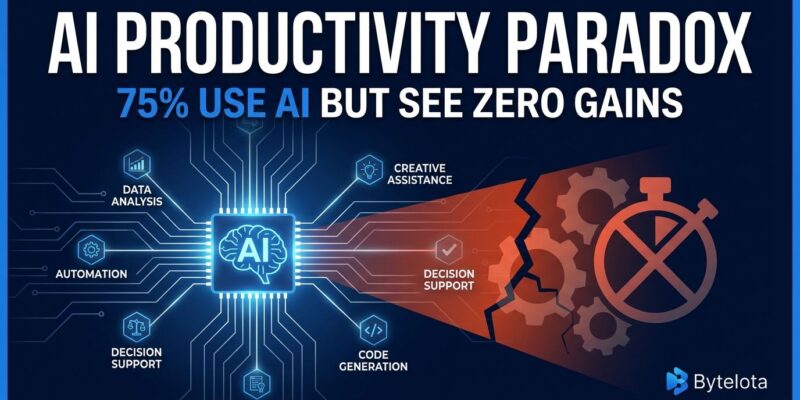
75% of developers use AI coding assistants and complete 21% more tasks with them, yet organizations see zero measurable productivity improvements. This is the AI Productivity Paradox, revealed by 2025 research analyzing over 10,000 developers across 1,255 teams. Moreover, a controlled study found experienced developers actually take 19% LONGER with AI tools, despite believing they’re 20% faster. The culprit isn’t the AI—it’s Amdahl’s Law in action, where accelerating one part of development creates bottlenecks elsewhere that absorb all gains.
Individual Output Soars, Company Metrics Stay Flat
Faros AI’s research analyzed telemetry from over 10,000 developers and found that teams with high AI adoption complete 21% more tasks and merge 98% more pull requests. Furthermore, developers touch 9% more tasks and 47% more pull requests daily. The data paints a picture of hyperactivity: developers shipping code at unprecedented velocity.
Yet across DORA metrics—deployment frequency, lead time for changes, change failure rate, mean time to recovery—the needle doesn’t move. Consequently, companies see no improvement in delivery velocity or business outcomes despite 75% of engineers using AI coding assistants. The productivity gains vanish somewhere between individual output and organizational throughput.
Engineering leaders who invested billions in AI tools expecting measurable returns are asking the right question: Where did the gains go? Additionally, the disconnect between individual velocity and system throughput reveals deeper workflow problems.
Developers Think They’re 20% Faster—They’re Actually 19% Slower
METR conducted a rigorous randomized controlled trial that challenges everything developers believe about AI productivity. Sixteen experienced open-source developers completed 246 real tasks from their own repositories—mature projects with an average of 22,000 stars and over 1 million lines of code. Tasks were randomly assigned to allow or disallow AI tools, primarily Cursor Pro with Claude 3.5 and 3.7 Sonnet.
The results shocked everyone. With AI tools, developers took 19% longer to complete tasks. Before the study, developers predicted a 24% speed improvement. After completing it, they estimated 20% gains. However, reality delivered a 19% slowdown—a 39 to 43 percentage point perception gap.
The study ruled out experimental artifacts. Developers used frontier models, produced similar quality PRs with and without AI, and didn’t drop difficult issues when AI was disabled. This wasn’t a measurement error. Therefore, experienced developers were completely wrong about AI’s impact on their own productivity.
If developers can’t accurately assess their productivity with AI, how can teams make informed decisions about when and how to use these tools? In fact, the perception gap isn’t a rounding error—it’s a crisis in how we measure and understand developer work. This mirrors recent findings that AI adoption hit 84% but developer trust crashed to 33%.
The 91% Review Time Increase That Kills All Gains
PR review time increases 91% on teams with high AI adoption. This is where the productivity gains die.
AI makes developers code 5 to 10 times faster, generating pull requests at machine velocity. But code review remains fundamentally human-paced and sequential. Consequently, you can’t parallelize human approval the way you parallelize code generation. The bottleneck absorbs everything.
The numbers tell the story: average PR size increases 154%, making reviews exponentially harder. Furthermore, bug counts rise 9% per developer, requiring extra scrutiny. Developers touch 47% more PRs daily, creating cognitive overload for reviewers. Meanwhile, code sits in review queues for an average of five days—a full workweek—while manual review processes take 18 hours from submission to completion.
This is Amdahl’s Law in practice. The law states that the overall performance improvement from optimizing a single part of a system is limited by the fraction of time that the improved part is used. When 10% of your workflow is sequential and bottlenecked, maximum speedup is 10x regardless of how fast you make the parallel parts. Thus, AI accelerates coding without upgrading review, testing, or deployment infrastructure. The system moves only as fast as its slowest component.
Four Adoption Patterns Explain the Plateau
The productivity paradox isn’t permanent. Four specific adoption patterns prevent gains from materializing, and all four are fixable.
First, recent critical mass. Widespread AI adoption (over 60% weekly active users) only emerged in the last two to three quarters. Consequently, companies haven’t had time to modernize workflows around AI-generated code velocity. Second, uneven distribution. Some teams use AI heavily while others don’t, creating coordination mismatches. Since software delivery is cross-functional, accelerating isolated teams creates dependencies and bottlenecks elsewhere.
Third, tenure skew. Newer employees adopt AI tools more readily while senior engineers remain skeptical—and the data validates their concerns. Fourth, surface-level use. Most developers only use basic autocomplete features, leaving advanced capabilities like chat interfaces and agentic task execution untapped. Moreover, positive AI sentiment decreased from over 70% in 2023 and 2024 to just 60% in 2025 as reality set in.
These patterns explain why individual acceleration doesn’t translate to organizational productivity. However, they also point to solutions.
Fix the Bottlenecks, Not Just the Coding Speed
The AI Productivity Paradox is solvable, but it requires system-level thinking, not tool-level fixes. Faros AI identifies five critical enablers teams must address simultaneously.
Workflow design comes first. Modernize the entire development lifecycle, not just the coding phase. PR review bottlenecks demand immediate attention: implement AI-assisted code review tools like CodeRabbit, Qodo, or Greptile to handle mechanical tasks—formatting, basic correctness, test verification. Subsequently, human reviewers focus on logic, architecture, and security. Teams implementing this approach see a 31.8% reduction in review cycle times and spend 60% less time on mechanical analysis.
Governance establishes clear policies for AI tool usage across teams. Infrastructure upgrades are non-negotiable: CI/CD pipelines, testing frameworks, and deployment mechanisms must handle larger, more complex AI-generated changes. Training teaches advanced AI features beyond autocomplete. Additionally, cross-functional alignment ensures organization-wide adoption strategies, not siloed experiments that create coordination mismatches.
Audit review queue metrics. Inventory which teams use AI and which don’t. Measure downstream bottlenecks in testing, deployment, and incident management. Therefore, the problem isn’t AI tools—it’s workflows designed for human coding velocity, not machine velocity.
Companies invested billions expecting productivity returns. The data shows why those returns aren’t materializing: individual gains evaporate into system bottlenecks. Fix the system, and the gains follow. Otherwise, AI tools remain expensive placebo buttons that make developers feel fast without making companies ship faster.


