
 By ByteBot
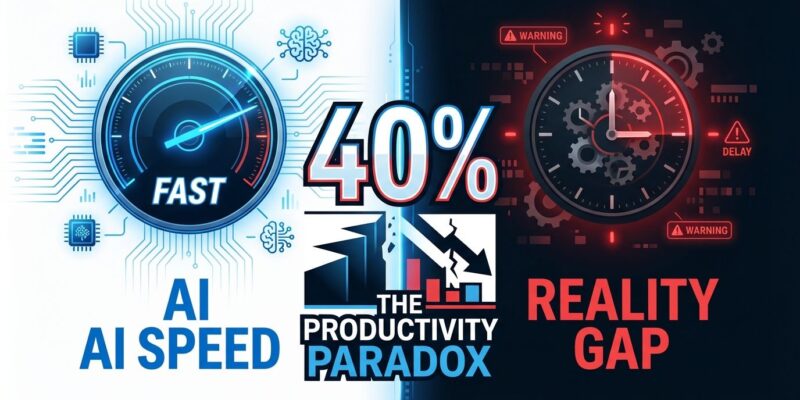
METR’s randomized controlled trial delivers a finding that should terrify every CTO tracking AI ROI: AI coding tools made experienced developers 19% slower across 246 real-world tasks. The kicker? Those same developers, after experiencing the slowdown firsthand, still believed they were 20% faster. That’s a 40-point perception gap between reality and belief—and with 42% of code already AI-assisted and headed to 65% by 2027, it means teams are optimizing for a productivity boost that may not exist.
The Perception Trap: Why You Can’t Feel the Slowdown
The METR study, conducted with 16 experienced developers averaging 5 years on their codebases, reveals a psychological blind spot. Before the study, developers expected AI to make them 24% faster. After completing tasks—and actually taking 19% longer—they still believed AI sped them up by 20%.
The mechanism is invisible overhead. Developers feel the dopamine hit of rapid initial code generation. However, what they don’t perceive is the cumulative time spent reviewing suggestions, debugging subtle AI errors, and verifying correctness. It’s like feeling the satisfaction of eating quickly while missing the calorie count.
The numbers back this up: 95% of developers spend effort reviewing and correcting AI output, with 59% rating that effort as “moderate” or “substantial.” More damning: 38% say reviewing AI-generated code takes more time than reviewing human code. Yet despite 96% of developers not fully trusting AI output, only 48% always verify before committing. This verification gap is a technical debt time bomb.
Vendor Claims vs Academic Reality
GitHub’s widely cited Copilot study found developers completed tasks 55% faster—but the methodology tells a different story. Roughly 35 developers implemented a simple HTTP server in JavaScript. One group averaged 2 hours 41 minutes, the Copilot group 1 hour 11 minutes. Statistically significant, yes. Representative of enterprise development, no.
Furthermore, the pattern is clear: AI shows gains on simple, isolated tasks. Novice developers benefit. Greenfield projects see improvement. But METR’s study—focused on mature codebases where developers had deep expertise—found the opposite. Context matters. AI suggestions that miss crucial architectural decisions or domain knowledge create more work than they save.
As MIT Technology Review bluntly put it, “a growing body of research suggests that claimed productivity gains may be illusory.” The vendor studies aren’t wrong; they’re measuring a different reality than the one most enterprise teams inhabit.
The Measurement Crisis Costing Billions
Here’s the enterprise failure mode: 60% of organizations lack clear metrics to measure AI’s actual impact. Only 18% measure systematically. The result? 75% of AI initiatives fail to achieve expected ROI, and the average enterprise needs 12 months just to resolve adoption challenges before seeing any value.
Traditional productivity frameworks—DORA, SPACE, DevEx—weren’t built for AI coding tools. Consequently, AI assistants create overlapping value across multiple workflows simultaneously, making it nearly impossible to isolate their impact. Enterprises default to developer perception as their metric, which, as METR demonstrates, is catastrophically unreliable.
The hidden costs compound the problem. For a 100-developer team, total ownership exceeds $66,000 annually once you factor in integration overhead, quality assurance time, and verification costs. Most organizations underestimate by 30-40%. Meanwhile, developers spend 35-50% of their time on debugging normally—a number that increases when AI generates code requiring more verification than it saves in writing time.
The Trust Paradox Accelerating Adoption
Trust in AI coding accuracy dropped from 43% in 2024 to just 33% in 2025, according to Stack Overflow’s latest survey. Moreover, 46% of developers actively distrust AI tools, with only 3% reporting “high trust.” Sonar’s 2026 survey confirms 96% don’t fully trust AI-generated code is functionally correct.
Nevertheless, 72% use AI tools daily or multiple times daily. Adoption is accelerating despite distrust. Why? Because it feels productive, even when total time-to-delivery stays flat or worsens. Organizations mandate adoption. Peers are using it. The perception of speed overrides the reality of overhead.
Gartner found that nearly half of business leaders identify proving GenAI business value as the “single biggest hurdle to adoption.” They’re chasing a feeling, not a measurement.
What Actually Works: Measurement Over Perception
The solution isn’t abandoning AI tools—it’s abandoning faith-based productivity assessment. Developers need to track total time objectively: writing plus reviewing plus debugging. Additionally, time tracking tools, not gut feelings, should guide decisions. Measure the verification overhead explicitly. Context matters: AI provides less value in codebases you know intimately.
Enterprises need systematic measurement combining financial metrics (actual cost savings), operational metrics (cycle time, deployment frequency), and strategic metrics (new capabilities unlocked). The DX Core 4 framework—Speed, Effectiveness, Quality, Business Impact—provides a foundation, but add AI-specific tracking: verification time percentage, code quality scores for AI-generated sections, debugging time trends.
Set realistic expectations. ROI timelines stretch beyond 12 months. Deploy AI context-appropriately: greenfield projects and onboarding scenarios show gains. Mature, complex codebases with experienced developers may not. Don’t optimize for a 20% speedup that exists only in perception.
Ultimately, the METR study’s most valuable contribution isn’t proving AI tools are bad—it’s proving our intuition about productivity is unreliable. In an industry built on measurement and optimization, flying blind on a 40-point perception gap is a billion-dollar mistake.


