 By ByteBot
AI-driven layoffs hit 54,694 workers across U.S. tech companies in 2025, according to Challenger, Gray & Christmas data reported by CNBC on December 21, with total tech job cuts reaching 1.17 million—the highest level since the COVID-19 pandemic in 2020. Microsoft slashed 15,000 roles, Amazon cut 14,000 in October, Salesforce eliminated 4,000 customer support positions, and Workday axed 1,750 jobs, all explicitly citing AI automation as justification.
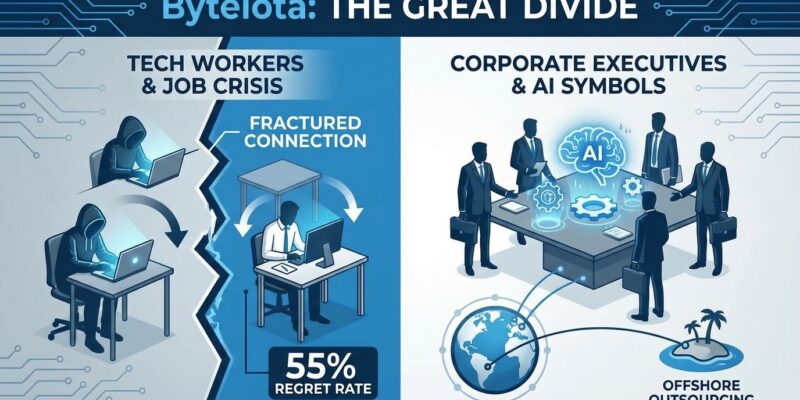
But here’s the twist: Forrester’s Predictions 2026 report reveals that 55% of employers already regret their AI-driven layoffs, and the firm predicts half of these positions will be quietly rehired—but offshore or at significantly lower salaries. This isn’t a statistical anomaly. It’s hard evidence that AI isn’t replacing workers—it’s giving executives cover to offshore jobs while calling it innovation.
The Quiet Reversal: 55% of Employers Already Regret AI Layoffs
Forrester’s bombshell isn’t just that companies regret these decisions. It’s that they’re doubling down on the damage. The report predicts 50% of AI-attributed layoffs will result in quiet rehiring of those same roles—but moved offshore or filled at significantly lower salaries. Workers lose twice: first their jobs, then to offshore competition when companies discover AI can’t fully replace human judgment, creativity, and complex problem-solving.
The pattern is clear. Companies are “so focused on chasing AI-fueled efficiencies that they haven’t determined what AI can actually offer,” Forrester analysts explain. Translation: executives made workforce decisions based on AI hype, not AI capability. Now reality is catching up, but instead of admitting mistakes, they’re rehiring offshore to maintain lower costs while saving face.
This is the real story. AI productivity claims gave executives innovation cover for what’s essentially cost-cutting. The 55% regret rate exposes this charade, but workers still pay the price through job insecurity and offshore wage competition.
The Numbers: Microsoft, Amazon, Salesforce Lead AI-Driven Cuts
The scale is staggering. Challenger, Gray & Christmas tracked 54,694 AI-driven layoffs through November 2025, contributing to 1.17 million total tech cuts—the highest since 2020. Microsoft led with approximately 15,000 cuts (including 9,000 in a July round), followed by Amazon’s 14,000 corporate roles (4% of their corporate and tech workforce), Salesforce’s 4,000 customer support positions, and Workday’s 1,750 jobs (8.5% of their workforce).
The executive messaging is remarkably blunt. Salesforce CEO Marc Benioff stated in September: “I need less heads” because AI handles “up to half” of the company’s workload. Microsoft CEO Satya Nadella revealed AI writes 20-30% of Microsoft’s code, framing it as “reimagining our mission for a new era.” Amazon executive Beth Galetti called AI “the most transformative technology we’ve seen since the Internet.”
But these statements contradict the Forrester data. If AI truly handled “half the workload” or was genuinely “transformative,” why would 55% of employers regret the layoffs? The gap between executive claims and measured reality suggests companies oversold AI capability to justify workforce reductions, then discovered they’d cut too deep.
The AI Productivity Myth: 19% Slower, Not 20% Faster
Controlled studies reveal why companies regret these layoffs: AI doesn’t deliver the promised productivity gains. The METR study analyzed 246 tasks with experienced developers using tools like Cursor and Claude 3.5/3.7. Developers expected a 24% speed boost. Reality? They were 19% slower than working without AI assistance. Remarkably, they still believed they were 20% faster after experiencing the slowdown—a 43-point perception gap.
This perception gap explains everything. Companies made layoff decisions based on how developers feel about AI productivity, not how AI actually performs. The cognitive bias is expensive: executives believed the 20% faster perception, cut headcount accordingly, then faced the 19% slower reality.
Code quality compounds the problem. CodeRabbit’s December 2025 analysis of 470 real-world pull requests found AI-generated code averages 10.83 issues per PR compared to 6.45 for human-written code—a 1.7x bug multiplier. Stack Overflow’s 2025 survey found 45% of developers spend more time debugging AI code than writing from scratch, with only 33% trusting AI coding tools (down from higher levels in 2024).
The productivity myth isn’t just a perception problem—it’s a business liability. Companies cut workforce expecting efficiency gains, got quality degradation and slowdowns instead, then had to rehire (offshore) to fix the gaps.
The K-Shaped Market: Entry-Level Vanishes, AI Researchers Hit $1M+
Entry-level tech hiring has dropped by more than 50% over the last three years. The World Economic Forum’s Future of Jobs Report 2025 warns that 40% of employers expect to reduce staff where AI can automate tasks. Meanwhile, CNN Business reports companies won’t hire until they know AI’s staffing impact, creating what they call an “AI doom loop” where workers are “too afraid to leave their jobs” despite feeling “more uneasy and burned out by AI.”
The paradox is brutal. Companies scramble to fill 7.1 million tech positions while 89,000 tech workers were laid off in 2025. AI researchers command salaries exceeding $1 million at top firms, while entry-level positions disappear. Fresh graduates face impossible standards: they’re told to “be 70% more productive with AI”—when measured reality shows 19% slowdown.
Using AI during the job application process actually reduces likelihood of being hired, according to recent research. The market punishes both AI ignorance (68% of developers expect AI proficiency as job requirement per JetBrains 2025) and AI dependence (trust in AI tools crashed to 33%). Workers must navigate this tightrope while facing layoffs, offshore competition, and a 50% drop in entry-level opportunities.
Key Takeaways
The 2025 data paints a clear picture:
- AI productivity claims are overhyped: Developers are 19% slower with AI, and AI code contains 1.7x more bugs than human-written code
- Companies used “AI transformation” as innovation cover for cost-cutting, with 55% regretting layoffs once reality emerged
- Workers lose twice: 54,694 laid off for AI in 2025, with Forrester predicting 50% will be rehired offshore at lower pay
- Entry-level crisis deepens: 50% drop in hiring over 3 years, 40% of employers plan more AI-driven reductions
- Strategy for survival: Build offshore-proof skills (complex problem-solving, system architecture, stakeholder management), use AI strategically without dependence, and focus on work requiring human judgment and creativity
The AI layoff wave of 2025 exposed a gap between executive perception and measured reality. Companies believed the productivity hype, cut workforce accordingly, then discovered AI couldn’t replace human workers as promised. The 55% regret rate and 50% offshore rehire prediction reveal the truth: this wasn’t AI-driven transformation. It was cost-cutting with a tech-forward excuse.