 By ByteBot
Hyperscalers are betting $600 billion on AI infrastructure in 2026—a 36% jump from last year that represents nearly half their revenue. Yet MIT research published in August 2025 revealed a stark truth: 95% of organizations see zero measurable ROI from generative AI despite spending $30-40 billion on enterprise deployments. This week, as Q1 2026 earnings season kicks off, CFOs are demanding answers to a question that should terrify the industry: if almost no one can prove value, why are we building the biggest infrastructure bet in tech history?
The numbers expose a paradox that’s impossible to ignore. Amazon, Microsoft, Google, Meta, and Oracle will each exceed $100 billion in annual capital expenditures this year, according to IEEE ComSoc Technology analysis. That’s 45-57% of revenue going to data centers, GPUs, and AI servers—unprecedented for software companies that historically ran lean. Meanwhile, MIT’s Project NANDA study found that only 5% of AI pilot programs achieve rapid revenue acceleration. Forrester’s 2026 predictions report confirms the disconnect: just 15% of AI decision-makers report EBITDA lift from their investments.
The Debt Structure That Should Worry Everyone
Behind this buildout sits a financial time bomb. Hyperscalers raised $108 billion in new debt during 2025 alone—four times the five-year average. Moreover, tech companies have moved over $120 billion in data center financing off their balance sheets using Special Purpose Vehicles, according to financial analyst Ernest Chiang.
What’s more concerning is how this debt is structured. Meta’s $27 billion Hyperion data center deal with Blue Owl Capital exemplifies the model. Meta owns just 20% of the joint venture while Blue Owl-managed funds control 80%. The facility is then leased back to Meta, keeping the debt off Meta’s books while maintaining operational control. Oracle has similar arrangements totaling over $69 billion—all funded through SPV structures.
If AI demand slows or enterprises can’t demonstrate ROI, this debt structure could trigger contagion across the financial system. The parallels to pre-2008 off-balance-sheet financing are uncomfortable.
2026: The Year CFOs Stop Funding Experiments
The free-spend era is over. Multiple industry reports point to the same shift: enterprises are moving from AI experimentation to accountability. Fortune’s CFO survey from December 2025 put it bluntly: “CFOs will kill more AI projects than CTOs launch” in 2026.
Gartner predicts that over 40% of agentic AI projects will be canceled by the end of 2027 due to escalating costs, unclear business value, or inadequate risk controls. CFOs reported budget reductions averaging 10%, with 49% identifying cost management as their biggest internal issue. Every technology investment now faces “audit-level scrutiny.”
Despite the scrutiny, AI spending will actually increase—but it will consolidate dramatically. VCs predict enterprises will spend more on AI in 2026 through fewer vendors. Organizations will “cut out experimentation budgets, rationalize overlapping tools, and deploy savings into AI technologies that have delivered.” The survivors will be those who can prove business outcomes, not those with the slickest demos.
The Developer Productivity Paradox
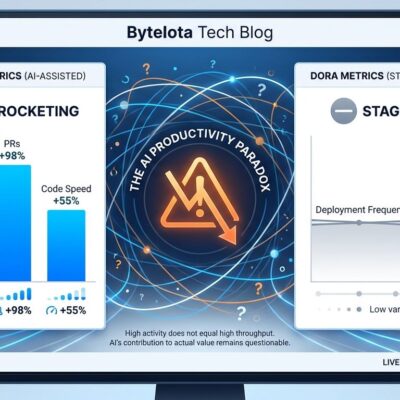
Faros AI’s analysis shows individuals completing 21% more tasks and merging 98% more pull requests since adopting AI coding assistants. Yet organizational DORA metrics remain largely unchanged. The bottleneck shifted. Pull request review times increased by 91%, creating new downstream constraints that eat the upstream productivity gains.
Furthermore, a July 2025 study by METR tested experienced developers with AI tools and found something striking: developers believed they were 20% faster, but objective measurements showed they were actually 19% slower on complex tasks. This explains why CFOs question six-figure AI tool licenses despite individual developer claims of massive productivity boosts. The value isn’t reaching the bottom line.
Why 95% Fail and What the 5% Do Differently
MIT’s research identified the core problem, and it’s not model quality. The “learning gap” exists in how organizations integrate AI, not in the capabilities of the models themselves. Generic tools like ChatGPT excel for individual use because of their flexibility, but they “stall in enterprise use since they don’t learn from or adapt to workflows.”
Resource allocation is backwards. More than half of generative AI budgets go to sales and marketing tools, yet MIT found the biggest ROI in back-office automation: eliminating business process outsourcing, cutting external agency costs, and streamlining operations. Organizations are spending big where returns are weakest and underinvesting where returns are strongest.
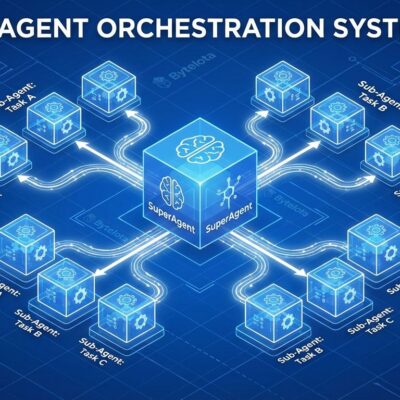
Despite the high failure rate, Gartner predicts meaningful long-term adoption among the survivors. By 2028, at least 15% of day-to-day work decisions will be made autonomously through agentic AI, up from 0% in 2024. However, getting there requires a focus on “enterprise productivity, rather than just individual task augmentation”—using AI agents for decisions, automation for routine workflows, and assistants for simple retrieval.
The Reckoning
The comparison to the dot-com bubble keeps surfacing. Ray Dalio of Bridgewater Associates said in 2025 that current AI investment levels are “very similar” to the late 1990s. Even Sam Altman, OpenAI’s CEO, stated publicly that he believes an AI bubble is ongoing. Nevertheless, there are differences. Today’s AI leaders have legitimate revenue and earnings, unlike many late-90s dot-coms that burned cash with no path to profitability.
But the infrastructure spending is speculative. We’re building $600 billion worth of capacity in 2026 based on projected demand that 95% of current adopters can’t justify with measurable returns. We’re financing it with debt and off-balance-sheet vehicles that concentrate risk across the financial system. And we’re doing it while enterprises are actively canceling projects and CFOs are demanding proof of value.
2026 won’t see a crash—the buildout has momentum, and hyperscalers can’t slow spending without ceding ground to competitors. However, it is the year the AI industry must prove value. The separation between hype and reality begins now. For developers, the message is clear: demand ROI proof from the AI tools you’re being sold. If 95% of enterprises can’t show value despite billions in spending, vendor productivity claims deserve skepticism until verified by independent analysis.