 By ByteBot
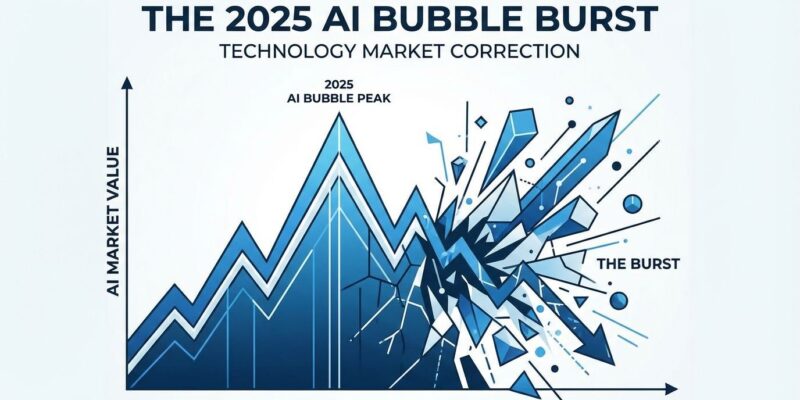
MIT Technology Review published a comprehensive “Hype Correction” package yesterday, December 15, declaring 2025 “a year of reckoning” for artificial intelligence. After years of grand promises about AGI, workforce replacement, and scientific breakthroughs, reality is setting in hard—and the evidence is brutal. MIT researchers found 95% of businesses trying AI got zero measurable ROI, Upwork showed AI agents routinely fail straightforward workplace tasks, and even OpenAI CEO Sam Altman admitted investors are “overexcited,” comparing AI to the dot-com bubble.
This isn’t just another “AI is overhyped” opinion piece. Moreover, this is MIT, multiple rigorous studies throughout 2025, and the CEO of OpenAI himself admitting the emperor has no clothes. If you’ve been skeptical of the AI hype, here’s your vindication.
The 95% Enterprise AI Failure Rate Nobody Talks About
MIT’s “GenAI Divide” report dropped in July 2025 with a damning statistic: 95% of enterprise AI deployments deliver no measurable business value. The research team analyzed over 300 AI deployments, conducted 52 executive interviews, and surveyed 153 leaders across industries. The conclusion? Despite $30-40 billion in enterprise investment, only 5% of integrated AI systems created significant value.
The problem isn’t model quality—it’s what MIT calls the “learning gap.” Organizations don’t know how to integrate AI into workflows, and buying AI tools won’t fix that. Additionally, the study found vendor partnerships succeed 67% of the time, while internal AI builds succeed only one-third as often. Translation: your company’s AI rollout is probably doomed unless you’re addressing integration, not just licensing GPT-4.
Sam Altman Admits the AI Bubble Is Real
In August 2025, Sam Altman sat down with reporters in San Francisco and said the quiet part out loud. When asked if investors are overexcited about AI, his response was blunt: “My opinion is yes.” He compared the situation directly to the dot-com bubble, noting that “when bubbles happen, smart people get overexcited about a kernel of truth.”
Then came the kicker: “Someone is going to lose a phenomenal amount of money. We don’t know who.” This from the CEO of OpenAI, the company that sparked the GenAI explosion with ChatGPT. The paradox? Altman said this while simultaneously raising $6 billion at a $500 billion valuation, following a $40 billion round at $300 billion just months earlier. When the biggest AI cheerleader admits it’s a bubble, believe him.
Autonomous AI Agents Fail 60-80% of Simple Tasks
Upwork’s November 2025 study tested the autonomous agent narrative that every AI vendor has been selling. They took Claude Sonnet 4, GPT-5, and Gemini 2.5 Pro and threw them at 300+ real client projects—deliberately choosing simple, well-defined tasks under $500. The result? AI agents failed 60-80% of the time working standalone.
Claude Sonnet 4 managed a 40% completion rate on its own, hitting 68% for web development and 64% for data science tasks. However, GPT-5 and Gemini barely cracked 20%. Tasks requiring cultural nuance—marketing copy, translations, website layouts—flopped completely. The Upwork researcher’s assessment was brutal: “These agents aren’t that agentic. As tasks move up the value chain, agents can’t solve them even to scratch the surface.”
Here’s the reality check: if AI can’t handle a $500 freelance project without human intervention, it’s not replacing anyone. Furthermore, the study found human-AI collaboration boosted completion rates by 70%, but that required an average of 20 minutes of expert feedback per cycle. Autonomous agents remain fiction.
Developers Are 19% Slower With AI (But Think They’re Faster)
METR’s 2025 study uncovered a disturbing productivity paradox. Developers using AI coding assistants completed tasks 19% slower than they did without AI. The twist? They expected AI to make them 24% faster, and even after experiencing the slowdown, they still believed AI had sped them up by 20%.
The top complaint tells the story: 66% of developers cited “AI solutions that are almost right, but not quite” as their biggest frustration, followed by 45% saying “debugging AI-generated code is more time-consuming” than writing it from scratch. Your brain tricks you into thinking you’re productive because the AI gave you something to start with, but you’re actually spending more time fixing “almost right” code than you would writing it correctly the first time.
What Actually Works: GitHub Copilot and Narrow Use Cases
Not everything is burning. GitHub Copilot has 20 million developers and 77,000+ organizations, with users reporting 75% higher job satisfaction and 55% faster coding for specific tasks. Stack Overflow’s 2025 survey shows 85% of developers use AI regularly, with 70% reporting reduced mental effort on repetitive work. ChatGPT hit 82% adoption among developers for explaining error messages and API documentation.
The pattern is clear: AI works for narrow, specific use cases—code completion, boilerplate generation, documentation, summarization—not the grand autonomous agent dreams vendors have been selling. GitHub Copilot genuinely helps with repetitive patterns. ChatGPT excels at explaining concepts. Nevertheless, architectural decisions, cultural nuance, and complex problem-solving remain firmly in human territory.
Key Takeaways: Reality-Based AI Strategy
The AI hype correction is healthy. It kills fantasy, not useful technology. Here’s what developers should do now:
- Use GitHub Copilot for code completion, not architecture: It’s proven for boilerplate and repetitive patterns. Don’t trust it for business logic or security-critical code.
- Ignore autonomous agent pitches: Upwork proved they fail 60-80% of simple tasks. If a vendor promises agents that “work while you sleep,” walk away.
- Demand pilot programs with measurable ROI: MIT’s 95% failure rate should terrify CFOs. No pilots, no enterprise rollout.
- Focus on integration, not models: The “learning gap” kills more AI projects than model quality. Buy from specialized vendors (67% success) instead of building internal (22% success).
- Don’t chase AGI timelines: The industry has admitted LLMs aren’t the path to AGI. Stop betting on 2027 AGI predictions.
Sam Altman compared this to the dot-com bubble for a reason. Consequently, the dot-com crash killed 90% of companies, but Amazon and Google survived and defined the next decade. AI will follow the same pattern—useful infrastructure emerges, but most of today’s AI startups won’t make it.
The great AI hype correction of 2025 isn’t the end of AI. Rather, it’s the end of the fantasy that autonomous agents will replace knowledge workers, that AGI is around the corner, and that every business needs an AI strategy. What survives is simpler: tools that genuinely help with specific tasks, integrated thoughtfully into human workflows. Reality wins.