 By ByteBot
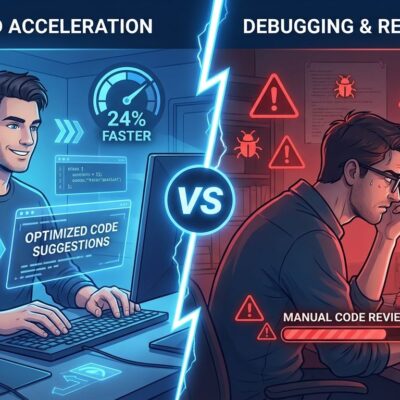
A rigorous randomized controlled trial published by METR in July 2025 reveals a troubling paradox: experienced developers using AI coding tools completed tasks 19% slower than working without AI—yet believed they were 20% faster. That’s a 39-percentage-point gap between perception and reality. The study involved 16 experienced open-source developers working on 246 real issues from repositories averaging 22,000+ stars and 1 million+ lines of code.
This isn’t about whether AI can generate code (it can). It’s about whether the tools actually deliver the productivity gains that justify billions in enterprise spending. When developers can’t accurately perceive their own slowdown, companies invest in productivity theater instead of measurable output.
The Cognitive Bias Behind the Paradox
Developers aren’t lying when they say AI makes them faster—they genuinely believe it. Three cognitive biases explain the 39-point perception gap.
First, effort justification bias: the harder you work to extract value from AI tools (prompting, reviewing suggestions, integrating outputs), the more you overestimate their worth. Second, cognitive load creates an illusion of productivity. Higher mental engagement during AI interactions leads developers to conflate thinking hard with working effectively. Third, visibility bias: instant code generation is obvious and feels productive, while gradual debugging time accumulates invisibly.
The METR study found developers expected AI to accelerate work by 24% before starting. Even after experiencing measurable slowdowns, they still believed they’d been sped up by 20%. The brain lies to justify the effort invested in adopting these tools.
88% of Companies See No Business Value
The AI developer productivity paradox extends beyond individual developers to enterprise-wide ROI failures. Gartner surveyed 114 HR tech leaders in January 2026 and found 88% report no significant business value from AI tools. An MIT study titled “The GenAI Divide: State of AI in Business 2025” found 95% of U.S. businesses that invested $35-40 billion in AI initiatives saw zero return on investment or no measurable impact on profits.
McKinsey’s 2025 research shows 88% of organizations use AI regularly, yet only 39% report any level of EBIT impact—and most of those attribute less than 5% of EBIT to AI use. Meanwhile, Larridin’s 2025 report reveals 89% of enterprises use AI, but only 23% bother measuring ROI. When you don’t measure, you can’t see the waste.
This is the $40 billion hallucination: companies spending billions on tools because developers advocate for them enthusiastically, without verifying actual delivery improvements. The perception gap at the individual level compounds into organizational-scale financial waste.
Related: AI Code Verification Bottleneck: 96% Don’t Trust AI Code
Code Volume Up, Quality Down
GitClear analyzed 211 million changed lines of code from 2020-2024 and documented a quality crisis building beneath the productivity hype. Code volume increased 10%, but every quality metric declined. Copy/paste code rose from 8.3% to 12.3%, while code blocks with 5+ duplicates increased 8x in 2024 alone. Refactored code collapsed from 24.1% in 2020 to just 9.5% in 2024—a 60% decline. Code churn (revisions within two weeks of initial commit) rose from 3.1% to 5.7%.
Google’s DORA report confirms the quality problem: every 25% increase in AI adoption showed a 1.5% dip in delivery speed and a 7.2% drop in system stability. Lines of code per developer rose 76% overall, while pull request size increased 33%. Even if AI-generated code is no less buggy than human code, the sheer volume increase means more defects slip through with the same reviewer count.
Why the quality decline? GitClear’s research explains: “Code assistants make it easy to insert new blocks of code simply by pressing the tab key, but it is less likely that the AI will propose reusing a similar function elsewhere in the code, partly because of limited context size.” AI tools optimize for new code generation, not code reuse or refactoring. Context window limits (4K-8K tokens) mean AI can’t reason about large codebases, so it suggests duplicates instead of finding existing functions. The code written in 2025 becomes the maintenance nightmare of 2026-2027.
Context Is Everything for AI Coding Tools
AI coding tools aren’t uniformly harmful—they show clear patterns of when they help versus hurt. Boilerplate generation, greenfield projects, and junior developer productivity see genuine gains. Complex mature codebases, experienced developers, and debugging scenarios see losses. The Hacker News developer consensus is blunt: “AI has little to no value in debugging complicated systems where developers spend dozens of hours per single line of code.”
Where AI helps: repetitive patterns like CRUD endpoints, scaffolding, and test generation. New codebases without legacy constraints. Junior developers lacking prior context who benefit from examples and reduced docs lookup. Simple tasks like regexes, error message parsing, and straightforward functions.
Where AI hurts: production systems with 500K+ lines and 5+ years of history. Experienced developers with already-optimized workflows who experience flow disruption. Legacy codebases AI can’t understand because it was trained on open source, not your decade-old production system. Debugging requires deep system understanding AI fundamentally lacks.
The METR study tested exactly this: experienced developers (averaging multiple years of contributions) working on mature, complex open-source repositories. GitHub’s earlier study showing 26.08% productivity gains tested simpler scenarios where juniors benefited most and seniors saw minimal improvement. Task complexity and developer experience determine whether AI helps or hurts—but “everyone must use AI” mandates ignore this nuance.
Related: Stack Overflow Questions Collapse 76% Since ChatGPT
Using Tools You Don’t Trust
Stack Overflow’s 2025 Developer Survey documents a toxic relationship: 84% of developers use or plan to use AI tools (up from 76% in 2024), yet trust in AI accuracy dropped from 43% in 2024 to 33% in 2025—a 23% decline in trust. Only 3% “highly trust” AI output. Meanwhile, 46% actively distrust it.
The top frustration? 66% cite “AI solutions that are almost right, but not quite.” Another 45% say debugging AI-generated code takes more time than expected. Furthermore, 75% say they’d ask a human for help “when I don’t trust AI’s answers.” Positive sentiment toward AI tools dropped from over 70% in 2023-2024 to just 60% in 2025.
Experienced developers with actual accountability—senior engineers, architects, tech leads—show the lowest “highly trust” rate (2.6%) and the highest “highly distrust” rate (20%). They understand what everyone learns eventually: “almost right” is more dangerous than obviously broken code. Subtle bugs in plausible-looking code consume hours to debug, erasing the seconds saved during generation.
Developers are locked in productivity theater: generating more code they don’t trust instead of writing less code they understand. Usage increases despite trust declining because industry pressure and perceived productivity (not actual) drive adoption. That’s not a sustainable foundation for professional tools.
Key Takeaways
- Developers using AI tools were 19% slower in rigorous testing, yet believed they were 20% faster—a 39-point perception gap driven by cognitive biases (effort justification, cognitive load illusion, visibility bias)
- 88% of HR tech leaders and 95% of businesses investing $35-40B report no significant ROI from AI tools, revealing enterprise-scale productivity theater
- Code volume increased 10% but quality collapsed: 4x more copy/paste blocks, 60% less refactoring, 7.2% system stability decline per 25% AI adoption increase
- Context determines outcomes: AI helps with boilerplate/greenfield/juniors, hurts with complex codebases/experienced developers/debugging scenarios
- Trust in AI coding tools declined 23% year-over-year (43% to 33%) despite usage increasing, with 66% frustrated by “almost right” code and only 3% highly trusting output
- Measure actual output (cycle time, defect rate, code quality metrics), not developer perception—feelings don’t equal productivity