
 By ByteBot
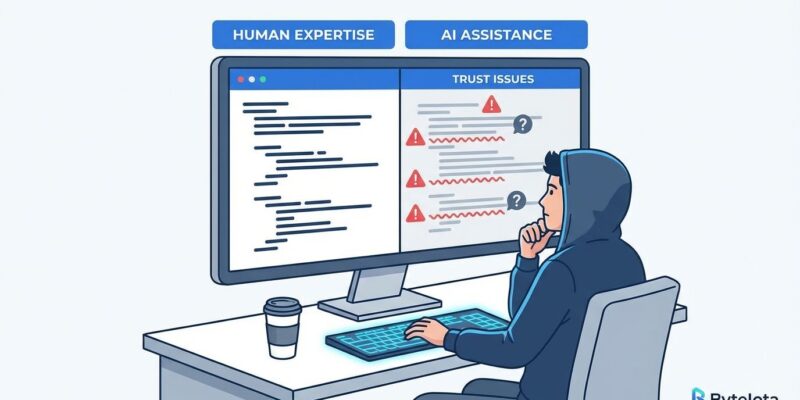
84% of developers now use AI coding tools daily. 46% don’t trust the accuracy of the output. This isn’t a typo—it’s the central paradox defining software development in 2026. The Stack Overflow 2025 Developer Survey reveals that while AI adoption skyrockets, developer trust is collapsing. Trust in AI accuracy dropped from 40% to 29% year-over-year. The culprit? What 66% of developers call the “almost right” problem: code that’s 95% correct but requires deep debugging to find the 5% that’s catastrophically wrong.
The Trust Collapse Nobody Saw Coming
Here’s what the numbers actually tell us. 46% of developers don’t trust AI tool accuracy—up from 31% last year. That’s a 48% increase in distrust in just 12 months. Only 3% “highly trust” AI output. Experienced developers are the most skeptical: 20% “highly distrust” AI tools, and they have the lowest trust rate at just 2.6%.
Meanwhile, adoption continues to climb. 84% of developers use or plan to use AI tools, up from 76% last year. 51% use them daily. Positive favorability dropped from 72% to 60%, yet here we are, typing prompts into Copilot every single day.
Why the disconnect? Because AI tools deliver speed at the cost of verification overhead. And experienced developers—the ones accountable for production code—are paying the price. They’ve seen the hallucinated methods, the subtle off-by-one errors, the security flaws that slip through because the code looked right. They know that “almost right” in production is worse than wrong.
The “Almost Right” Problem Is Worse Than You Think
Let’s quantify this. A METR randomized trial in July 2025 found that developers using AI were 19% slower on average. The kicker? They believed they were faster. This perception gap is killing productivity.
The Stack Overflow survey reveals the top frustrations: 66% cite “AI solutions that are almost right, but not quite” as their biggest pain point. 45% report that debugging AI-generated code takes more time than writing it from scratch. GitHub Copilot shows 50% accuracy in projects exceeding 10,000 lines of code. 75% of senior engineers spent MORE time correcting AI suggestions than coding manually.
This is what developers are calling the “verification tax”—the time spent proving AI-generated code wrong often exceeds the time required to write it correctly in the first place. Companies budget $140K-180K for QA but actually spend $900K-1M annually on AI-related overhead once you account for verification, debugging, and extended PR reviews.
Why is “almost right” worse than wrong? Wrong code fails tests immediately. “Almost right” code passes basic checks, ships to production, and fails on edge cases. It creates a false sense of progress while building technical debt.
What Actually Works: Best Practices from the Trenches
The developer consensus in 2026 is clear: treat AI as a junior developer requiring oversight, not autonomous judgment. Addy Osmani’s workflow exemplifies this approach: read every line AI generates, run tests immediately, never deploy without human review.
Smart teams are building layered AI workflows. Editor copilots handle boilerplate. Agent-based workflows scaffold new features. Terminal assistants suggest commands. AI runs in CI for test generation. But humans review logic, architecture, and security. Every. Single. Time.
The skill amplification effect is real but conditional. If you have strong fundamentals—solid architecture skills, deep understanding of your stack, testing expertise—AI amplifies your productivity. Without that foundation, you get what developers are calling “Dunning-Kruger on steroids”: code that seems great until it falls apart.
The work is shifting upstream. Implementation speed is no longer scarce. Correct thinking is. Architecture decisions, system design, code review skills—these matter more than ever. And here’s the uncomfortable truth: you need to periodically code without AI to keep your fundamentals sharp.
The Market Is Maturing, Finally
We’ve moved from the 2023-2024 hype phase (“AI will replace developers!”) to the 2026 reality phase (“AI is an intelligent assistant with clear limitations”). MIT Technology Review notes that initial enthusiasm is waning as developers bump against real limitations and research suggests productivity claims may be illusory.
Model quality is no longer the differentiator. What matters now: workflow integration, project context, predictable behavior under real conditions. Tools that solve actual production problems—dependency security, fragile workflows, broken local environments—are winning. Tools with flashy demos and vague promises are not.
The path forward is specialization. AI for security scanning. AI for test generation. AI for refactoring. Not “AI does everything” but “AI excels at these specific domains and we know its limitations.”
What Developers Should Do Right Now
First, audit your AI usage. Track time spent debugging AI code versus writing from scratch. Measure actual productivity, not perceived. You might be surprised.
Second, establish quality gates. Mandatory testing for AI-generated code. Human review for anything touching production. Document AI usage in PRs so reviewers know what to scrutinize.
Third, invest in fundamentals. Architecture skills, code review expertise, testing knowledge—these aren’t optional anymore. They’re the difference between AI amplifying your productivity and AI amplifying your mistakes.
Fourth, set realistic expectations. AI is an accelerator, not a replacement. The “almost right” problem will occur. Budget time for verification. Plan for it.
The Bottom Line
The 48% trust decline isn’t a failure of AI—it’s a market correction. Developers are moving from unrealistic expectations to practical integration. This is healthy. The hype is deflating. The tools are improving. We’re learning where AI helps (boilerplate, scaffolding, documentation) and where humans are non-negotiable (logic, architecture, security).
Treat AI-generated code like you’d treat code from a smart but inexperienced intern: helpful, fast, but requiring oversight. That’s not a limitation. That’s reality. And reality is what we needed all along.


