METR’s February 24, 2026 research update reveals a striking productivity paradox: experienced developers using AI coding tools take 19% longer to complete tasks, yet believe they’re working 20% faster. That’s a 39-percentage-point gap between perception and reality. The finding, based on controlled studies with 16 experienced open-source developers across 246 real-world tasks, challenges the AI productivity narrative driving billions in enterprise spending.
This isn’t just about AI being slower—it’s about developers being unable to accurately judge their own productivity. With 84% of developers using AI tools and 90% of Fortune 100 companies adopting GitHub Copilot, organizations are making major spending decisions based on false productivity assumptions.
The 39-Point Perception Gap
METR’s controlled study measured actual task completion times. Developers using tools like Cursor with Claude 3.5 Sonnet took 19% longer to complete coding tasks compared to working without AI assistance. The confidence interval ranged from 2% to 39% slower—no scenario showed a speedup.
However, developers predicted they’d be 24% faster with AI before starting. After completing the study and experiencing the slowdown, they still believed AI had sped them up by 20%. One participant described the dependency clearly: “My head’s going to explode if I try to do too much the old fashioned way because it’s like trying to get across the city walking when all of a sudden I was more used to taking an Uber.”
If developers can’t accurately assess their own productivity, self-reported metrics are worthless for ROI evaluation. Enterprises spending on AI tools based on developer enthusiasm surveys may be burning money while actual delivery velocity stagnates.
Why Developers Can’t Tell They’re Slower
The perception gap isn’t a measurement error—it’s psychology. Three factors create the illusion of speed: automation bias (trusting that automated systems are inherently more efficient), visible activity bias (watching code generate instantly triggers dopamine and reward responses), and emotional time dilation (enjoying work makes time seem to pass faster).
Jonathan Cook explains the mechanism: “The experience of time passing while at work is relative to our emotional relationship to the work we do. The way that developers felt while doing their work warped their perception of the time that it took to complete their work.” When AI generates code instantly, it feels productive even when debugging takes longer than writing from scratch.
Understanding the psychological mechanism matters because it’s persistent—you can’t fix perception bias with training or better prompting strategies. Organizations need objective metrics: task completion time from assignment to production deployment, not satisfaction scores.
Context Switching and the 70% Problem
The 19% slowdown stems from two main culprits. First, context-switching overhead—developers shift between coding mode and prompting mode dozens of times per hour. Each cognitive transition carries a 23-minute recovery cost, destroying flow state. Traditional AI tools with 4,000-8,000 token context windows force constant manual prompting.
Second, the “70% Problem”—AI generates code that’s roughly 70% correct, requiring significant effort to debug and polish the final 30%. This shows up in PR acceptance rates: AI-assisted code has a 32.7% acceptance rate versus 84.4% for manually written code. AI code also has 1.7x more bugs than human code, adding downstream quality costs.
These mechanisms suggest solutions: use AI selectively for boilerplate and test generation where the 70% problem doesn’t hurt, but avoid it for complex refactoring where debugging overhead dominates. Don’t apply AI tools universally—match tool to task.
The Bottleneck Just Moved to Code Review
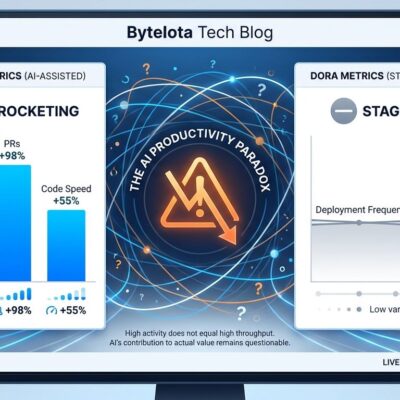
High-AI-adoption teams show a productivity paradox at the organizational level. They complete 21% more tasks and merge 98% more pull requests. That sounds like success until you examine review times: PR review increases 91%, and PRs are 154% larger. The bottleneck shifted from coding to review, leaving delivery throughput unchanged.
Eugene Petrenko captured this in January 2026: “Stop optimizing code generation: code review is your real SDLC bottleneck.” Organizations report developers “feel faster” but see no improvement in business outcomes. With 82 million monthly code pushes and 41% of new code AI-assisted, review teams are drowning.
Faster code generation without scaled review capacity just moves the constraint downstream. Enterprises adopting AI tools need to increase review team size by 50-90% or implement AI code review assistants. Otherwise, they’re solving coding speed while creating review backlogs.
Tools Are Improving, But the Perception Gap Remains
METR’s February 2026 update acknowledges limitations in their research. Selection bias is severe—30-50% of developers refused to participate in tasks without AI tools. The most AI-dependent users (who might see benefits) avoided the study, potentially skewing results. METR believes early 2026 tools are likely faster than early 2025 versions, though they lack reliable data.
The J-curve theory suggests productivity with general-purpose technologies dips initially, then rises after workflow adaptation. AI coding tools might follow this pattern: current slowdown could precede long-term gains. Vendor claims support this—GitHub Copilot reports 55% faster task completion, a 74-percentage-point gap from METR’s 19% slowdown measurement.
However, even if tools improve and close the performance gap, the perception gap persists. Developers still can’t accurately judge their own productivity. That makes objective measurement critical regardless of whether AI tools eventually deliver speedups. Trust data, not feelings.
Key Takeaways
- Don’t trust developer self-reports about productivity—measure task completion time objectively from assignment to production deployment
- The perception gap is psychological, not methodological. Automation bias and emotional time dilation warp duration estimates even after experiencing slowdowns
- Use AI selectively: boilerplate and test generation benefit, but avoid complex refactoring where the 70% problem and debugging overhead dominate
- Scale review capacity by 50-90% if adopting AI tools enterprise-wide. Faster coding without review capacity just shifts the bottleneck downstream
- Track quality metrics (PR acceptance rates, defect rates, review rejection rates), not just velocity metrics (commits, PRs merged)
Are we optimizing for developer happiness or business outcomes? The 39-point perception gap suggests enterprises need to choose their metrics carefully.