 By ByteBot
Microsoft CEO Satya Nadella and Google CEO Sundar Pichai both claim around 25% of their companies’ code is now AI-generated. Stack Overflow reports 65% of developers use AI coding tools at least weekly. The narrative is clear: AI is revolutionizing software development. But MIT Technology Review’s December investigation, backed by rigorous studies from METR and Microsoft itself, reveals an uncomfortable truth. Developers are growing more skeptical as they use these tools, and the promised productivity gains may be an illusion.
The Productivity Paradox
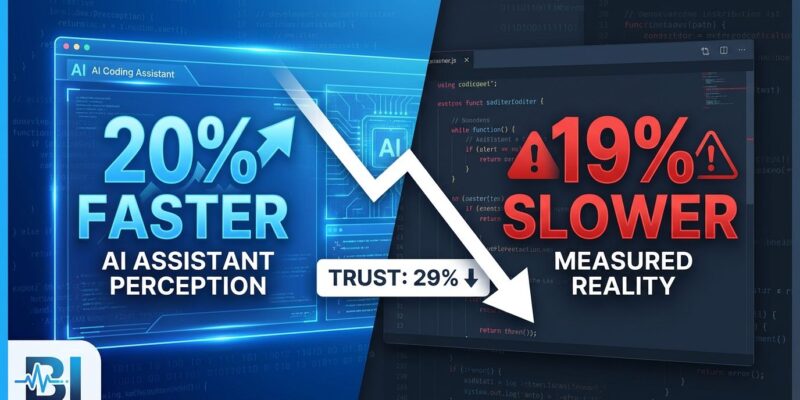
The most damning evidence comes from METR’s randomized controlled trial with experienced open-source developers. Researchers expected developers using AI to be 24% faster. The reality? They were 19% slower. More striking: even after experiencing the slowdown, developers still believed they were 20% faster.
Microsoft’s own 3-week study on GitHub Copilot showed zero statistically significant gains in telemetry data tracking time spent coding and pull request activity. When pressed on the lack of measurable improvements, researchers moved the goalposts, suggesting developers might need 11 weeks of daily use before seeing gains. At what point do we admit the productivity claims are questionable?
This perception gap matters because billions in investment and thousands of corporate adoption decisions hinge on productivity assumptions that don’t appear in actual measurements.
The Trust Crisis
Here’s what should terrify AI coding tool vendors: developers trust these tools less the more they use them. Stack Overflow’s 2025 survey found that only 29% of developers trust AI tool accuracy, down from 46% who actively distrust them. Only 3% report “highly trusting” the output.
The pattern is backwards from normal technology adoption. Developers without Copilot experience are more optimistic. Those with experience are more skeptical. Experienced developers show the lowest trust rates: just 2.6% highly trust AI-generated code, while 20% highly distrust it.
When asked about their biggest frustration, 66% of developers cited “AI solutions that are almost right, but not quite.” The second-biggest complaint? Debugging AI-generated code takes more time than writing it themselves.
This isn’t a temporary adoption hurdle. This is the market telling us the tools aren’t delivering.
The Job Market Irony
While senior developers question AI productivity gains, junior developers are paying the price. Stanford’s recent study, analyzing payroll data from millions of workers, found employment for software developers aged 22 to 25 declined 20% from its 2022 peak. Entry-level positions in AI-exposed roles dropped 13% relative to less-exposed roles. The timing? Exactly coinciding with ChatGPT and generative AI’s rise.
Older workers in the same period saw 6-9% employment growth. Companies are eliminating junior developer positions based on AI productivity assumptions that research suggests are false. The irony is brutal: we’re cutting jobs based on productivity gains that may not exist.
The Technical Debt Nightmare
Even if AI tools provided short-term speed gains, the long-term costs tell a different story. GitClear’s report documented an 8x increase in duplicated code blocks since AI assistant adoption. Google’s 2024 DORA report found that a 25% increase in AI usage led to a 7.2% decrease in delivery stability.
API evangelist Kin Lane put it bluntly: “I don’t think I have ever seen so much technical debt being created in such a short period of time during my 35-year career in technology.”
The problem is architectural. AI-generated code is, as Ox Security notes, “highly functional but systematically lacking in architectural judgment.” Developers can code 55% faster with AI, but that means 55% more poorly structured code requiring future maintenance. The time saved upfront gets consumed by code review, debugging, and technical debt remediation.
Most developers now spend more time debugging AI-generated code than they did before these tools existed. The productivity gains vanish when you measure the full software lifecycle, not just initial code generation.
The Acceptance Gap
The numbers behind developer skepticism are revealing. GitHub Copilot contributes 46% of code in files where it’s enabled. But developers only accept 30% of its suggestions. They’re rejecting 70% of what the AI generates.
This massive curation effort may offset any time saved on accepted suggestions. Human verification remains mandatory for anyone with accountability for code quality, which undermines the automation promise entirely.
What This Actually Means
AI coding tools have legitimate uses. Boilerplate code, documentation generation, and simple completions genuinely save time. But the industry narrative that these tools deliver transformative productivity gains doesn’t hold up under scrutiny.
The convergence of evidence is striking: controlled trials show slower performance or no gains, trust declines with experience, technical debt accumulates at unprecedented rates, and developers reject most AI suggestions. When the people actually using the tools daily become more skeptical over time, that’s not a temporary adoption curve. That’s the market rendering judgment.
Developers making tool adoption decisions deserve honest assessment, not hype. Companies cutting junior positions based on illusory senior developer productivity gains need to reconsider. And vendors claiming revolutionary productivity improvements need to explain why their own studies can’t measure the gains they’re promising.
The emperor has no clothes. It’s just taken the industry this long to admit it.