 By ByteBot
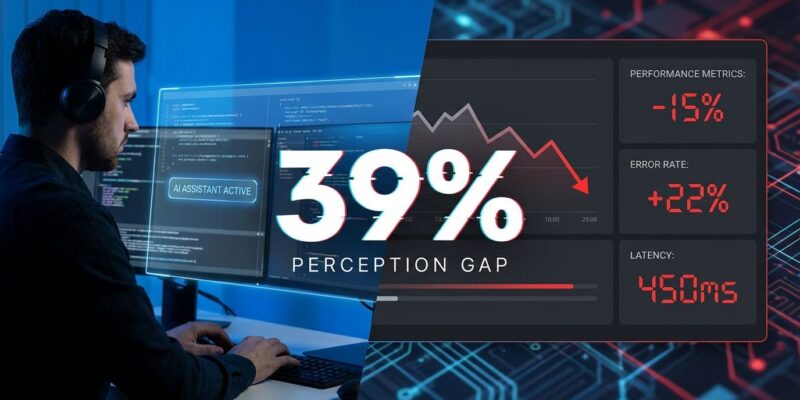
Developers using AI coding tools believe they’re 20% faster. Objective measurements show they’re 19% slower—a 39% perception gap that should terrify every engineering leader approving six-figure AI tool budgets. A July 2025 METR study of experienced developers using Cursor Pro and Claude reveals the industry’s dirty secret: 75% of engineers have adopted AI coding tools, yet most organizations measure zero performance gains. The productivity revolution? It might be an expensive illusion.
Developers Think They’re 20% Faster. They’re Actually 19% Slower.
The METR study put 16 experienced open-source developers through 246 coding tasks, paying them $150/hour to complete realistic bug fixes and features. Before starting, developers predicted AI would make them 24% faster. The measured result? They took 19% longer with AI tools enabled.
Here’s the part that should worry you: even after experiencing the slowdown, developers still believed they were 20% faster. That’s a 39-point gap between perception and reality.
Why do developers misjudge their own productivity so badly? Automation bias—we inherently trust that automated systems are efficient. AI generates code instantly, which feels productive, even when debugging that code takes longer than writing it from scratch. Less typing equals less work in our brains, but total completion time tells a different story.
This pattern repeats everywhere. Google’s 2024 DORA report surveyed 39,000 tech professionals: 75% felt more productive using AI tools, but system performance metrics declined. Microsoft ran a 3-week Copilot study where developer surveys showed productivity gains, but telemetry showed none. Self-reported gains aren’t just unreliable—they’re often inversely correlated with reality.
AI Is Generating More Code. But Is It Good Code?
GitClear’s analysis of 211 million lines of code from Google, Microsoft, and Meta repositories found a troubling trend: while AI tools produced 10% more “durable code” (code that survives more than two weeks), they also drove a 4x increase in code cloning—copy/pasted code that rarely represents thoughtful engineering.
Code churn, the percentage of lines rewritten within two weeks, is projected to double in 2024 compared to the 2021 pre-AI baseline. For the first time in history, copy/paste code exceeds “moved” code, the metric that captures refactoring and deliberate code reuse. More code, faster—but at the cost of maintainability.
Some studies found developers using Copilot introduced significantly higher bug rates while maintaining the same issue throughput. The extra time spent validating AI-generated code canceled out any speed gains. AI writes code that looks correct but isn’t, and developers who trust the output pay the debugging price later.
75% Adoption, Zero Measured Gains: The ROI Crisis
Here’s the organizational paradox: 85% of developers use AI coding tools regularly, yet most organizations see no measurable improvement in deployment frequency, cycle time, or change failure rate. Why?
First, 95% of organizations don’t connect AI tool usage to engineering performance metrics. They track which tools developers use, not whether those tools drive results. Teams adopt five different AI assistants without strategic focus, creating tool sprawl instead of workflow integration.
Second, adoption doesn’t equal integration. Developers use AI for code snippets and boilerplate, not end-to-end workflows. Organizations deploy Copilot with zero onboarding, no best practices for when to use AI (and critically, when not to), and no measurement of whether the investment pays off.
The industry conversation has shifted from “which tool is smartest?” in 2023 to “which tool has ROI?” in 2026. Pricing models are now debated as intensely as capabilities. Engineering leaders are waking up to a reality where universal AI access doesn’t guarantee universal productivity gains.
Measure, Don’t Assume: A Framework for Engineering Leaders
If self-reports are unreliable and adoption rates don’t correlate with outcomes, what should you measure for AI coding productivity?
Start with DORA metrics: deployment frequency, lead time for changes, change failure rate, and mean time to recovery. Cortex’s engineering leaders guide recommends connecting AI tool adoption directly to these performance indicators. Are you shipping more often? Faster? Breaking production less? Fixing issues quicker?
Pair DORA metrics with code quality indicators: code churn (percentage rewritten within two weeks), PR cycle time, rework frequency, and approval rates. Track AI-specific data too—token consumption, actual costs, feature usage depth—then correlate that with engineering outcomes.
Here’s the five-step framework: Define success metrics first, before you buy tools. Establish baseline DORA data before rollout. Run controlled experiments—A/B test an AI tool cohort against a control group for at least six months. Track adoption continuously (usage patterns, not just installations). Connect usage to outcomes using platforms like Cortex, Faros AI, or Sleuth that integrate AI metrics with deployment tracking and incident correlation.
Ignore vanity metrics. Lines of code generated, AI suggestion acceptance rates, and tool usage frequency tell you nothing about productivity. Self-reported time savings are worse than useless—they’re actively misleading.
The Path Forward Isn’t Rejection, It’s Rigor
AI coding tools aren’t inherently good or bad. Microsoft’s controlled studies showed 55.8% faster task completion in specific scenarios. The issue isn’t the technology—it’s the lack of rigor in evaluating it.
Strategic adoption beats universal adoption. AI excels at boilerplate, repetitive code, testing scaffolds, and documentation generation. It struggles with complex architecture, critical systems, and unfamiliar domains. Use it where it works, skip it where it doesn’t, and measure the difference.
Before approving the next AI coding tool budget, ask one question: How will we measure success? If the answer is “developer surveys,” you’re already measuring the wrong thing. The 39% perception gap isn’t a quirk of one study—it’s a systemic warning that our industry has been optimizing for feelings instead of outcomes.
Measure first. Prove ROI. Then scale. Anything else is just expensive guesswork.