 By
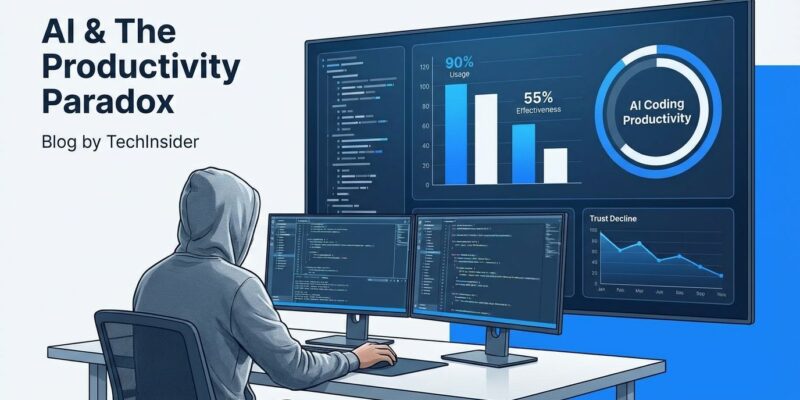
By Three major developer surveys released between October 2025 and January 2026—covering 75,000+ developers globally—reveal a critical productivity paradox in AI-assisted coding. While 42% of all code is now AI-generated (up from just 6% in 2023) and 90% of developers use AI for new code development, only 55% rate these tools as “extremely or very effective” for that task. For refactoring and optimization, the disconnect widens: 72% use AI, but only 43% find it effective—a 29-point gap. Developers predict AI-generated code will reach 63% by 2027, but the industry is racing toward mass adoption without mass effectiveness.
The Three Gaps Nobody’s Talking About
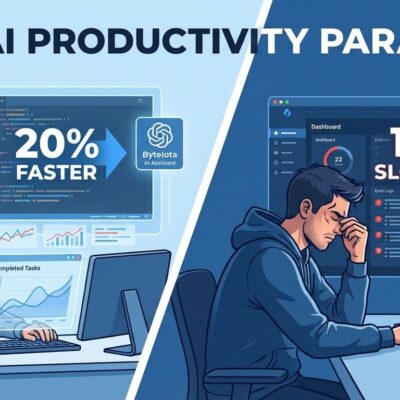
The AI coding crisis manifests in three distinct forms. First, the usage-effectiveness gap: 90% use AI for new code, yet only 55% find it effective (35 points). Second, the adoption-trust gap: 84% use or plan to use AI tools, but 46% actively distrust them—more than the 33% who trust them. Third, and most striking, the perception-reality gap: developers believe AI makes them 20% faster when independent studies show they’re actually 19% slower. That’s a 39-point perception gap.
Stack Overflow’s 2025 survey of 49,000+ developers found trust in AI accuracy dropped from 40% to 29% year-over-year, with only 3% “highly trusting” the output. JetBrains’ survey of 24,534 developers confirmed 85% use AI regularly, yet concerns persist: 23% cite inconsistent code quality, 18% point to limited understanding of complex logic. The METR study’s finding cuts deepest: developers expected AI to speed them up by 24%, experienced a 19% slowdown, yet still believed AI had sped them up by 20%.
For engineering leaders, this means self-reported productivity metrics are unreliable. AI adoption rates don’t correlate with actual productivity gains. Companies are investing billions based on vendor claims of 20-55% speedups while independent research from Bain & Company describes real-world savings as “unremarkable.”
The “Almost Right But Not Quite” Debugging Hell
66% of developers cite “AI solutions that are almost right, but not quite” as their biggest frustration, followed by 45% who report debugging AI-generated code takes longer than writing it from scratch. This creates a verification bottleneck: 95% of developers spend at least some effort reviewing AI code, with 59% rating that effort as “moderate” or “substantial.” Yet despite 96% not fully trusting AI code, only 48% always verify before committing.
AI generates code that compiles and appears correct but contains subtle logic errors, edge case failures, or security vulnerabilities. Sonar CEO Tariq Shaukat explains: “The burden of work has moved from creation to verification and debugging. That verification workload is the bottleneck—and the risk zone where subtle bugs and vulnerabilities accumulate.” The gap between distrust (96%) and verification (48%) creates risk zones where subtle bugs slip through into production.
Related: AI Code Verification Crisis: 96% Distrust, 48% Verify
When Team Gains Don’t Scale to Company Wins
Faros AI’s analysis of 10,000+ developers across 1,255 teams found that teams with high AI adoption complete 21% more tasks and merge 98% more pull requests. Impressive numbers. But PR review time increases 91%, and bugs per developer increase 9%. Most critically, despite these team-level changes, no significant correlation was observed between AI adoption and improvements at the company level across DORA metrics or quality KPIs.
Average PR size increased 154%, meaning more code to review per PR. The verification bottleneck consumes the productivity gains from faster code generation. As Faros AI explains: “AI-driven coding gains evaporate when review bottlenecks, brittle testing, and slow release pipelines can’t match the new velocity.” Engineering teams see local improvements—more PRs, more tasks—but organizational productivity stays flat because the release pipeline can’t keep up.
This is the ROI killer for AI coding investments. Companies see impressive team-level metrics (21% more tasks!) and believe AI is paying off, but company-level throughput, quality, and velocity remain unchanged. The bottleneck isn’t code creation anymore. It’s verification, testing, and deployment. Throwing more AI at the problem just makes the bottleneck worse.
Racing Toward 63% AI Code—But Effective for What?
AI-generated code comprised just 6% of all committed code in 2023. By 2026, that number jumped to 42%—a 7x increase in three years. Developers predict this will reach 63% by 2027, a 50% increase from current levels. This trajectory is accelerating despite effectiveness gaps, declining trust (40% → 29% year-over-year), and the verification bottleneck worsening. AI is deployed everywhere: 88% use AI for prototypes, 83% for internal production code, 73% for customer-facing apps, and 58% for mission-critical services.
Among developers who use AI tools, 72% use them daily. Tool adoption remains high: ChatGPT at 41% usage (down from 49% in 2024), GitHub Copilot steady at 30%, with most developers using both for different tasks—ChatGPT for exploration and debugging, Copilot for in-IDE autocomplete.
The industry is on a collision course. AI-generated code is becoming the majority of all code (projected 63% in 2027) while the tools generating it show persistent effectiveness gaps. Organizations will be managing codebases where two-thirds of code was generated by tools that developers don’t trust and find ineffective for key tasks. This raises fundamental questions about code quality, maintainability, and technical debt in AI-dominated development.
The Junior-Senior Productivity Split
Independent research reveals a striking split: junior developers see up to 39% productivity gains from AI coding tools, while experienced developers on familiar codebases are often 19% slower when using AI. Only 16.3% of developers said AI made them more productive “to a great extent,” while the largest group (41.4%) said it had “little or no effect.”
The explanation lies in task complexity. AI excels at scaffolding, boilerplate, and learning new frameworks—exactly what juniors need. JetBrains found 65% report faster learning with AI, and 9 in 10 save at least one hour weekly. But AI struggles with complex logic and novel problem-solving, where senior developers operate. For experts, fixing AI’s “almost right but not quite” errors takes longer than writing correct code from scratch.
One-size-fits-all AI strategies fail. Engineering leaders need segmented approaches: encourage AI use for juniors (proven 39% boost), but let seniors opt out (19% slowdown). Aggregate productivity numbers like “35% boost” hide this distribution and lead to poor decisions. The ROI of AI coding tools varies dramatically by experience level, and forcing adoption across all developers may hurt more than help.
Key Takeaways
- Three gaps define the AI coding crisis: Usage vs. effectiveness (90% use, 55% effective for new code), adoption vs. trust (84% use, 46% distrust), and perception vs. reality (feel 20% faster, actually 19% slower—a 39-point gap)
- The “almost right but not quite” problem is the top frustration (66%), with 45% reporting debugging AI code takes longer than writing from scratch, and 96% distrusting AI code while only 48% always verify
- Team-level gains don’t scale: High-AI teams complete 21% more tasks and merge 98% more PRs, but PR review time increases 91%, bugs rise 9%, and company-level DORA metrics show zero improvement
- The industry races toward 63% AI-generated code by 2027 (up from 6% in 2023, 42% in 2026) while effectiveness gaps persist, trust declines, and the verification bottleneck worsens
- Junior developers gain 39% productivity, senior developers lose 19%—one-size-fits-all AI strategies fail because aggregate numbers hide the experience-based distribution
- Focus AI adoption on proven strengths: Documentation (74% effective), code explanation (66%), and test generation (59%), not new code development (55%) or refactoring (43%)
The gap between adoption and effectiveness represents billions in wasted developer time and questionable ROI for AI coding investments. Engineering leaders must measure effectiveness, not just usage rates. Self-reported productivity is unreliable—the 39-point perception gap proves it. Trust vendor claims with skepticism, and remember: 2026 is the “show me the money” year. Enterprises need real productivity gains, not impressive adoption statistics.