 By ByteBot
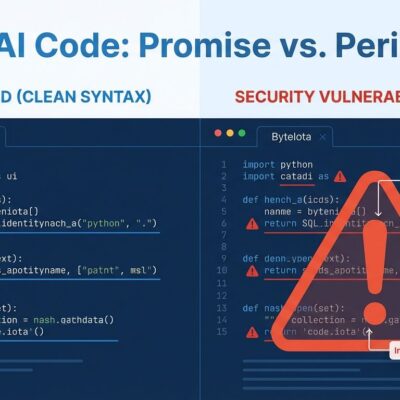
Developers don’t trust AI-generated code. Survey after survey confirms it: 96% say they don’t fully trust AI’s functional accuracy. Yet here’s the paradox nobody’s talking about—48% commit that code anyway without verification. Welcome to the trust-verification gap, where the biggest risk in AI-assisted development isn’t the code quality. It’s the gap between what developers know and what they do.
The Numbers That Don’t Make Sense
SonarSource’s 2026 State of Code Survey of 1,149 developers reveals a stunning contradiction. While 96% don’t fully trust AI code, 48% don’t always verify it before committing. And they’re using these tools constantly—72% daily or multiple times daily. The result? AI now accounts for 42% of all committed code, projected to hit 65% by 2027.
Stack Overflow’s 2025 survey shows the trust crisis deepening. Developer trust in AI tools fell from 40% to 29%. Only 3% “highly trust” AI output. Yet 84% use or plan to use AI tools, up from 76% in 2024.
The contradiction is stark. Developers know AI code can’t be trusted, yet they’re committing nearly half of it without verification. As AI-assisted code volume explodes, the gap between distrust and verification widens.
Why Developers Skip Verification
If developers know the risks, why skip the check? The answer lies in what AWS CTO Werner Vogels calls “verification debt.” When AI writes code, developers must rebuild comprehension during review—and that takes time. A lot of time.
Here’s the bottleneck: 38% say reviewing AI code takes more time than reviewing human code. Code review time increased 91% according to Google’s 2025 DORA Report. AI writes code 10x faster, but overall engineering velocity gains hover around 10-20%. Teams generating 30% of code with AI see only 10% velocity improvements. Verification can’t keep pace with generation.
Stack Overflow data reveals the developer frustrations driving this behavior. 66% cite “AI solutions that are almost right, but not quite.” 45% say debugging AI code is more time-consuming. Faced with verification that takes longer than the original task, developers make a calculated risk: commit now, deal with problems later.
The Quality Decline Evidence
The consequences? The data is damning. CodeRabbit’s analysis of 470 open-source pull requests found AI code creates 1.7x more issues than human code—10.83 issues per PR versus 6.45 for human-written code.
GitClear’s research shows a 4x increase in code cloning. The percentage of code devoted to refactoring dropped from 25% in 2021 to less than 10% in 2024. Meanwhile, copy/pasted code rose from 8.3% to 12.3%. For the first time in history, developers are pasting code more often than refactoring or reusing it.
Google’s DORA report found that a 90% increase in AI adoption correlated with a 9% increase in bug rates. Security vulnerabilities appear 1.5-2x more frequently in AI-generated code. PR sizes ballooned 154%.
After two years of improvements, AI models reached a quality plateau in 2025 and are now declining. Tasks that took 5 hours with AI versus 10 without now take 7-8+ hours. 48% of engineering leaders say code quality has become harder to maintain as AI-generated changes increase.
The Productivity Paradox
The productivity narrative is collapsing under the weight of data. A METR study of 16 experienced open-source developers completing 246 tasks revealed a shocking gap between perception and reality.
Before starting tasks, developers expected a 24% speedup. After completing them, they believed AI made them 20% faster. The reality? They were 19% slower with AI. That’s a 39-percentage-point gap between perception and reality.
This perception gap explains why adoption accelerates despite mounting quality concerns. Developers feel faster, so they use AI more. The metrics say otherwise, but the feeling persists. One developer reported: “A task that might have taken five hours assisted by AI, and perhaps 10 hours without it, is now more commonly taking seven or eight hours, or even longer.”
What This Means for 2026
The trajectory is clear and concerning. AI-assisted code will jump from 42% to 65% by 2027. Trust is declining even as adoption accelerates. Verification debt compounds. Volume is surging faster than verification capabilities can scale.
Forrester predicts 75% of decision-makers will face moderate-to-severe technical debt by 2026. More code is being written than can be properly reviewed. Technical debt accumulates faster than it can be addressed. The gap widens.
What needs to change? Quality gates must become essential—developer judgment alone isn’t enough when perception gaps run 39 points. Automated verification tools are seeing market explosion. Team processes need rethinking. “Trust but verify” is failing in practice. Enterprise policies requiring systematic AI code review are emerging as necessity, not nice-to-have.
The uncomfortable truth: The industry is betting on AI to accelerate development. But if verification can’t keep pace with generation, we’re not moving faster. We’re accumulating debt faster. Trust without verification isn’t a development strategy. It’s technical debt in disguise.