 By
By AI code assistants promised to 10x developer productivity. The reality? Developers using AI complete 21% more tasks and merge 98% more pull requests—but PR review time increases 91%. The bottleneck shifted from writing code to verifying it. In March 2026, Martian released the first independent benchmark measuring whether AI code review tools actually solve this problem. Spoiler: Current tools achieve 50-60% effectiveness, leaving massive room for improvement.
The Review Bottleneck Is Killing Productivity Gains
AI solved the wrong problem. It made code generation 10x faster, but productivity only improved 10-20%. Why? Because developers spend only 16% of their time writing code. The rest goes to meetings, context switching, waiting for builds, and—critically—waiting for code reviews.
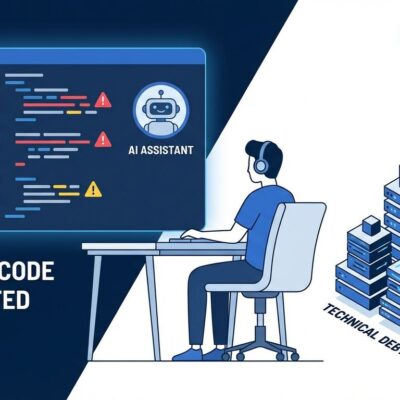
The numbers tell the story. Developers using AI tools complete 21% more tasks and merge 98% more pull requests. Sounds great until you see that PR review time increases 91%. Teams now generate 200 pull requests per week but still have the same review capacity. The bottleneck didn’t disappear—it moved downstream.
The root cause? Trust. 96% of developers don’t trust AI-generated code. They can’t just merge and move on. Every AI-generated line needs human verification. 70% of developers report spending extra time debugging AI code. LinearB’s 2026 analysis of 8.1 million pull requests across 4,800+ organizations confirms the paradox: developers feel 20% faster but are actually 19% slower. That’s a 39-point perception gap between feeling productive and being productive.
Martian Built the First Real Benchmark
This is where Martian’s Code Review Bench changes the conversation. Released in February 2026 by researchers from DeepMind, Anthropic, and Meta, it’s the first independent evaluation framework specifically for AI code review systems.
The innovation isn’t the scale—though 17 tools across 200,000+ real pull requests from open-source repositories is impressive. It’s the methodology. Previous benchmarks measured theoretical accuracy: “Did the tool correctly identify this bug in a test dataset?” Martian asks a better question: “Did the developer actually modify the code after the tool left a comment?”
If yes, the comment counts as a true positive. If the developer ignored it, the suggestion was noise. This dual-layer approach combines offline testing (controlled comparison across identical PRs) with online monitoring (real GitHub activity during January–February 2026). The result? The first benchmark measuring real-world usefulness, not just technical correctness.
Martian open-sourced everything: dataset, judge prompts, evaluation pipeline, and methodology. That transparency matters. It lets teams reproduce results and evaluate their own tools against the same standard.
Current State-of-the-Art: 50-60% F1 Scores
The results are a reality check. The best AI code review tools achieve F1 scores in the 50-60% range. That’s not impressive—it’s a baseline.
F1 score combines precision and recall into a single metric. Precision measures how often developers act on a tool’s suggestions. If a tool leaves 100 comments and developers change code after 52 of them, precision is 52%. Recall measures how many real issues the tool catches. If a PR has 10 bugs and the tool flags 7, recall is 70%. F1 balances both, penalizing tools that optimize only one side.
CodeRabbit topped the Martian benchmark with a 51.2% F1 score, the highest overall balance of precision and recall. CodeAnt AI ranked third globally at 51.7%. Baz led in precision, meaning its suggestions have the lowest noise—developers trust them. Qodo hit 60.1% F1 on a separate benchmark with 56.7% recall, catching more real issues than competitors.
Here’s what 50-60% means in practice: these tools catch half the issues and deliver half the value they could. That’s progress compared to nothing, but it’s not good enough. The gap between current capability and what teams need is massive.
The Precision-Recall Tradeoff Teams Must Understand
Not all tools optimize for the same goal, and that matters when choosing one. Precision-focused tools like Baz leave fewer comments, but the ones they leave are high-signal. Developers trust them. The downside? They miss issues. Bugs escape to production.
Recall-focused tools like Qodo catch more real problems. Higher recall means fewer defects make it through. The cost? Noise. When a tool flags too many non-issues, developers start ignoring it. High recall without sufficient precision trains teams to tune out the tool.
Most AI code review tools optimize for precision over recall. It’s easier to avoid false positives than to comprehensively detect all real issues. The challenge is achieving balance. Tools that push recall higher often become noisy. Tools tuned for precision miss significant numbers of real bugs. F1 scores in the 50-60% range reflect how difficult this balance is.
For teams evaluating tools, context matters. Shipping safety-critical code? Prioritize recall. Running a fast-moving startup where velocity is everything? Precision might matter more to keep reviews flowing. There’s no universal “best” tool—only best fit for your constraints.
Enterprise Adoption Accelerates Despite Limitations
Here’s the surprising part: despite 50-60% effectiveness, enterprise adoption is accelerating. Stack Overflow’s 2025 survey showed 47% of professional developers used AI-assisted code review, up from 22% in 2024 and 11% in 2023. GitHub’s Octoverse 2025 report found 1.3 million repositories using AI code review integrations—a 4x increase from roughly 300,000 in late 2024.
The ROI is real. One analysis found automated code review reduces cost to $150-300 per 1,000 lines of code, a 75-85% reduction compared to manual reviews. Repositories using AI-assisted review see 32% faster merge times and 28% fewer post-merge defects. Payback periods run 12-24 months for well-selected implementations.
Large enterprises—financial institutions, healthcare companies, defense contractors, Fortune 500 tech—began deploying AI code review at scale in 2025 and early 2026. Enterprise requirements pushed vendors toward SOC 2 Type II compliance, self-hosting options, audit logging, role-based access control, and annual contracts with volume discounts. Qodo raised $70 million in a Series B round in March 2026 specifically to meet enterprise demand.
The adoption makes sense when you consider the alternative. AI code generation isn’t going away. Teams are already drowning in pull requests. An imperfect tool that catches 50% of issues while reducing review time by 30% is better than no tool at all. The calculus shifts from “Is this perfect?” to “Does this improve our current bottleneck?”
What This Means for Teams
Martian’s benchmark gives teams a baseline for evaluating AI code review tools. Here’s what matters: understand the precision-recall tradeoff for your context. Don’t chase the highest F1 score—chase the right balance for your team’s constraints. Ask vendors for performance data on repos similar to yours. Generic benchmarks help, but domain-specific performance varies.
Expect 50-60% effectiveness from current tools. That’s the state-of-the-art. Budget for the gap. Plan for human review to catch what automation misses. These tools shift bottlenecks, they don’t eliminate them. AI code review reduces review burden, but it doesn’t remove the need for human judgment.
The good news? 50-60% F1 scores mean massive headroom for improvement. This space is early. Better models, better training data, better benchmarks will push scores higher. For now, teams adopting AI code review are making a calculated bet: an imperfect tool that improves today’s crisis is worth more than waiting for a perfect tool that doesn’t exist yet.