 By ByteBot
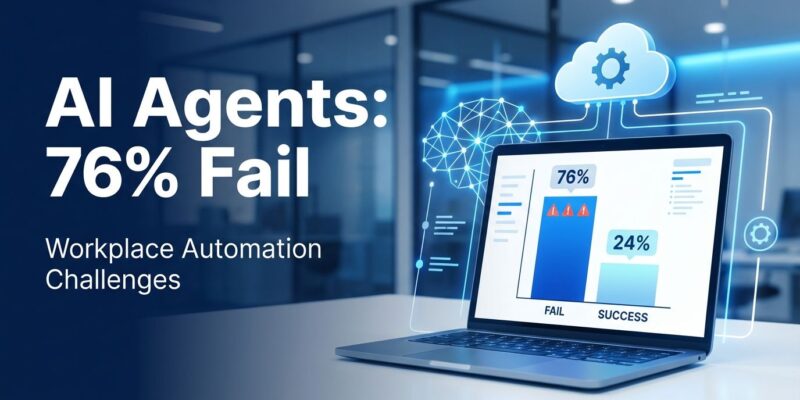
A new benchmark study released on January 21, 2026 reveals that leading AI models fail 76-82% of real white-collar work tasks from investment banking, consulting, and corporate law on their first attempt. Mercor’s APEX-Agents benchmark, covered exclusively by TechCrunch on January 22, tested Gemini 3 Flash, GPT-5.2, and Claude Opus 4.5 on 480 professional tasks—and even the best performer (Gemini 3 Flash) succeeded only 24% of the time. With 8 attempts, success rates plateau at just 40%, leaving 60% of tasks incomplete.
This bombshell arrives as Gartner predicts 40% of enterprise applications will embed AI agents by end of 2026, and companies prepare to double AI spending with 30%+ directed to agentic AI. The disconnect: enterprises are betting billions on technology that can’t reliably complete three-quarters of professional-level tasks.
AI Agents Fail 3 Out of 4 Professional Tasks
Mercor’s APEX-Agents benchmark didn’t use synthetic problems—it tested real work created by investment banking analysts, management consultants, and corporate lawyers. Tasks averaged 1.8 hours of expert-estimated human effort and required navigating documents, spreadsheets, PDFs, email, and calendar applications. The results expose a harsh reality.
Gemini 3 Flash led with 24% success, followed by GPT-5.2 at 23%, while Claude Opus 4.5 and Gemini 3 Pro both scored 18.4%. Even after 8 attempts, the best agents topped out at 40% success—still failing 60% of tasks. Moreover, performance degraded after 35 minutes of task time, with failure rates scaling exponentially: doubling task duration quadrupled (not just doubled) the failure rate.
According to Mercor CEO Brendan Foody, “The models’ biggest stumbling point was tracking down information across multiple domains—something that’s integral to most of the knowledge work performed by humans.” The verdict: “No model is ready to replace a professional end-to-end.”
40% Adoption Forecast Meets 24% Capability
Gartner forecasts 40% of enterprise applications will integrate AI agents by end of 2026—representing 8x growth from less than 5% in 2025. The agentic AI market is projected to explode from $5.2 billion in 2024 to $200 billion by 2034, with 90% of executives expecting measurable ROI in 2026. Companies are doubling AI budgets, directing 30%+ to agentic AI deployments.
However, Gartner also predicts 40%+ of agentic AI projects will be canceled by end of 2027. The gap between vendor promises and benchmark reality couldn’t be starker: enterprises are rushing to adopt technology with a 76% failure rate on first attempt. This isn’t a minor discrepancy—it’s a fundamental mismatch between market hype ($200B projections) and actual capability (24% success).
Why AI Agents Struggle: Context Retention Breaks Down
The benchmark revealed a critical weakness: AI agents can’t track information across multiple domains effectively. Foody explains, “Many agents fail not due to lack of capability, but because they can’t manage ambiguity, find the right file, or hold context across the entire workflow.” Context retention collapses after 35 minutes—far short of the multi-hour tasks common in professional services.
This explains the performance gap between chat AI and agentic AI. ChatGPT, Claude, and Gemini score 80-90%+ on single-turn benchmarks, but drop to 18-24% on multi-step workflows. Chat AI handles contained tasks brilliantly; agentic AI fails at sustained, cross-application coordination. The problem isn’t model quality—it’s architectural limitations in long-horizon reasoning and context management.
Enterprise Reality: Infrastructure Gaps and Security Fears
Multiple enterprise surveys from January 2026 confirm reliability as the number one adoption barrier. A survey of 306 AI agent practitioners found reliability issues forced teams to abandon long-running tasks and stick to simple, few-step workflows instead. Furthermore, 86% of enterprises need tech stack upgrades before deploying agents, while 46% cite integration complexity as their primary challenge.
Security concerns run deeper than leadership acknowledges. While 53% of executives prioritize security, 62% of practitioners do—revealing a gap between boardroom confidence and developer anxiety. Additionally, 76% of customers view AI as introducing new security risks, directly affecting their willingness to engage with AI-driven services. Quality issues kill production deployments, with 32% citing it as the top blocker.
The infrastructure burden is substantial: 42% of enterprises need access to 8 or more data sources to deploy agents successfully. Integration timelines stretch to 6-12 months, not the weeks vendors promise. Even if models improve, these operational barriers aren’t disappearing.
What This Means for Jobs and Careers
Short term, professional jobs are safe. Agents that fail 76-82% of tasks can’t replace knowledge workers performing consulting, legal, or financial analysis work. The 2026-2027 timeline offers breathing room—current agents simply aren’t capable of end-to-end professional work, regardless of vendor marketing claims.
Long term remains uncertain. Will models improve to 80%+ success rates, or plateau at the current 40% ceiling? Gartner’s prediction of 40%+ project cancellations by 2027 suggests a reality check phase ahead. Developers should learn agentic AI for long-term career growth, but temper expectations for near-term deployment. Human-in-the-loop workflows are mandatory, not optional—agents draft, humans verify and refine.
Key Takeaways
- New APEX-Agents benchmark shows frontier AI models (Gemini 3 Flash, GPT-5.2, Claude Opus 4.5) fail 76-82% of professional tasks from investment banking, consulting, and corporate law on first attempt, with only 24% peak success rate.
- Gartner’s 40% enterprise adoption forecast by end of 2026 conflicts sharply with 24% capability reality—enterprises are betting billions on technology with 3-out-of-4 failure rates.
- Root cause: Agents struggle with cross-domain information tracking and context retention beyond 35 minutes, with exponential (not linear) failure scaling for longer tasks.
- Enterprise deployment faces massive barriers: 86% need infrastructure upgrades, 46% cite integration complexity, 62% of practitioners prioritize security concerns, and 32% identify quality as production killer.
- 2026-2027 jobs are safe—current agents can’t replace professional knowledge workers end-to-end—but 40%+ of agentic AI projects will be canceled by 2027 as reality catches up with hype.
Enterprises finalizing Q1 and Q2 budgets should demand proof on their specific tasks, not vendor-selected benchmarks. Pilot narrow use cases with human-in-the-loop verification, accept 60%+ initial failure rates, and plan for 6-12 month integration timelines. The $200 billion market projection assumes exponential improvement—but APEX-Agents benchmark suggests we’re nowhere near that trajectory yet.