 By
By 2025 was the year agentic AI exploded onto developer workflows. Claude Code hit terminals, Cursor rewrote IDEs, and every engineering team piloted agent tools. But here’s the reality check: IBM research shows 38% of organizations pilot AI agents, yet only 11% actually deploy them to production. That’s a 27-point gap between hype and reality. 2026 is when we find out what survives the maturation test.
The New Stack just published definitive analysis identifying five trends shaping agentic development this year. These aren’t speculative predictions – they’re already unfolding. If you’re building with agentic tools or planning to, understanding these trends separates competitive advantage from costly mistakes.
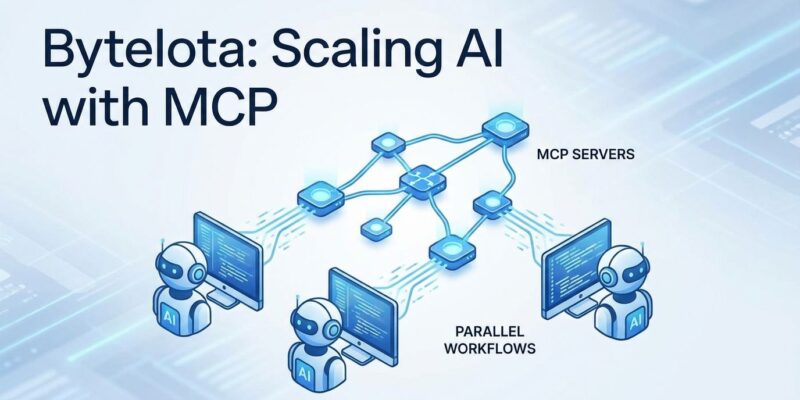
MCP Management: The Server Sprawl Crisis
The Model Context Protocol democratized agent tool integration when Anthropic open-sourced it in November 2024. It worked almost too well. Today, over 7,640 MCP servers are registered in the PulseMCP directory. Enterprises face what Portkey calls “server sprawl” – an uncontrolled proliferation of MCP servers with zero governance.
Here’s the problem: any developer can spin up an MCP server for an API or tool. You end up with dozens of variations of the same server, all slightly different, scattered across GitHub repos, internal docs, and Slack threads. There’s no single source of truth. Non-technical employees can’t identify which servers are official versus rogue. Security researchers documented in April 2025 that MCP has multiple vulnerabilities – prompt injection attacks, tool permission exploits where combining tools can exfiltrate files, and lookalike tools that silently replace trusted ones.
The solution isn’t fewer MCP servers – it’s governance. MCP gateway tools are emerging as the answer. Portkey MCP Hub provides governance-first centralized control. Microsoft released an open-source MCP Gateway for Kubernetes environments. Azure MCP Server just hit general availability in Visual Studio 2026, built directly into the IDE. Directory tools like MetaMCP, NCP, and Magg offer orchestration and discovery.
The recommendation from early adopters is clear: focus on governing consumption, not just building servers. Implement a central catalog, enforce consistent security policies, and maintain visibility into usage across your organization. If you don’t control MCP sprawl now, you’ll have a security nightmare by Q2.
Parallel Task Revolution: 10x Faster Workflows
Sequential workflows are dying in 2026. Parallel execution is becoming the standard, and the speed difference is brutal.
Verdent AI’s parallel agent execution functions like a personal dev team. Multiple agents work simultaneously on different tasks using isolated branches via git worktree, ensuring zero conflicts between agents. Tasks that would take a single agent hours complete in minutes. Verdent claims 10x acceleration for complex project cycles compared to sequential execution.
Orchestration platforms like Conductor and Temporal are enabling enterprise-scale parallel workflows. Temporal acts as the “conductor,” managing interactions among multiple agents as they communicate and pass information when tasks complete. The ParallelAgent workflow pattern executes sub-agents concurrently, dramatically speeding up processes where tasks can be performed independently.
The workflow model is shifting from sequential (Agent 1 → Agent 2 → Agent 3) to concurrent (Agents 1, 2, 3 run simultaneously, coordinate via orchestrator). Developers can run tasks in the background while starting new ones, fundamentally changing how complex projects get built.
If your competitors adopt parallel workflows and you don’t, they’ll ship 10x faster. Sequential execution is becoming a competitive liability. Learn git worktree, explore tools like Verdent or Conductor, and rethink every sequential process for concurrency opportunities.
VS Code Fork Security: The Extension Attack
If you’re using Cursor, Windsurf, Google Antigravity, or Trae, you need to know about a supply chain vulnerability disclosed in January 2026.
Popular AI-powered IDEs forked from VS Code can’t use Microsoft’s official extension marketplace due to licensing restrictions. They rely on OpenVSX, an open-source alternative. But here’s the flaw: these forks inherit VS Code’s hardcoded list of “recommended extensions” that point to Microsoft’s marketplace. Those extensions don’t exist in OpenVSX.
Attackers can claim the namespace in OpenVSX and upload malicious extensions with the same names. When developers see a recommendation and install it, they deploy rogue code that can steal credentials, secrets, and source code. It’s a simple act of trust with severe consequences.
Cursor patched the vulnerability on December 1, 2025. Google fixed Antigravity on January 1, 2026, after removing 13 extension recommendations. Windsurf hasn’t responded as of this writing. At this time, researchers found no indication that attackers exploited the gap before disclosure, but the window was open.
The fix is manual: verify extensions directly via the OpenVSX registry and check publisher reputation. Don’t blindly trust recommendations. And if you haven’t updated your IDE in the last month, do it now.
Maturation and Consolidation: Production vs Pilots
2025 was the breakout year – new tools launched monthly, features multiplied, everyone ran pilots. 2026 is the consolidation year. The focus shifts from innovation to proving production-readiness.
The New Stack puts it bluntly: “2026 is expected to be about securing that ground.” That means reliability over features, trust over hype, and addressing the deployment gap. IBM’s research is damning: 85% of organizations claim to be “data-driven” or “AI-First,” but objective assessment shows only 11% are truly AI-ready. Strategic investments are potentially misaligned because leaders overestimate maturity and miss bottlenecks.
Developers cite customization (32%), rate of change (31%), and infrastructure complexity (29%) as major challenges. The top AI agent concern? Trustworthiness (31%). Enterprise readiness requires secure integration in complex IT environments, data quality and privacy management, and orchestrating interactions across systems. Features don’t matter if you can’t trust the agent in production.
Markets consolidate. Weaker tools will exit. If you’re evaluating agentic platforms, prioritize production-ready solutions with monitoring, auditing, and verification mechanisms. Focus on reliability, not flashy demos.
Agent-Driven Commerce: Autonomous Payments
AI agents making purchases without human intervention sounds futuristic, but the infrastructure arrived in January 2026.
Fiserv integrated Mastercard’s Agent Pay Acceptance Framework into its merchant platform, enabling AI-initiated purchases to be authenticated, tokenized, and settled via existing card network rails. The framework includes authentication to distinguish authorized agents from malicious automation, authorization to verify agents are approved to act on behalf of users, and parameter checks to ensure transactions stay within predefined limits. Tokenization allows agents to execute purchases without direct access to credentials.
Real-world examples are already live. Amazon is testing a “Buy for Me” AI feature. OpenAI partnered with Stripe to launch “Instant Checkout,” where ChatGPT finds and purchases products on behalf of users. PayOS, a fintech startup, is unifying the agent payment experience across digital wallets and APIs.
The market is projected to reach $136 billion by 2025 and $1.7 trillion by 2030, driven by platforms like Mastercard Agent Pay and Visa tokenization protocols. For developers, this means background agents can autonomously access paid APIs and services to complete tasks without interrupting workflows. Commerce integration is becoming a core agent capability, not an add-on.
If you’re building agentic workflows, understand agent payment capabilities, implement budget and authorization controls, and consider use cases where autonomous purchases unlock value.
What Developers Should Do Now
These trends aren’t theoretical – they’re already reshaping how we build software. Here’s what matters:
Audit your MCP servers. Identify duplicates, consolidate around trusted implementations, and establish a central catalog before sprawl creates security vulnerabilities.
Learn parallel workflows. Explore git worktree for isolated branch work. Test tools like Verdent AI or Conductor. Identify tasks in your current projects that could run concurrently.
Verify your IDE extensions. If you use a VS Code fork, check every extension against the OpenVSX registry. Verify publisher reputation manually. Update your IDE to the latest version.
Focus on production-readiness. Stop chasing features. Implement monitoring for agent workflows. Establish verification mechanisms. Build trust through reliability.
Understand agent commerce. Review how autonomous payments could fit your use cases. Implement authorization and budget controls before agents start spending money.
2026 separates pilot projects from production reality. The gap between 38% piloting and 11% deploying to production exists because most teams haven’t addressed maturation challenges – governance, security, reliability, trust. The trends above define what survives the transition.
Choose wisely.