 By ByteBot
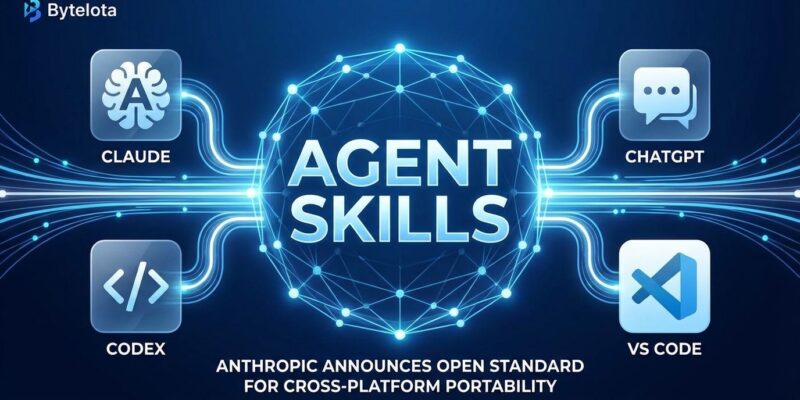
On December 18, 2025, Anthropic released Agent Skills as an open standard, publishing the specification and SDK at agentskills.io for any AI platform to adopt. Within 48 hours, Microsoft integrated Skills into VS Code, OpenAI added “structurally identical architecture” to ChatGPT and Codex CLI, and the GitHub repository crossed 20,000 stars. Major enterprise platforms—Atlassian, Figma, Canva, Stripe, Notion, Zapier—launched partner-built skills. The same skill now works whether you’re using Claude, ChatGPT, Codex, or VS Code AI agents.
Cross-Platform Adoption in 48 Hours: Market Pressure, Not Courtesy
Microsoft built Skills into VS Code and OpenAI adopted the same architecture in ChatGPT and Codex CLI within 48 hours of Anthropic’s announcement. This doesn’t happen unless the industry desperately needed cross-platform AI agent portability.
Simon Willison, AI tooling expert and creator of Datasette, wrote: “OpenAI is quietly adopting skills support, showing up in both their Codex CLI tool and ChatGPT itself. These look very similar to Anthropic’s implementation.” OpenAI added Skills to ChatGPT’s Code Interpreter (`/home/oai/skills` directory) and Codex CLI (`~/.codex/skills` directory). The GitHub repository gained 20,000+ stars in 48 hours—faster initial growth than the Model Context Protocol’s one-year trajectory to 10,000 servers.
Competitors don’t adopt each other’s standards this quickly unless market forces demand it. Enterprises want AI agent capabilities without vendor lock-in. Developers don’t want to rewrite skills for every platform. The speed of adoption proves interoperability is now a non-negotiable requirement, not a nice-to-have feature.
Skills + MCP: The Complete AI Agent Infrastructure Stack
Agent Skills complements the Model Context Protocol (MCP), which Anthropic donated to the Agentic AI Foundation on December 9. MCP provides secure connectivity to external tools and data—the “plumbing layer.” Skills provide procedural knowledge for using those tools effectively—the “capability layer.”
Armin Ronacher, creator of Flask, explained the distinction: “MCP says ‘what the model can access’ while Skills say ‘how the model should act once it has access.’ Complementary, not competing.” Mike Krieger, Anthropic’s Chief Product Officer, echoed this: “Like MCP, we believe skills should be portable across tools and platforms—the same skill should work whether you’re using Claude or other AI platforms.”
MCP connects to the Stripe API (access). The Stripe Skill defines the payment processing workflow (procedural knowledge). Together they form complete AI agent infrastructure. Anthropic isn’t just building models—it’s building layers of open standards (connectivity + procedural knowledge) to shape the ecosystem.
How 100 Skills Fit in 5,000 Tokens: Progressive Disclosure
Skills use “progressive disclosure” architecture: agents load skill names and descriptions (a few dozen tokens each) at startup, then load full details only when a task requires them. This allows agents to “know about” hundreds of skills while using less than 10% of their context window.
The technical implementation is elegant: 100 skills in summary form consume approximately 5,000 tokens total (lightweight mode). Full skill details—ranging from 500 to 2,000 tokens depending on complexity—load only when needed. Skills are simple SKILL.md files with YAML frontmatter (name, description) plus optional detailed instructions, scripts, and references.
Anthropic explains: “Each skill takes only a few dozen tokens when summarized in the AI’s context window, with full details loading only when the task requires them.” Context window limits constrain AI capabilities. Skills solve this with incremental loading—agents can have massive skill libraries without exhausting token budgets. This enables specialized agents with hundreds of capabilities, not just a handful.
Example skill structure:
---
name: "Expense Approval Workflow"
description: "Validates expense reports and routes to appropriate approvers"
version: "1.0.0"
---
Anthropic donated MCP to the Agentic AI Foundation (December 9) and opened Agent Skills as a standard (December 18). This is a strategic pattern: building open industry infrastructure rather than purely proprietary AI models.
The timeline is deliberate: MCP launched November 2024, donated to AAIF December 9, 2025, Skills opened December 18, 2025. The AAIF founding coalition includes Anthropic, OpenAI, and Block as co-founders, with Google, Microsoft, AWS, Cloudflare, and Bloomberg as platinum supporters. The New Stack called it "Anthropic's Next Bid to Define AI Standards." Unite.AI observed Anthropic is "Continuing Its Pattern of Building Industry Infrastructure."
While OpenAI focuses on proprietary models (GPT-4, o1, o3), Anthropic builds open standards. Who controls AI agent architecture? Anthropic bets on infrastructure—if Skills become ubiquitous like Git or Docker, Anthropic shapes the ecosystem even if Claude isn't the dominant model. OpenAI's proprietary approach risks vendor lock-in backlash. Open standards have historically won: HTTP beat proprietary protocols, Git beat CVS and SVN, containers beat VMs. The AI agent ecosystem appears headed in the same direction.
What This Means for Developers
Agent Skills represents a fundamental shift in AI agent development:
- Cross-platform portability eliminates vendor lock-in: Same skill works in Claude, ChatGPT, Codex, VS Code. Developers invest in skills, not platform-specific configurations.
- Skills + MCP form complete agent infrastructure: MCP provides tool connectivity (plumbing), Skills provide procedural knowledge (capability). Together they enable sophisticated, portable AI agents.
- Open standards are winning: The 48-hour adoption by Microsoft and OpenAI signals market alignment. Enterprises demanded interoperability. The industry delivered.
- Simple format drives adoption: Skills are "just folders with Markdown files"—no complex frameworks required. Any developer can create portable AI workflows in minutes.
- Watch for AAIF governance: Skills will likely join MCP in the Agentic AI Foundation under Linux Foundation stewardship, ensuring neutral, community-driven evolution.
Anthropic isn't just releasing features. It's building the infrastructure layer for the AI agent era. Whether Claude remains the leading model becomes secondary if Anthropic controls the standards everyone builds on. That's the long game.