 By ByteBot
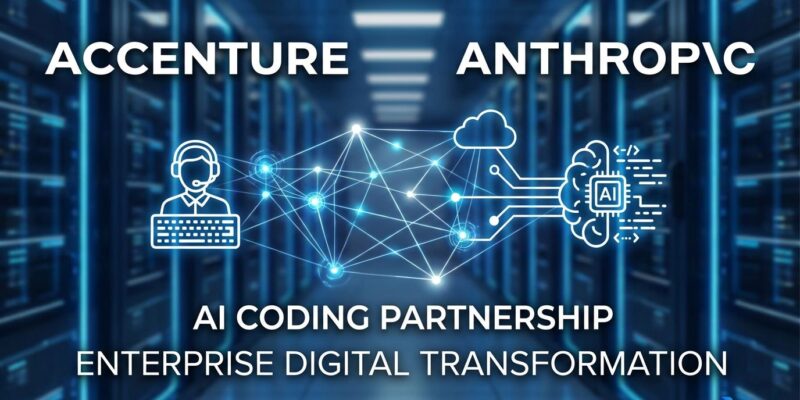
Accenture announced on December 9, 2025, that it will train 30,000 developers on Claude Code—the largest AI coding deployment in enterprise consulting history. This isn’t a pilot program or an experiment. It’s a full-scale bet that AI coding has moved from “should we?” to “how fast can we scale?” The formation of the Accenture Anthropic Business Group marks a turning point: AI coding is no longer optional in enterprise software development.
Claude Code Now Dominates Enterprise AI Coding
The market data backs up Accenture’s confidence. Claude Code now holds 54% of the enterprise AI coding market, according to Menlo Ventures’ late-2025 report—up from just 32% in the summer. The platform reached $1 billion in run-rate revenue by November 2025, just six months after its public launch. For comparison, OpenAI’s code generation tools hold only 21% market share.
This isn’t a fair fight anymore. When the world’s largest consulting firm trains 30,000 developers on one platform, it creates network effects that smaller competitors can’t match. Accenture consultants will recommend Claude to clients. Clients will hire Accenture because they have Claude expertise. The flywheel is spinning, and if you’re an enterprise developer, the question is shifting from “Which AI tool should I learn?” to “Do I need to learn Claude specifically?”
Building the Enterprise AI Playbook
Training 30,000 developers is just the beginning. Accenture is building something more valuable: an enterprise playbook for scaling AI coding in regulated industries. The partnership includes a joint CIO offering to measure ROI and scale AI-powered development, with industry-specific solutions for financial services, healthcare, life sciences, and the public sector. Think automated compliance workflows for banks, clinical trial streamlining for pharma, and AI agents helping citizens navigate government services.
The Accenture-Anthropic partnership is targeting the gap most companies struggle with—moving from “our developers use AI tools” to “we’ve transformed our software development lifecycle with AI.” Accenture CEO Julie Sweet framed it clearly: “This expansion will help clients shift from experimenting with AI to using it as a catalyst for enterprise reinvention.”
But here’s the skeptical angle worth considering: Is this about technology, or expensive marketing? Training 30,000 developers doesn’t guarantee they’ll all use Claude daily. ROI frameworks sound compelling in presentations, but AI coding ROI remains actively debated. The real test comes in 12 months when we see actual adoption data, not just partnership announcements.
The Consolidation Risk Developers Should Watch
Market consolidation around one or two AI coding platforms might be efficient for enterprises, but it’s not necessarily good for developers or innovation. Accenture employs over 775,000 people globally—30,000 trained developers is just the starting wave. Other major consulting firms including Deloitte and IBM have already partnered with Anthropic. Meanwhile, GitHub Copilot remains the primary competitor, backed by Microsoft’s resources and GitHub’s ecosystem.
We’re watching the AI coding market split into two tiers. The enterprise tier features Claude Code and GitHub Copilot with massive institutional backing, while tools like Cursor and Codeium may thrive with independent developers but struggle to win large enterprise contracts. This consolidation makes sense for enterprises seeking validated, supported solutions. But developers should worry about reduced competition. When two platforms dominate, they set the terms: pricing, features, data policies. The fast-moving startup energy that drove innovation in 2023-2024 gets replaced by enterprise sales cycles and partnership announcements.
AI Coding Has Reached Mainstream Adoption
The Accenture partnership is actually a lagging indicator—it confirms what’s already happening. According to Stack Overflow’s 2025 Developer Survey, 65% of developers now use AI coding tools at least weekly, and 84% either use them or plan to start. The statistics from major tech companies tell the same story: Microsoft reports 30% of its code is AI-written, Google says 25% of its code is AI-assisted, and overall, 41% of all code written in 2025 is AI-generated or AI-assisted.
Accenture isn’t leading this shift—they’re responding to client demands. Enterprise CTOs are asking “How do we scale AI coding across 5,000 developers?” and Accenture is building the answer. If you’re not using AI coding tools by mid-2026, you’re falling behind—not because AI automatically makes you a better developer, but because enterprises are standardizing on workflows that assume AI assistance is part of the process.
The Bottom Line
The three-year Accenture-Anthropic partnership is a bet on market consolidation, with both companies staking their reputations on large-scale enterprise deployment. For developers, the takeaway is clear: pay attention to which platforms enterprises standardize on, because those choices shape career paths and tool ecosystems. Learn Claude Code if you work in enterprise settings. But stay skeptical about vendor lock-in and keep watching the competitive landscape. By 2028, we’ll know whether this partnership transformed enterprise software development or proved to be expensive theater.