 By ByteBot
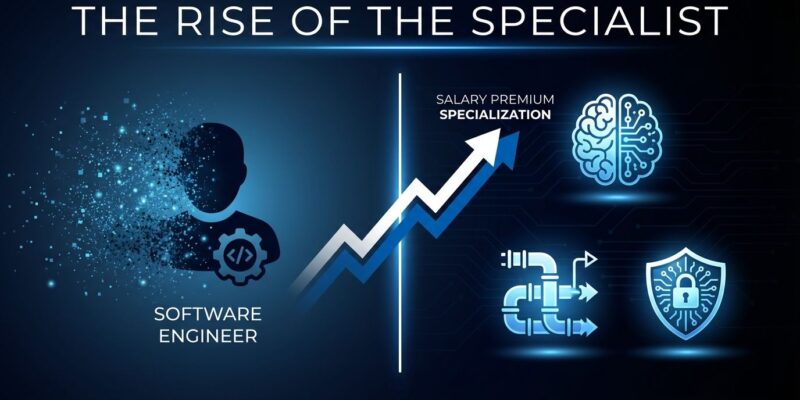
After laying off 500,000 tech workers since ChatGPT’s release in late 2022, companies are rehiring—but with a radically different playbook. The era of the generalist “software engineer” is ending. In 2026, demand for AI specialists surged 49% while entry-level hiring at top firms dropped 25%. This isn’t about AI replacing developers. It’s about specialists replacing generalists, and the rules of tech careers have changed overnight.
The Specialist Shift: Generalist Roles Vanishing
Companies are abandoning broad job titles like “software engineer” and “data scientist” for hyper-specialized positions. Following mass layoffs in 2024-2025, strategic rehiring targets specialists only—engineers who deliver immediate value in narrow domains rather than generalists who need time to ramp up.
The numbers tell the story. Job postings for Forward Deployed Engineers—client-facing technical implementers who customize AI solutions—surged 800% between January and September 2025. Demand for AI specialists rose 49% in 2025 while generalist IT roles stagnated. As Built In reports, “Companies will drift away from broad-spectrum roles with catch-all titles toward more tailored, task-specific job titles.”
This is structural, not cyclical. Companies view generalist skills as automatable. They want specialists who can hit the ground running.
The Salary Premium: What Specialists Earn
The market is speaking through compensation. LLM developers—engineers who build and fine-tune custom language models—earn an average of $209,000 in base compensation. Compare that to $178,000 for senior generalist data workers. That’s a 17% premium, and specialists with equivalent experience command 30-50% higher salaries across the board.
Mid-level AI engineers saw the highest salary gains in 2025 at 9.2% year-over-year. At OpenAI, the median software engineer earns $800,000 in total compensation, with ranges from $249K to $1.28M. McKinsey Global Institute projects that by 2026, demand for data scientists in the U.S. will exceed supply by over 50%.
Money follows value. Companies pay premiums for specialists because they can’t find them elsewhere.
The Hottest Specialist Roles in 2026
Five specialist roles dominate 2026 hiring, each requiring deep domain expertise rather than broad skills:
Forward Deployed Engineer tops the list. Venture capital firm a16z calls it “the hottest job in tech,” with Salesforce alone building a team of 1,000. FDEs embed with clients, architect custom solutions, and act as technical translators between cutting-edge systems and enterprise reality. The Pragmatic Engineer reports 922 FDE job postings as of November 2025—a fivefold increase year-over-year.
LLM Developer ranks second. Custom model training and fine-tuning has become the most sought-after skill in enterprise AI as companies move beyond generic ChatGPT integrations toward proprietary models trained on their data.
Data Engineer holds the second most advertised role after software engineer, driven by the massive demand-supply gap. MLOps Engineer and AI Ethics Specialist round out the top five, both new role categories that didn’t exist at scale three years ago.
These aren’t broad “software engineer” positions. They’re vertical specializations requiring deep technical expertise in specific domains.
Entry-Level Lockout: Junior Developers Shut Out
The dark side of specialization: entry-level hiring is collapsing. Entry-level positions at the top 15 tech firms fell 25% from 2023 to 2024. New grads now account for just 7% of Big Tech hires, down 25% from 2023. At startups, the number is even lower—under 6%.
Most alarming: entry-level positions at P1 and P2 job levels saw a 73% decrease in hiring rates in the past year, according to Ravio’s 2025 Tech Job Market Report. IEEE Spectrum reports that “no one’s hiring junior devs—companies now expect higher-level skills from the start.”
There’s a contradiction worth noting: job postings for entry-level software engineers grew 47% between October 2023 and November 2024. But actual hiring dropped 73%. Companies post positions but don’t fill them with new grads. They want experience even at “entry” levels.
The traditional path into tech—learn to code, land a junior role, gain experience—is breaking down. Companies expect day-one specialization, which new grads can’t deliver.
The Upskilling Imperative: 80% Must Adapt
Gartner predicts that by 2027, 80% of the engineering workforce will need to upskill to keep pace with generative AI. The essential skills aren’t what you’d expect: retrieval-augmented generation (RAG), natural-language prompt engineering, and understanding AI-generated code matter more than writing code from scratch.
As one industry analysis puts it: “Simply learning how to write code won’t be enough—what really matters is understanding how code works, system design, performance, security, and how different technologies interact.”
Mid-career generalists face a stark choice: specialize now or risk obsolescence. The market has decided that broad “software engineer” roles are interchangeable and automatable. Specialists who combine technical depth with domain expertise command both job security and salary premiums.
The clock is ticking. By 2027, most code will be AI-generated. Engineers who can’t work with AI systems, understand their output, and architect solutions around them will struggle to compete.
The Regret Factor: Are Companies Betting on Vaporware?
There’s a counterargument worth considering. Forrester’s Predictions 2026 report reveals that 55% of employers already regret their AI-driven layoffs. A separate Orgvue survey found that 39% of business leaders made employees redundant due to AI, and 55% of those admit they made wrong decisions.
Forrester predicts half of AI-attributed layoffs will be quietly rehired—but offshore or at significantly lower salaries. The root cause: companies believed the productivity hype, cut their workforce accordingly, then discovered AI couldn’t replace human workers as promised. They laid off people for AI capabilities that don’t exist yet, betting on future promises rather than proven technology.
This raises uncomfortable questions. Are specialists truly more valuable, or is this cost-cutting disguised as strategy? Will companies realize they need generalists when complex problems require broad problem-solving skills? The 55% regret rate suggests many companies are already having second thoughts.
The Verdict
The generalist “software engineer” is going extinct. Whether this creates a more effective or more fragile workforce remains to be seen—but the trend is undeniable. Companies are restructuring around specialists, and the salary premiums, hiring data, and job posting surges all point in the same direction.
For developers, the message is clear: pick your specialization. AI/ML, data infrastructure, security, or domain-specific verticals—choose one and go deep. The broad skillset that defined tech careers for decades is no longer enough. In 2026, specialists set the terms. Generalists update their resumes.